Plowville spotlighted in Reading Eagle history feature

“Plowville” to an Updike fan calls to mind the image of 13-year-old John in the back of the family Buick looking out of the rear window at his beloved dogwood tree and house at 117 Philadelphia Avenue receding into the distance, both spatially and temporally.

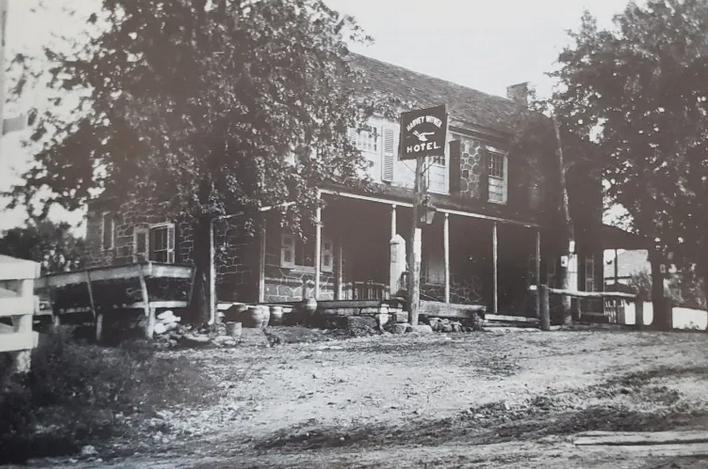
Plowville is big part of the Updike story, and readers might want to check out the historical feature on Plowville that Susan Miers Smith wrote for the Reading Eagle in January 2022: “Berks Place: Plowville a slice of Americana in Robeson Township; The village grew up around a well-known hotel on Route 10.”

Smith writes, “The cemetery is also the final resting spot of Linda Grace Hoyer Updike and Wesley Russell Updike, the parents of author John Updike. Linda Updike was born in and died in a Plowville farmhouse nearby.” That farmhouse was prominently featured in Updike’s early novel Of the Farm, in which a writer returns to visit his parents and introduce to them his second wife—with tensions between wife and mother creating much of the drama.

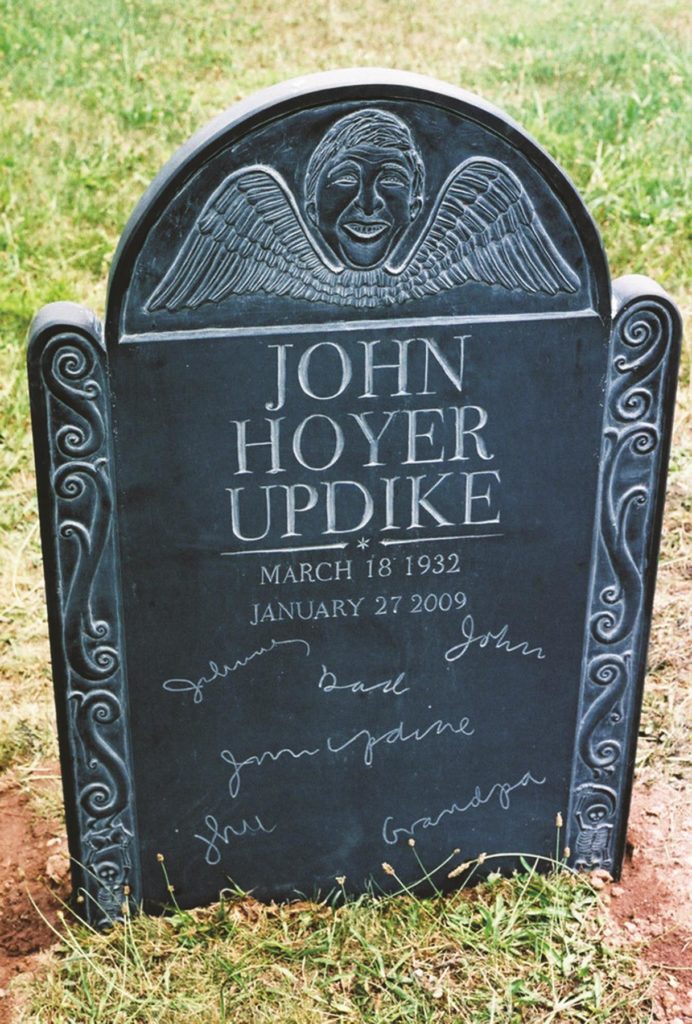
Interview with Michael Updike spotlights Plowville gravestone

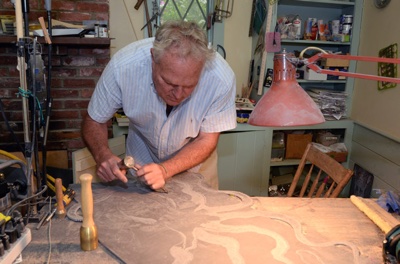
If you haven’t been to Plow Church cemetery to see John Updike’s gravestone carved by son Michael, there’s a large photo of it accompanying a Northshore Magazine story about how Updike’s sculptor son changed his artistic course after that gravestone.

In “Artist Michael Updike Creates Works of Art in Stone,” Robert G. Pushkar (who also took the photos) writes, “After the death of his father, writer John Updike, in 2009, Michael experienced a tectonic shift in his artistic awareness. He set out to commemorate his father’s life in a meaningful and also aesthetically unique way. But first he had to learn the intricacies of gravestone art. Already he had experience carving in granite and marble, but slate required another skill set. He explains, ‘You have to carve in a totally different way.'”

Michael told Pushkar, “In my art I do make death heads and winged skulls as a nod and recognition to the early folk artists of New England . . . . I can tell a carver’s style and feel. We won the American Revolution but looked back toward the neoclassical influence in creating gravestones, instead of the pagan skulls and wings with so much personality. Now you have urns and weeping willows, which are stagnant.”

Since the one he carved for his father, Michael has done a number of gravestones.

“It’s very exciting to me. . . . It takes me to a wide-range gamut of emotion, because I can suddenly be working with a parent who lost a child, or I can be working with very ironic people who want to do their own gravestone before they die. A lot of jokes and humor could be built into it. . . . The journey of getting the stone is what helps them recover and heal. . . . Not completely, but to a certain level where they can move on. There’s a little bit of being a psychoanalyst, a little bit of being a pastor or minister, or just sometimes being a friend realizing their vision.”