New Stephen King novel alludes to Updike et alia

Screen Shot 2015-06-03 at 7.04.25 AMStephen King, the master of horror who debuted with Carrie (1974), has turned to the newspaper headlines and a trio of literary masters for the subject of his new book. Finders Keepers is about a psychopath’s obsession with writer John Rothstein (a mash-up of John Updike, Philip Roth, and J.D. Salinger), whose “fame comes from his Runner books, a trilogy that tips its hat to Updike’s Rabbit novels,” says Guardian writer James Smythe.

“Finders Keepers by Stephen King—writers, beware your fans”

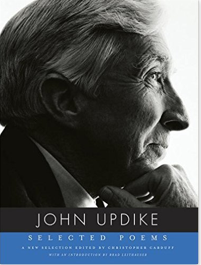
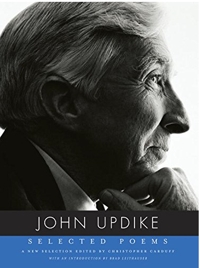
Random House announces John Updike: Selected Poems

9781101875223Random House announced that John Updike: Selected Poems will go on sale October 13, 2015 in a 320-page hardcover edition edited by Christopher Carduff. The volume features five decades of Updike’s witty, intimate, and moving poems “with the cumulative force of an autobiography in verse,” according to the publisher’s webpage.

“Though John Updike is widely known as one of America’s greatest writers of prose, he began and ended his career with books of poems, and between them published six other accomplished collections. Now, six years after Updike’s death, Christopher Carduff has selected the best of his life’s work in poetry: 132 of his most significant and accomplished poems, from precocious undergraduate efforts to well-known anthology classics to the late-life mastery of the blank-verse sonnet sequence “Endpoint.” Art, nature, popular culture, foreign travel, erotic love, and personal history—these recurring topics provided the poet ever-surprising occasions for metaphysical wonder and matchless verbal invention. His Selected Poems is, as fellow-poet Brad Leithauser writes in his introduction, a celebration of American life in the second half of the twentieth century, and no one but Updike ‘captured upon the page, in prose and in poetry, so much of this passing pageant. That he did so with brio and delight and nimbleness is yet another reason to celebrate our noble celebrant.'”

Suggested list price is $30.00; Amazon is selling the hardcover for $22.80, with a Kindle Edition available for pre-order at $15.99.

Review of COSMIC DEFIANCE: UPDIKE’S KIERKEGAARD AND THE MAPLES STORIES

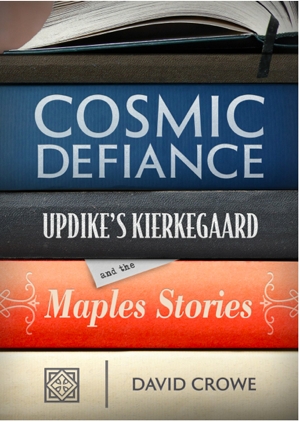
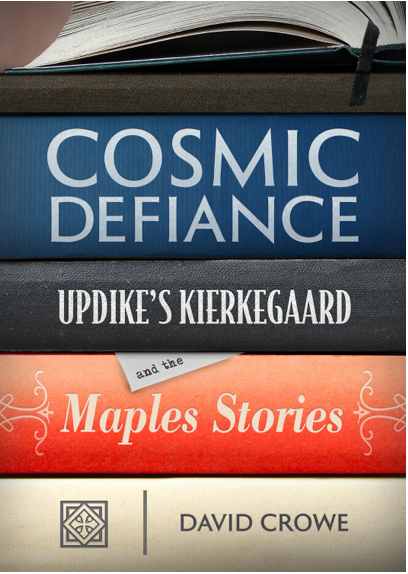
CosmicDefianceThere’s been talk among Updike scholars that there isn’t enough critical attention paid to the poems, short stories, and minor novels, and that there’s perhaps too much of an emphasis on autobiographical criticism. For them, David Crowe’s 352-page study, Cosmic Defiance: Updike’s Kierkegaard and the Maples Stories, should provide a welcome change.

Crowe, a full professor at Augustana College and a graduate of Luther College, includes Updike’s oft-quoted excerpt from Midpoint—“Praise Kierkegaard, who splintered Hegel’s creed / Upon the rock of Existential need; / Praise Barth, who told ho saving faith can flow from Terror’s oscillating Yes and No . . . . ”—but concentrates his study on the Danish philosopher and theologian.

At first reading, it seemed slow going in the first chapter, which is really a compressed summary of all that Crowe covers in the rest of the book, peppered with language like “as we will later see.” But a rereading of it yields a number of to-the-point summary statements that frame Updike in numerous ways that haven’t hitherto been proposed.  Chapter 1 may pose a similar first-read obstacle if one breezes past the concepts and assumptions and conclusions that can feel too general, without enough quotation to anchor them. But again, a rereading of the text proves fruitful. After that the intro and first chapter, though, Cosmic Defiance becomes practically indispensable.

Crowe treats the Maples stories as a whole in his first three chapters, including a useful timeline of the Maples’ relationship. Chapters 2 and 3—“The Neighbor-Love Problem for the Rather Antinomian Believer” and “Kierkegaard’s Marital Ideality and Updike’s Reality”—also offer discussions that center on broad thematic concepts but with more detail. And with Chapter 4: “Identity transformation and the Maples Marriage,” Crowe really hits his stride, integrating basic discussions of Kierkegaard’s philosophies with  specific discussions of Updike’s stories that make you see those stories differently. Continue reading

New Yorker copy editor talks about work . . . and Updike

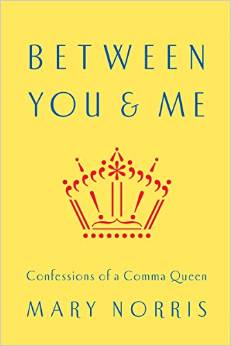
UnknownIn an essay titled “Holy Writ: Learning to love the house style,” Mary Norris writes a “personal history” that covers her first job and how she came to be a copy editor for The New Yorker. She also talks about some of the writers she admired, among them, John Updike:

“And there were writers whose prose came in so highly polished that I couldn’t believe I was getting paid to read them: John Updike, Pauline Kael, Mark Singer, Ian Frazier! In a way, these were the hardest, because the prose lulled me into complacency. They transcended the office of the copy editor. It was hard to stay alert for opportunities to meddle in an immaculate manuscript, yet if you missed something you couldn’t use that as an excuse. The only thing to do was style the spelling, and even that could be fraught. . . .

“I was on the copydesk when John McPhee’s pieces on geology were set up. I tried to keep my head. There was not much to do. McPhee was like John Updike, in that he turned in immaculate copy. Really, all I had to do was read,” she writes.

Norris began working at The New Yorker in 1978 and has been a query proofreader at the magazine since 1993. Her book, Between You & Me: Confessions of a Comma Queen, will be published by W. W. Norton & Co. on April 6, 2015.

Updike and Kierkegaard spotlighted in a new book

Screen Shot 2015-02-08 at 9.10.55 AMDavid Crowe, Professor of English at Augustana College, recently saw his book on Cosmic Defiance:  Updike’s Kierkegaard and the Maples Stories published by Mercer Press.

According to an article in the Aledo Times Record, Crowe tells the “story of Updike’s life-altering encounter with Fear and Trembling in his early career” and traces “the subsequent evolution of Updike’s complex and coherent theology.”

Crowe told the Times Record, “I wrote the book so that even people who haven’t read Kierkegaard can get up to speed on his central claims. Unlike most literary critics, I also avoid jargon and believe that if you can’t state a theory plainly and clearly you’re probably hiding something.”

George Hunt devoted a great deal of time and space to a discussion of Kierkegaard in his seminal work on Updike’s “three great secret things,” but this is the first book-length study on Updike and Kierkegaard.

We’ll post a review of the book on this site within the next week.

Entertainment Monthly shares Top Five Anti-Holiday Reads

UpdiketerrorsThere haven’t been many Grinches or Scrooges or shouts of “Bah Humbug” this holiday season, but Entertainment Weekly has offered the next best thing:

“‘Tis (Not) The Season: Top Five Anti-Holiday Reads.”

Updike has been making a lot of “best” lists this season, and he makes this one as well, coming in at #2 right behind Dr. Seuss’s How the Grinch Stole Christmas! with a book that may be unfamiliar to many Updike fans: The Twelve Terrors of Christmas, featuring illustrations by fellow Harvard alum Edward Gorey. The hardcover book was published in 2006 by Pomegranate Communications and released in a revised edition a year later. You can find a copy, as with almost all out-of-print books, at Abebooks.com.

In making the selection, Entertainment Monthly‘s Madeline Poage writes, “An old one, but a good one, Updike’s wry voice and natural sense of humor flows organically through this compact work. A deconstruction of every facet of Christmas, the book unpacks every ritual and tradition down to the bare bones. Mercilessly witty and disturbingly accurate, every aspect of Christmas if put to the test against logic—what are Santa’s true motives? How do reindeer landing of roofs not destroy them by accident? Do the elves need a union? And of this wouldn’t be complete without Edward Gorey’s illustrations, haunting and stark on every page. For anyone tired of the Christmas hype, this is an absolute must.”

Pennsylvania locals interviewed by Begley rate his biography

Bruce Posten of the Reading Eagle wrote a story in anticipation of Adam Begley’s visit to Reading for the Third Biennial John Updike Society Conference in which he spoke to three classmates and Updike’s Shillington contact and asked what they thought of the biography, Updike.

Dave Silcox, who served as Site Director for the first Updike Society conference at Alvernia University, said he’d give it an A, “but with a few key reservations.”

“I give Begley good grades for his book and I feel his attention to detail was impressive,” Silcox said. “I like the way he structured the book interweaving everything with John’s writings, even though John probably would have been very upset over Begley’s effort to show that so much of his work was autobiographical in nature.

“Had Martha (Updike’s second wife, who survives, as does his first wife, Mary) cooperated with Begley, maybe much more of the real person would have come out, assuming she (Martha) would have been willing to talk about the real person behind the man of letters,” Silcox said. “He (Begley) tried to fill that in by interviewing friends, but Updike had very few close friends after leaving Ipswich.”

“Updike classmates interviewed for biography.” 

Daily Beast picks Updike as a Best Biography

In selecting “The Best Biographies of 2014 (So Far),” The Daily Beast noted, “Only half way into 2014, historical biographies are already having a banner year. Adam Begley’s Updike—a ‘superb achievement’ and ‘brilliant new biography’—is perhaps the most lauded title so far this year in any genre, Ramachandra Guha’s just-published Gandhi Before India is garnering similar buzz, and an armload of other big bios are making waves.”

Of Updike, they wrote:

“The reviews of Adam Begley’s biography of John Updike—the prolific novelist, short story writer, critic, poet, and serial philanderer—approach universal acclaim. Wall Street Journal: ‘Begley has a great many strengths—concision, eloquence, an eagle eye—and few of the usual shortcomings.’ Washington Post: ‘[A] convincing interpretative biography, one characterized by suavity, wit, and independent judgment throughout.’ Newsday: ‘Thoroughly researched, written with intelligence, sympathy and grace, it is a model of first-rate literary biography.’ New York Observer: ‘[A] monumental treatment of a towering American writer.'”