Will we ever see another Rabbit or Portnoy?

08COLAPINTO-4-master180That’s the question that comes immediately to mind when you read Steven Kurutz’s New York Times feature “John Colapinto Revives the Male-Centric Literary Sex Novel.”

Colapinto’s novel Undone has been deemed “too tricky” because of its frank subject matter. Forty-one publishers turned it down before a small independent press in Canada decided to take a chance. And yet, as Kurutz points out, “Roth, Mailer and Updike were far more graphic in their descriptions decades ago. So why not be explicit in 2016?

“‘I can’t do it,’ Mr. Colapinto said. ‘I can’t go there. It shocks me when I see Updike do it.'”

That won’t set well with Katie Roiphe, whom Kurutz describes as having “lamented the inability of male novelists to reckon with lust in a 2009 essay in The New York Times, and not much has changed in the years since. For the crew of writers that includes Dave Eggers, Benjamin Kunkel and Jonathan Safran Foer, she wrote, ‘Innocence is more fashionable than virility, the cuddle preferable to sex.'”

So will we ever see another Rabbit or Portnoy? Not if 41 publishers pass on a novel that seems tame by comparison.

Great Writers at the End book includes Updike

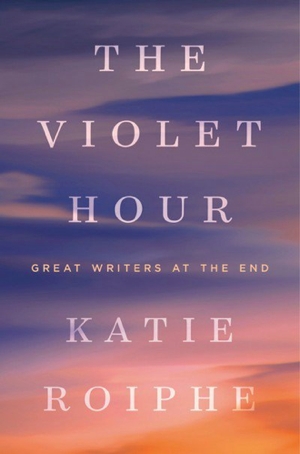
VioletHourNew from The Dial Press is The Violet Hour: Great Writers at the End, by Katie Roiphe, who, as a New Republic review-article notes, “explores the final days of Susan Sontag, Sigmund Freud, John Updike, and other writers at the end.”

Of the book, William Giraldi writes, “Here is a critic in supreme control of her gifts, whose gift to us is the observant rigor that refuses to flinch before the Reaper.

“Each chapter, skillfully eliding overlap, constitutes a ‘biography backward, a whole life unfurling from a death.’ In the slow fade of her five writers—cancer came for Sontag, Freud, and Updike; a stroke felled Sendak; Thomas decimated himself exuberantly with drink—Roiphe finds ‘glimpses of bravery, of beauty . . . of truly terrible behavior, of creative bursts, of superb devotion, of glitteringly accurate self-knowledge, and of magnificent delusion.'”

“Roiphe flashes her richness of mind most intently on Updike,” Giraldi writes. “In Updike’s work, ‘one is struck not by the glittering seductions of the sharp, ambitious, sexually enthralling mistresses but by the deep, agonized love the husbands feel for the first wives.’ She commands a supercharged insight into Updike’s religio-sexual realm that many critics, female and male both, are too ideological or outright painterly to muster. . . .

“Whole swaths of Updike’s work are ‘about not submitting gratefully to that eternal sleep, cheating, tricking, denouncing it, protesting it, fixating on it; so much involves the hope for more than our animal walk, an afterlife, or, better yet, more life.’ His unkillable buoyancy of language, his style that pursued every contour and lineation of living: No other major American novelist has been so downright delighted by the tensile strength of English, no one else so wedded to the notion of writing as deliverance. . . .”

Here’s the full review-article. The book is now available for pre-order from Amazon.com.
Writer Sebastian Faulks’ picks six, including Updike

Screen Shot 2016-02-06 at 5.14.05 PMWriter Sebastian Faulks shared his six favorite books with The Week, and one of them is by John Updike.

In “Sebastian Faulks’ 6 favorite books,” posted 6 Feb. 2016, he names, in no apparent order, A Month in the Country by J.L. Carr, Lord Jim by Joseph Conrad, The Rack by A.E. Ellis, The House on Moon Lake by Francesca Duranti, The Prime of Miss Jean Brodie by Muriel Spark, and Endpoint, by Updike.

In choosing the latter Faulks writes, “John Updike kept writing even as he lay dying in the hospital: the man as pen. In his last poems he gives thanks for his life and his ability to write in verses that are unsentimental and at times deeply moving. An Updike character once said that in death what he would most miss was not being alive, but being American. A wonderful farewell to his readers.”

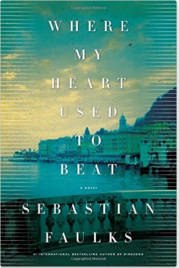
Faulks recent novel is Where My Heart Used to Beat, a work of historical fiction about a psychiatrist who comes to terms with memories of World War II and his father’s past.

Updike quoted in review of Murdoch journal

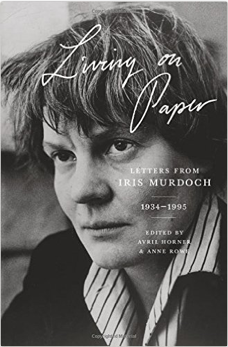
Screen Shot 2016-02-06 at 8.03.01 AMIn reviewing Living on Paper: Letters from Iris Murdoch, 1934-1995 (Princeton Univ. Press) for the National Post, Robert Fulford cited John Updike prominently. His review begins,

“Dame Iris Murdoch, a much-admired novelist for several decades, was also a bold sexual adventuress. Perhaps she was a love addict before that term was popularized in the 1970s (and with it the 12-step program, Sex and Love Addicts Anonymous). She had many lovers and a close attention to sex was crucial in her life and art.

“According to John Updike, love was for Murdoch what the sea was for Joseph Conrad and war was for Ernest Hemingway. Updike considered her the leading English novelist of her time and believed she learned the human condition through her relationships. Her tumultuous love life, he wrote, was ‘a long tutorial in suffering, power, treachery, and bliss.’ Updike believed that in reading her novels he could feel the ideas, images and personalities of her life pouring through her.”

“The intimate biography of Iris Murdoch,” by Robert Fulford

Updike-edited gift recalled

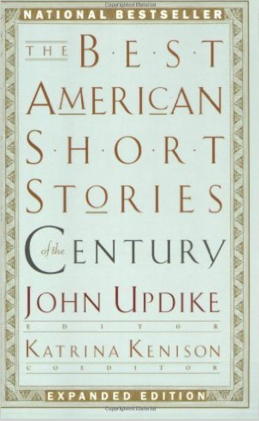
Screen Shot 2016-01-06 at 8.56.22 AMIn the online “Books: The gift I’ll never forget” section of The Guardian, Sloane Crosley recently shared “The book that reminded me America could be magical too.”

It was 1999 and Crosley, who was studying in Scotland and reluctant to leave, recalled how she “fell in love with Edinburgh so intensely” that she “literally fell (first night, Victoria Street, knees skinned). A magical place that smells of salt, hops and sewage, and features a sizable castle sticking up in the middle, Edinburgh was mind-blowing to a young American.”

She talks about how her parents, never good gift-givers, found the perfect way to welcome her home. “There, waiting on my bed, was a 775-page brick of a book. The Best American Short Stories of the Century, edited by John Updike and inscribed by my father: ‘Welcome to America – we’re not so bad.’

“I had not spoken to my parents about how sad I was to leave Scotland. I had barely spoken to them about how much I loved it. But still, they knew. Not only that, they acted on that knowing without laundering it through their own impulses. They did not buy me thistle-patterned linens or play bagpipe recordings. This was a gift truly for me; 100 reminders of why home was still beautiful and funny and complex.”

Angell book offers Updike insights

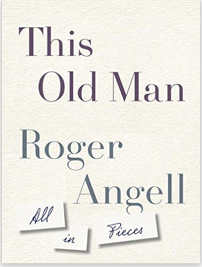
Screen Shot 2015-11-27 at 2.43.39 PMOn November 17, 2015, Doubleday published This Old Man: All in Pieces by Roger Angell (320pp., cloth, SRP $26.95), and Updike Society member Bruce Moyer says that the selected writings from the acclaimed New Yorker writer and editor include editorial notes for John Updike.

One of the reviewers at Amazon.com seconds the notion: “Personal observations such as the insight into John Updike are gems on their own.”

Amazon is currently selling the book in hardcover/cloth for $17.51, or 35 percent off list price.

New short story anthology includes Pigeon Feathers

9780547485850On October 6, 2015, Houghton Mifflin Harcourt published 100 Years of the Best American Short Stories, edited by Lorrie Moore and Heidi Pitlor. And, of course, Updike was included.

This is the best of the best, really, as it’s culled from The Best American Short Stories Series. This is the centennial celebration of the series.

The editors were careful to distribute their picks so that a wide range of American authors could be represented, and no author got more than one story in this collection—though, of course, many writers deserved more than one.

Their are some surprises, but for the classic American authors the classic stories seem to have been chosen. Ernest Hemingway’s “My Old Man” was included, as was F. Scott Fitzgerald’s “Babylon Revisited” and James Baldwin’s “Sonny’s Blues.” Updike’s “Pigeon Feathers” made the cut, as did Philip Roth’s “The Conversion of the Jews,” along with frequent anthology standards like John Cheever’s “The Enormous Radio” and Tillie Olsen’s “I Stand Here Ironing.”

Raymond Carver fans might be surprised that “Will You Please Be Quiet, Please?” was selected over “Cathedral” or “So Much Water So Close to Home,” as might Donald Barthelme fans that “The School” (a great short story) was chosen over some of his more popular ones. The editors clearly put some thought into this, and the fact that a Pennsylvania story was chosen from Updike reinforces how much his home state meant to his fiction . . . and poetry, and creative non-fiction and criticism.


New Yorker runs previously unpublished Updike poem

Screen Shot 2015-09-28 at 5.00.49 PMJohn Updike’s previously unpublished early poem “Coming into New York” appears on page 38 of the October 5 issue of The New Yorker, on sale at newsstands today.

The poem is also available online, here: “Coming into New York.” Both a printed version of the poem appears, as well as a recording of Brad Leithauser reading Updike’s poem.

Leithauser provided the introduction to John Updike: Selected Poems (Knopf), edited by Christopher Carduff. That volume hits bookstores on October 13, 2015 (Amazon link).

Brad Leithauser reading “Coming into New York.”

First look: John Updike: Selected Poems

UpdikepoemsWe received the uncorrected proof for John Updike: Selected Poems, edited by Christopher Carduff and with an introduction by Brad Leithauser, which will be published on October 16, 2015 by Alfred A. Knopf (320 pp., $30/SRP). Because it’s an uncorrected proof we can’t quote from it without comparing it to the finished book, but we can give you an idea of what’s here.

As an editor’s note summarizes, the poems span the years 1953-2008, from the time Updike was 21 until he was 76. Carduff confirmed the completion date for each poem by looking at manuscripts in the John Updike Papers at Harvard’s Houghton Library, and the poems are arranged chronologically by those dates. As a further organizing principle—or rather, as a principle of exclusion—Carduff followed Updike’s lead in assembling his Collected Poems 1953-1993 and excluded light verse, children’s verse, and poems written for private occasions.

Almost all the poems in Selected Poems are from Collected Poems 1953-1993, Americana, and Endpoint, Carduff told us in an email. “Memories of Anguilla, 1960” is from Picked-Up Pieces; “Not Cancelled Yet” is from Higher Gossip; “Commuter Hop,” “Above What God Sees,” and “Big Bard” were published in magazines but are previously uncollected; and “Coming into New York” is an undergraduate poem and appears here for the first time (but is scheduled to appear in a large-circulation national magazine before publication). Selected Poems will be published simultaneously in hardcover and eBook formats. A Knopf paperback edition will follow, “probably in April 2017,” Carduff said.

According to Carduff, the volume is part of an ongoing series edited by Deborah Garrison for Knopf. “All share the same trim size, same Baskerville typography, same interior design and series look; most have notes; each has a critical introduction, a short chronology of the author, an index of titles. Some of the other volumes are Wallace Stevens, Frank O’Hara, Vladimir Nabokov, also Amy Clampitt, Anthony Hecht, James Merrill. . . .”

Leithauser’s 11-page introduction is pithy and insightful, with the award-winning poet calling Updike’s verse “naked poetry,” and not just because of the often frank topics and titles. He notes that the poems come to the readers “naked” without any narrative mediation, that they come from Updike himself. Leithauser includes a liberal amount of lines from the poems and extends his commentary to those specific excerpts.

Included are two appendices—detailed notes on the poems, and a short chronology of Updike’s life—and a title index.

What poems make the cut? You can probably guess. “Midpoint” and “Endpoint” are here, along with “Shillington” (which first appeared in the borough publication Fifty Years of Progress, 1908-1958), “My Mother at Her Desk,” “Outliving One’s Father,” “Elegy for a Real Golfer,” “Jesus and Elvis,” “Upon Becoming a Senior Citizen,” “In the Cemetery High Above Shillington,” “Elderly Sex,” “To a Dead Flame,” “The Beautiful Bowel Movement,” “Squirrels Mating,” “Two Hoppers,” “Poisoned in Nassau,” “Golfers,” “Above What God Sees,” “Tossing and Turning,” “Seven Stanzas atEaster,” “Tao in the Yankee Stadium Bleachers,” “Ex-Basketball Player,” and “Why the Telephone Wires Dip and the Poles Are Cracked and Crooked.” There are 132 in all, and pared down from the Collected Poems they reinforce just how good of a poet Updike really was.

Here’s a link to the Amazon.com pre-order page.

Updike inspired fine press publisher

10801923_575518042584588_3734138739554104525_nJohn Updike Society members may know Andrew Moorhouse from the last two conferences he attended, at which he modestly suggested he was not an academic but “only” an Updike fan, a reader, and a lover of books.

But it turns out that his love of books has made him one of the most respected fine press publishers in the United Kingdom. And John Updike inspired him.

“The American author John Updike said: ‘A book is beautiful in its relation to the human eye, to the human hand, to the human brain and to the human spirit,’ and it is this quote which encouraged me to get involved in Fine Press publishing,” Moorhouse wrote in an article that appeared yesterday in The Irish Times: “Michael Longley’s Sea Asters: publishing as a work of art.”

In the article, Moorhouse talks about how he started Fine Press Poetry in 2013 and how his first three books—two featuring British poet Simon Armitage and this third release, Michael Longley’s Sea Asters, illustrated by the author’s artist daughter—came to be. The article also contains several poems by Longley, who was recently announced as winner of the Griffin International Poetry Prize.

Moorhouse’s forthcoming publication is Andrew Motion’s Ted Hughes Award-winning Coming Home poems. Fine Press Poetry, which specializes in creating letterpress editions of poems accompanied by illustrations by wood engravers and artists, is based in Rochdale, England.

Screen Shot 2015-06-06 at 8.12.53 AM