Camden House is now accepting pre-orders for “Becoming John Updike”

Camden House has begun accepting pre-orders for Becoming John Updike: Critical Reception, 1958-2010, by Laurence W. Mazzeno.

The book provides a comprehensive overview of the journalistic and academic response to Updike’s writings.

Mazzeno, President Emeritus of Alvernia University, is a member of the Society. Here’s the link. No cover art is available yet.

Delbanco book includes Updike response to questions

Member Larry Randen called our attention to a book written by Nicholas Delbanco, “who was in the class Updike taught at Harvard before he retired from academe in the summer of 1962. It includes a letter dated August 26, 2007 in response to three questions Delbanco asked him (and many others) for his book, “Lastingness: The Art of Old Age” (New York/Boston: Grand Central Publishing, 2011, ISBN 978-0-446-19964-3.”

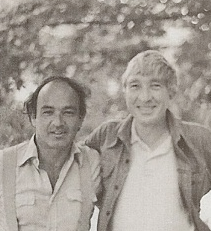
Randen says that Updike’s response to the form letter sent to writers, quoted in its entirety, appears in Chapter 8, “Gratification.” Also included in a mid-section gallery is a photo of Updike and Delbanco in Bennington, Vermont, 1980, taken by Elena Delbanco.

Random House will Mark Updike’s birthday with paperback reprints

Arts Beat reports that Random House will “mark John Updike’s birthday this month with the rerelease of some of his most beloved works, including the ‘Rabbit’ series, the publisher said on Tuesday.”

There’s no press release on the Random House media site to that effect, but Arts Beat writer Julie Bosman might have inside information. “Random House will also rerelease e-book editions of the entire backlist of Mr. Updike’s work,” she writes, “most of which has never appeared in e-book format. A posthumous essay collection, ‘Higher Gossip,’ will appear in paperback for the first time,” she writes, but gives no date. Here’s the link. Thanks to Jack De Bellis for calling it to our attention.

A report on the Updike biography-in-progress

Adam Begley, who is under contract to produce an as-yet-untitled biography of John Updike for HarperCollins, writes that the work is going well and that there’s enthusiastic support for the project. In addition to a 2010 Guggenheim Fellowship that got him started, he has received a 2011-12 fellowship from The Leon Levy Center for Biography, based on a section from the third chapter that he submitted. The chapter details the 18 months that Updike spent in New York City.

Research is progressing nicely, Begley says, adding that he still was work to do in Pennsylvania and that he’s in the middle of a long fourth chapter about Ipswich. “I spend most of every day with John Updike,” Begley writes, “and after more than two years I can report that I haven’t been bored for a minute.”

Begley says he’s hoping to have a first draft completed by the end of June 2012 so he will be free when new Updike materials at the Houghton Library become available to researchers in July 2012. Publication of the biography is set for sometime in 2013.

Amazon is now taking preorders for Higher Gossip

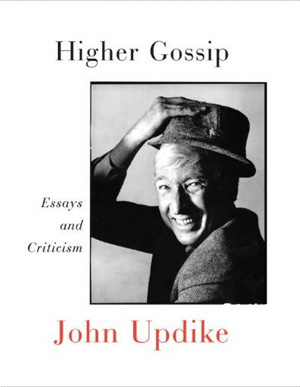
Amazon.com has begun accepting preorders for Higher Gossip: Essays and Criticism, edited by Christopher Carduff. Here’s the link.

As we reported earlier, Higher Gossip is divided into five sections:

“Real Conversation” consists of two previously published personal essays, one previously published humorous piece, three previously published short fictions, and six poems (”The Lovelorn Astronomer,” “Basium XVI,” “Head of a Girl, at the Met,” “Cafeteria, Mass. General Hospital,” “An Hour Without Color,” and “Not Cancelled Yet.”

“Book Chat” includes three speeches (”Humor in Fiction,” “The Plight of the American Writer,” and “The Written Word”); tributes to Kierkegaard, Fitzgerald, Hemingway, Sissman, and Carver; three forewords/afterwords; and 15 book reviews.

“Gallery Tours” features 20 essays on art, and “Pet Topics” contains three previously published essays on science, six musings on Massachusetts (including “Harvard Square in the Fifties,” “Ipswich in the Seventies,” and “Memoirs of a Massachusetts Golfer”), and five post-Golf Dreams writings on golf.

“Table Talk” is the ephemeral category, including remarks made at book conventions, short musing, forewords, addresses, letters, prefaces, notes, and a humorous piece on “The original ending of Self-Consciousness.

Knopf provides details about Higher Gossip

The Knopf PR people may be on vacation, but we learned from bibliographers Michael Broomfield and Jack De Bellis’ Knopf contact that Higher Gossip is estimated at 512 pages—roughly the same size as Hugging the Shore—and it’s priced at $40. Christopher Carduff compiled and edited the volume, which is divided into five sections:

“Real Conversation” consists of two previously published personal essays, one previously published humorous piece, three previously published short fictions, and six poems (“The Lovelorn Astronomer,” “Basium XVI,” “Head of a Girl, at the Met,” “Cafeteria, Mass. General Hospital,” “An Hour Without Color,” and “Not Cancelled Yet.”

“Book Chat” includes three speeches (“Humor in Fiction,” “The Plight of the American Writer,” and “The Written Word”); tributes to Kierkegaard, Fitzgerald, Hemingway, Sissman, and Carver; three forewords/afterwords; and 15 book reviews.

“Gallery Tours” features 20 essays on art, and “Pet Topics” contains three previously published essays on science, six musings on Massachusetts (including “Harvard Square in the Fifties,” “Ipswich in the Seventies,” and “Memoirs of a Massachusetts Golfer”), and five post-Golf Dreams writings on golf.

“Table Talk” is the ephemeral category, including remarks made at book conventions, short musing, forewords, addresses, letters, prefaces, notes, and a humorous piece on “The original ending of Self-Consciousness.

Updike’s debut as a literary character?

Brian Keener, author of John Updike’s Human Comedy: Comic Morality in The Centaur and the Rabbit Novels, writes that “our man John Updike has now made an appearance as a literary character. According to a book review of Steve Martin’s new novel, An Object of Beauty, in The New York Times on Nov. 26 (“Only Collect,” by Alexandra Jacobs), Updike appears “in the form of a stranger on a train” with the heroine addressing him, ‘Sit down, father figure.’ This development may open up a new vein of Updike scholarly investigation: John Updike as a literary character.”

And to think that a comic actor may have started the ball rolling.