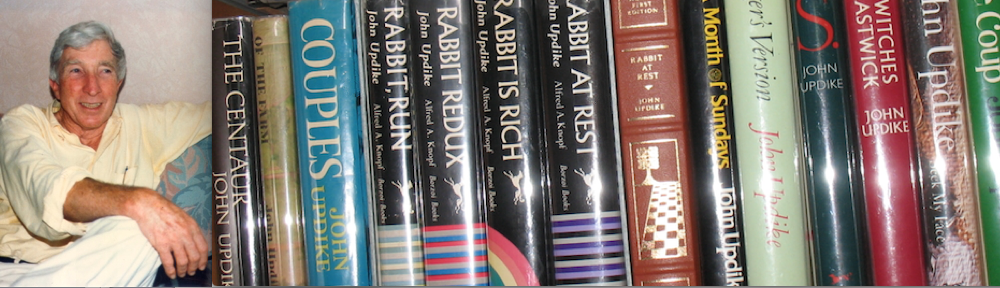
Ethan Hemmati, a second-year British-Iranian doctoral candidate in American Literature at the University of Glasgow in Scotland, was named as the recipient of the 2025 Robert M. Luscher Scholarship for travel to research collections for a project involving John Updike. Hemmati will receive $1000 from The John Updike Society to help defray the costs of travel to the U.S.
Hemmati, who previously engaged in masculinity studies at the universities of Durham and Cambridge, is working on a doctoral project titled “Adultery and Postwar American Fiction.”
“My project takes an intertextual approach to the fiction, life-writing, and biographies of three postwar American writers: John Updike, John Cheever, and Raymond Carver,” Hemmati wrote in his proposal. “My specific focus is on textual representations of infidelity across the writers’ fictional and nonfictional writings. As writers who wrote about adultery but were also adulterous themselves, the textual mediations of the subject throughout their art proves a compelling juxtaposition to its other representations within the writers’ (auto)biographical texts.”
One judge wrote, of Hemmati’s proposal, “It is detailed and nuanced, and it articulates a line of inquiry that I think is urgently important for Updike scholarship going forward. The recent revelations about Alice Munro’s daughter as well as such books as Claire Dederer’s Monsters: A Fan’s Dilemma suggest we might be at an inflection point around the very questions Ethan’s projects seeks at addressing—namely, how to engage with ‘art of a perceivably problematic nature, typically as a result of information about its creator or production.”
Hemmati previously made the short list for The Literary Encyclopedia Travel Award 2024.
 course, played an important role for a lot writers—no need to list them all here.) John Ashbery enjoyed a nice cup of tea and classical music when he wrote, which was usually in the late afternoon. Charles Simic enjoyed writing when his wife was cooking. Eudora Welty could write anywhere—even in the car— and at any time, except at night when she was socializing. Flannery O’Connor could only write two hours a day and her drink was Coca Cola mixed with coffee. Simone de Beauvoir wrote from 10AM-1PM and from 5-9PM. Louise Glück found writing on a schedule “an annihilating experience.” A. R. Ammons wrote only when inspiration hit—he compared trying to write to trying to force yourself to go the bathroom when you have no urge. Anne Sexton took up writing after therapy sessions. Jack Kerouac had various rituals at different times—one was writing by candlelight, and another was doing “touch downs” which involved standing on his head and touching his toes to the ground. Ernest Hemingway and Virginia Woolf wrote standing up. Wallace Stevens composed poems while walking to work. Gabriel García Márquez listened to the news before writing. Amy Gerstler sometimes listens to recordings of rain while writing. I tried that once, and the rain put me into a deep and dreamless sleep.”
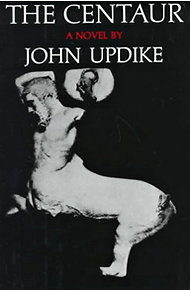 Greatest Books of All Time on Teachers,” and it’s no surprise that John Updike’s 1963 novel, The Centaur, ranks high on the list. His tribute to his father (and teacher), Wesley Updike, did win the National Book Award, after all.