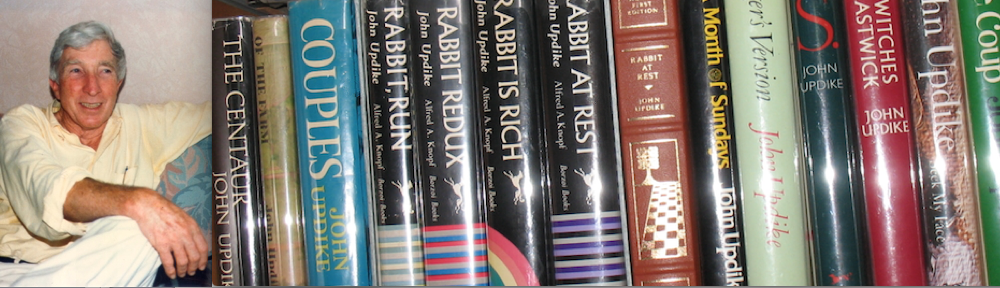
The Local News reported that J. Barrett Realty just listed the Polly Dole house on 25 East Street—the second house John and Mary Updike lived in after they moved to the Ipswich area—for sale at $729,000. It’s the first time the house has been listed in 30 years.
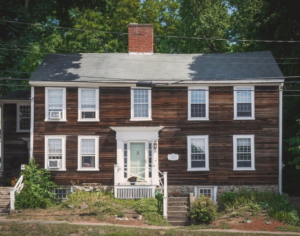
Photo: J. Barrett Realty
The Updikes bought the house in 1958, a year before his first novel (The Poorhouse Fair) and first short story collection (The Same Door) were published by Knopf. The purchase, he told a New Yorker editor, made him feeling “quite panicked” because of mortgage payments that, for a writer still trying to establish himself, could be burdensome.
As Local News reporter Trevor Meek wrote, fictional versions of the Polly Dole house appeared in many of Updike’s short stories, “most notably in the ‘Maples Stories’ that trace the doomed-to-fail marriage of recurring characters Joan and Richard Maple,” and the “house inhabited by Angela and Piet Hanema, central characters in Updike’s controversial novel Couples (1968), also seems to be based on the East Street home.” Publication of the latter caused a row in Ipswich because people in this small North Shore town recognized elements of themselves in the novel, prompting the Updikes to move to London for a year to let things calm down.
In 1969, John and Mary sold the Polly Dole house to Alexander and Martha Bernhard. Meek quoted biographer Adam Begley’s succinct summary of what happened next: “Soon, the Bernhards were part of the gang, and several years later John and Martha launched into an affair that broke up both marriages.”
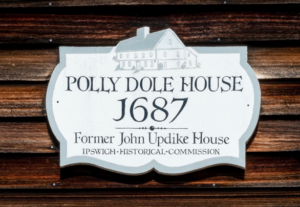
Photo: J. Barrett Realty
Updike had jokingly told his young children that a big nut on the ceiling that had been turned to straighten the house was holding the house together, and if it was loosened the whole house might collapse. “Once we moved, the fact is, things fell apart,” Updike wrote in Architectural Digest.
According to the Historic Ipswich, the Polly Dole house has “elements from 1687, but acquired its current form in 1720.” Meek noted, “At 2,942 square feet, it sits on 0.24 acres and is being advertised as a multi-family home with two separate side-by-side units. The house last sold in 1995 for $238,000, according to property tax records.”
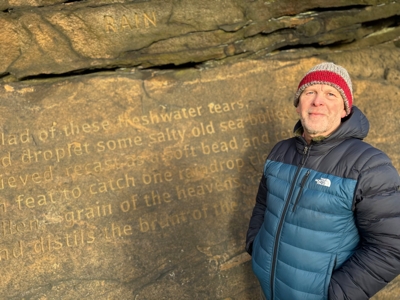 With heavy hearts we report the death of longtime John Updike Society member Andrew J. Moorhouse, whom many members first met when he attended the society’s second biennial conference in Boston in 2012.
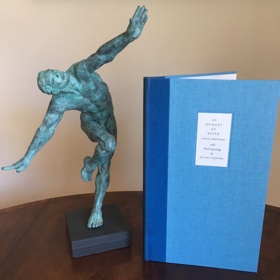 Inspired by Updike and Updike small-press limited edition publisher William Ewert, Andrew contacted UK Poet Laureate Simon Armitage, whose work he collected, asking if he’d be interested in working with him to produce fine press editions of his works. Armitage was interested, and in October 2013, Andrew started
 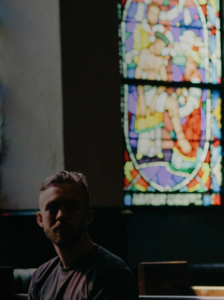 Chase Replogle, pastor of Bent Oak Church in Springfield, Mo., posted a chapter excerpt that didn’t make the final cut of his book, A Sharp Compassion. “I think it still matters, he wrote. “It is taken from the chapter on affirmation and examines how the church has been tempted to avoid what offends.”
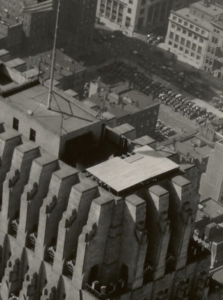 In
In 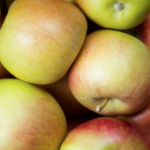 Phoenixville (Chester County) Pa.’s Excursion Ciders “uses local apples that are presssed and made in-house, also utilizing other locally-grown ingredients to make their drinks. Currently, the star of the show is Of the Farm: Core. This cider has an ABV of 7.5 percent and is made with apples from Plowville Orchard. Author John Updike spent time there and they named this cider after his novel, Of the Farm.” Here’s the