Eat My News: Rabbit Recapped

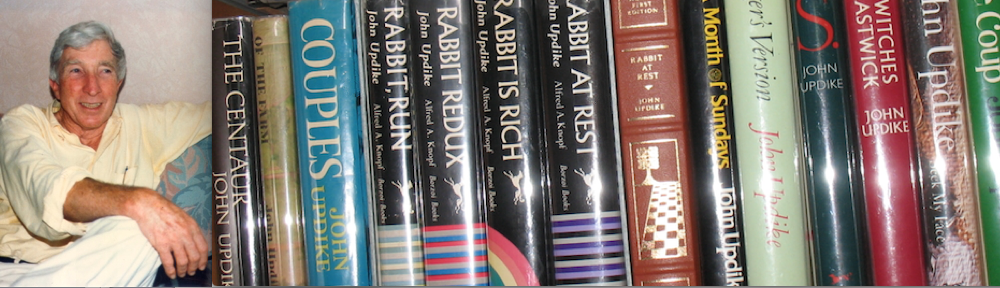
The global media platform Eat My News published a primer on “Exploring John Updike’s Iconic ‘Rabbit’ Series” on October 26, 2023. For what is apparently the first installment of a series, contributor Anushka Dabhade began,
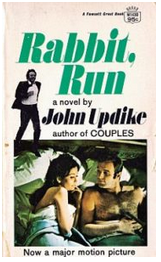
“In the realm of American literature, few authors have left as indelible a mark as John Updike. His ‘Rabbit’ series, comprising four novels that span several decades, offers readers a profound exploration of the human condition and the evolution of a character named Harry “Rabbit” Angstrom. As we embark on this literary journey, we’ll unravel the complexities of these novels, their impact on readers, and the enduring legacy of John Updike.”

Dabhade ended this segment with this summary: “John Updike’s ‘Rabbit’ series is a literary journey that transcends time and place. Through the eyes of Harry “Rabbit” Angstrom, readers are invited to ponder the complexities of human existence and the ever-changing landscape of American life. As you embark on this literary voyage, you’ll discover why Updike’s ‘Rabbit’ series continues to be a source of fascination and contemplation for generations of readers.”

Read what’s in-between, and apparently stay tuned.
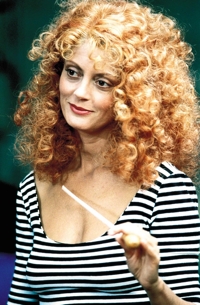
 

Witches of Eastwick ranks among Susan Sarandon’s best performances

In a no-byline roundup, The Guardian (UK) compiled a list of the 20 best performances by actress Susan Sarandon, best known for Thelma and Louise (1991), Bull Durham (1988), and Dead Man Walking (1995). Those three make the list, of course, coming in at Nos. 1, 4, and 5, respectively. But Sarandon’s performance as witchy cellist Jane in John Updike’s The Witches of Eastwick (1987) landed in the 7 spot.

“Sarandon knows Hollywood is ageist and sexist; she once said female actors over the age of 40 get stuck playing “witches or bitches”. Still, she makes the most of both. In Miller’s uneven, SFX-heavy adaptation of the John Updike novel, insecure cellist and music teacher Jane, is one of three Rhode Island women whose hidden, supernatural powers are unleashed when Jack Nicholson rocks up. With a light touch, Sarandon captures the agony and ecstasy of being a sex-starved, highly strung supernatural singleton. Imagine highlights from Powell and Pressburger’s Black Narcissus, played for laughs.”

Susan Sarandon’s 20 best performances—ranked!

New Yorker Cartoonists note Updike-Roth connection

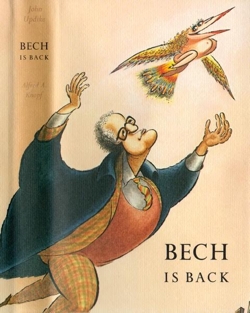
Ink Spill: New Yorker Cartoonists News, History, and Events posted an October 14, 2023 item about the “Roth Art on Updike’s Desk”:

“When I interviewed Arnold Roth in 2016, we spoke about the cover art he provided for John Updike’s Bech series. Last night I cam across this 1983 Time Magazine ad and was pleased to spot a stack of Arnie’s Bech Is Back art on Updike’s desk.

“On the top of the pile is what looks to be a proof, and just below it, looks very much like original art (Updike had all three Roth Bech cover originals in his collection).”

See photos and read more.

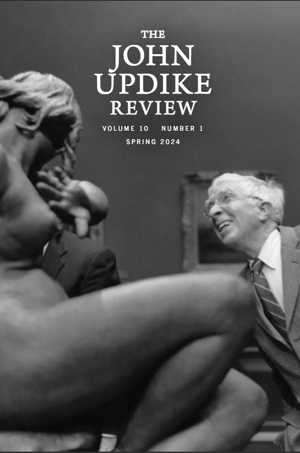
Just published: The John Updike Review 10: 1 (Fall 2023)

The fall 2023 (Vol. 10, No. 1) issue of The John Updike Review has been mailed to members and institutional subscribers in the U.S., and members in good standing have also been sent a digital version. The journal, published twice yearly by the University of Cincinnati and the John Updike Society, is based at the University of Cincinnati’s Dept. of English and Comparative Literature, Arts & Sciences, with James Schiff serving as editor and Nicola Mason managing editor.

The new issue features expanded versions of remarks by a 2022 American Literature Association conference panel on “Women and Sex in the Works of John Updike and Other Male Authors” that was organized by the John Updike Society. Featured on the panel and in this issue were James Plath, Sue Norton, Marshall Boswell, Biljana Dojčinović, Olga Karasik-Updike, and Matthew Koch.

Also included in the fall 2023 issue: a tribute to Christopher Carduff by editor Schiff, an essay on “The Enduring Religious Relevance of John Updike” by JUR Emerging Writer Prize-winner Domenic Cregan, and additional essays on “More Distorted Mirrors: Ironic Self-Portraits in Updike’s My Father’s Tears” (Peter J. Bailey), “John Updike’s Review-Essays: Educating Himself and Others on Brazil” (Carla Alexandra Ferreira), and “Updike’s ‘Wife-Wooing’: The Seven-Year Itch and the Soliloquy of Seducton” (James Plath).

Institutions wishing to subscribe and society members who haven’t received the electronic version yet should email jplath@iwu.edu.

In Memoriam: Martha Ruggles (Bernhard) Updike

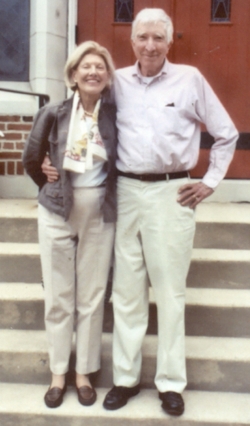
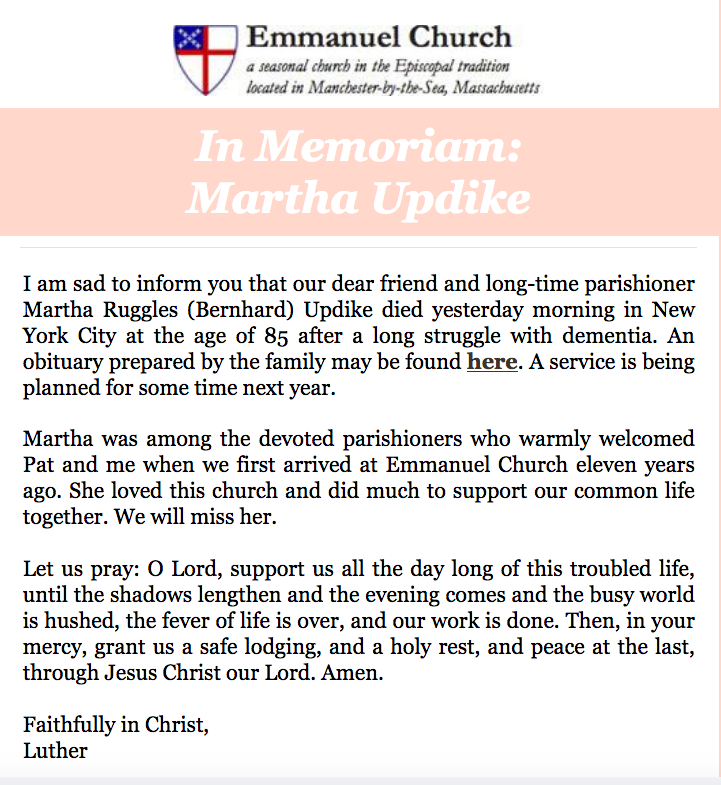
The society is saddened to report that Martha Ruggles (Bernhard) Updike died Monday, October 9, at the age of 85. Below is the obituary written by her sons from her first marriage, as well as an announcement sent to parishioners by Emmanuel Church in Manchester-by-the-Sea, Massachusetts. She is pictured here on the steps of another church—Grace Lutheran, in Shillington, Pa.—in a photo taken by society member David Silcox.

Martha Ruggles (Bernhard) Updike, previously of Beverly Farms, MA, died on October 9 2023 in New York City at the age of 85 after suffering from dementia for several years. She was the widow of the author John Updike to whom she had been married for over 30 years when he died in 2009. Her previous marriage to Alexander Bernhard ended in divorce in 1974. Martha is predeceased by her parents Margaret Ruggles and Frederic Stanboro Ruggles and her brother Keith Ridgeway Ruggles. Born in Chicago in 1937, Martha was raised in Fairfield Connecticut before attending Cornell University and later obtaining her Masters in Education from Harvard University in 1964 and her Masters in Social Work from Simmons College in 1988. She subsequently worked at Massachusetts General Hospital in Boston as a social worker in their inpatient psychiatric unit. A long-time resident of Boston’s North Shore, Martha was a member of Myopia Hunt Club and at the time of her death the Chilton Club. Martha was passionate about gardening, holding several positions with the Garden Club of America throughout her lifetime and was involved in numerous organizations including the Holland Dames, the Huguenot Society of America and the Mayflower Society. Martha was known for her no- nonsense Yankee approach to life and people, her work and her gardens. Her greatest happiness was the life she shared with her late husband John. Martha is survived by her four stepchildren, Liz Updike Cobblah, David Updike, Michael Updike and Miranda Updike, and three sons from her first marriage, John H. Bernhard II, Jason Ruggles Bernhard and Frederic (Ted) Ridgeway Bernhard. A memorial service will be held at a future date in Manchester MA.

The society extends its deepest sympathies to John, Jason, and Ted Bernhard, and to the stepchildren and grandchildren.