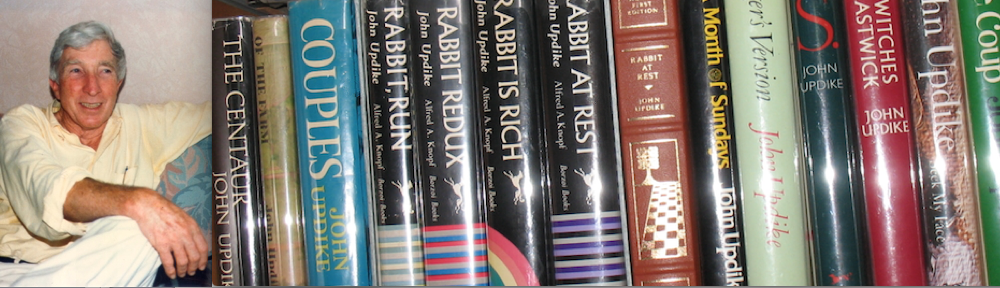
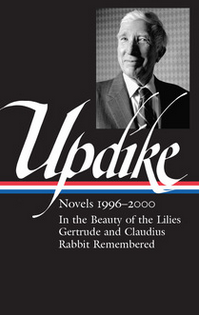
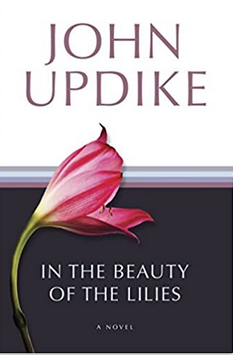
Library of America has just published the fifth and final volume in the John Updike: Novels series: John Updike Novels 1996-2000, containing In the Beauty of the Lilies, Gertrude and Claudius, and Rabbit Remembered. Not available in bookstores until March 13, the volume is now on sale through the LOA webstore for $32 plus free shipping—29 percent off the $45 retail price.
In addition, the complete LOA five-volume set, John Updike: Fifteen Novels (five individual volumes, not a boxed set) is on sale now at the webstore for $145 plus free shipping—34 percent off the $225 retail price.
Series editor Christopher Carduff said “there are indeed more LOA Updike volumes to come. None are as yet scheduled, but stay tuned.”
This sounds like a fun course: Witchcraft in Literature 101. You can take it, too, online, and for free from Arcadia, thanks to researcher-author Anna Artyushenko.
“Witchcraft takes on many forms and perspectives in various works of literature, Artyushenko wrote. “It finds its origins in folklore and myths, it carries the traits of gothic and horror, but it is also used in satire and comedy, and undoubtedly plays a major role in fantasy.”
Updike’s 1984 novel is the subject of the third post, “Social Commentary in The Witches of Eastwick“:
“All three witches possess some powers at the outset of the novel, but their abilities develop and turn darker with the arrival of Darryl Van Horne. It is never stated directly in the novel that the stranger who has arrived in Eastwick is the Devil. However, his nature is obvious, according to many remarks in the novel. Updike purposefully plays around the “stranger danger” trope, inviting the Devil to the small conservative town of New England. He ridicules the reception of the occult in the traditional Puritan society, though “God’s absence, presumably, opens the way for evil” in the novel (Verduin, 1985, p. 306). Van Horne is purposefully drawn to the witches and corrupts their powers. The women cannot escape the stereotypical pattern, as “in order to satisfy their extraordinary sexual appetite, the witches turn to a devil figure, Darryl Van Horne” (Loudermilk, 2013, p. 101).”
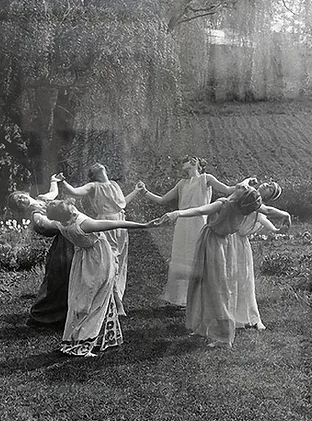
Wiccan magic circle
“Updike makes a reference to the Wiccan perception of magic, connecting it with nature, though his vision of witchcraft is “closely tied to both, carnality and mortality” (Antwood, 1984, para. 10). Updike sees nature not from a spiritual or ecological, but from a rational perspective: incapable of empathy towards humankind, and as inseparable from death and decay as it is from life and growth. In the novel Alexandra thinks that one of the major nature’s rules is “that there must always be a sacrifice” (Updike, 1996, p. 18). Jenny becomes this victim, sacrificed to the Devil. Updike makes a point that the male’s power is still greater, as later on the witches learn that they did not cast the curse out of their own free will and were controlled by Van Horne. The Devil in the novel acts as a trickster who manipulates the witches while they abandon their family duties in order to follow the path of the occult and magic, which leaves them with nothing but regret in the end.”
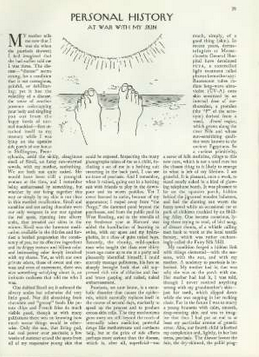
Surely there were more than 21 celebrities who had psoriasis, but a writer for news aggregate site Yahoo!’s “women’s health” section settled on that number . . . among them, John Updike (#20).
“The Pulitzer Prize-winning novelist and poet penned a 1985 essay for The New Yorker aptly titled ‘At War With My Skin,‘ where he addressed his struggles with the autoimmune disease. In his essay, Updike wrote, ‘Why did I marry so young? Because, having once found a comely female who forgave me my skin, I dared not risk losing her and trying to find another.'”
It’s always interesting to look back at early reviews of an author’s work.
Time magazine’s Nov. 1, 1963 review of John Updike’s volume of poetry, Telephone Poles, noted that “Updike has neither [Ogden] Nash’s bewildered air of good sense wrapped in metrical nonsense nor [Morris] Bishop’s malicious delight in destroying his targets in a single, whiplashing line. His tone is more urbane and more lyrical, a bit reminiscent of Britain’s John Betjeman.”
Two years later, in their Nov. 12,1965 issue, Timereviewed Updike’s Of the Farm and warned readers that Updike’s fourth novel “will disappoint those admirers who have been waiting hopefully for a major talent to produce a major work. Instead of expanding, the Updike compass seems to be narrowing, as if its wielder were desirous of proving that he can, if need be, engrave his graceful arabesques on the head of a pin. Of the Farm barely qualifies as a novel; it is too brief, inactive, and unambitious. But as a delicate cameo that freezes three people in postures that none of them finds comfortable, it is almost faultless. Its achievement is that with incredibly economical means, it suggests that each of these people will change, develop, shift in their relations to each other and makes the reader wonder what their future will be. Its failure is that Updike never explores that future.”
American Purpose has a holiday tradition where editorial board members, contributing editors, and staff share their favorite reads from the past year. They call it “Turning the Page.”
Board member Adam Garfinkle, who is also founding editor of The American Interest and serves on the board of advisors at the Foreign Policy Research Institute, chose John Updike’s In the Beauty of the Lilies as his favorite read of 2022.
“John Updike’s 1996 bestseller In the Beauty of the Lilies has become part of the pantheon of fictive meditations on the thick sinews of Protestant Christianity that run deep and wide within the American body social and politic,” wrote Garfinkle, a former speech writer for secretaries of state Colin Powell and Condoleeza Rice.
“It tells a multigenerational family tale starting in Paterson, New Jersey, in 1905 and ending four generations and eighty years later in a Waco-like conflagration near Bighorn, Colorado. When I read the book a quarter century ago I marveled at Updike’s storytelling skills despite being unable to bond emotionally with any of the characters—rather like how I have since felt about Marilynne Robinson’s multigenerational Christological stories spread out in multiple books.
“This year’s deliberately slower second reading collided with my more mature ruminations on the wider topic of Protestantism’s shaping of a nation rushing through time, and itself being reshaped in the process. The collision revealed more of Updike’s prophetic shrewdness amid his formidable literary skills than I discerned the first time around. Now that we live truly in an age of spectacle, something still inchoate in 1996, the dancing demons and angels of the Protestant bequest to America appear far more vivid to me. The book didn’t change as time passed, but the reader did.”
Updike came here for a handful of summers to practice his golf game before the New England weather turned hospitable. He wrote about a cherished hat he lost here in “A Desert Encounter.” And John Updike Society members will travel to Tucson, Arizona for the 7th Biennial John Updike Society Conference in September 20-24, 2023. Here is the Updike in Tucson Registration Packet: