Tonight only: Updike’s Witches take the London stage

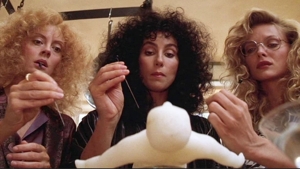
Playbill‘s Leah Putnam reports that for one night only, June 20, 2022, The Witches of Eastwick Concert will play London’s Sondheim Theatre, with original cast member Maria Friedman directing the performance.

The cast consists of Natasha J Barnes as Alexandra, John Partridge as Darryl Van Horne, Carrie Hope Fletcher as Sukie, and Laura Pitt-Pulford as Jane.

“Featuring a book by and lyrics by John Dempsey (The Fix), with music by Dana P. Rowe (The Fix), the show is based on the John Updike novel and film adaptation of the same name. Musical staging is by Chrissie Cartwright, with associate direction by Jack McCann, and associate musical direction by Mike Steel. Also serving on the creative team are Isaac McCullough as musical director, Jonathan Lipman as costume designer, Simon Sherriff as lighting designer, Adam Fisher as sound designer. Jack Maple serves as producer of the concert, which is presented by arrangement with Cameron Mackintosh Ltd.

“Friedman said in a statement, ‘I’m so incredibly excited to be revisiting Eastwick after all these years. To be reunited with the fantastic Stephen Mear, and to have the opportunity to bring this beloved musical back to London, and at the simply stunning Sondheim Theatre, for one-night-only is an absolute thrill, and I can’t wait to get started.” Friedman is set to reprise her direction of Merrily We Roll Along when the British production transfers to Off-Broadway’s New York Theatre Workshop later this year.

The Witches of Eastwick‘s last major production on the London stage was its original run at the Theatre Royal Drury Lane in 2000, from which it transferred to the Prince of Wales Theatre the following year.”

Read the whole article.
UnHerd writer worries about the future of literature

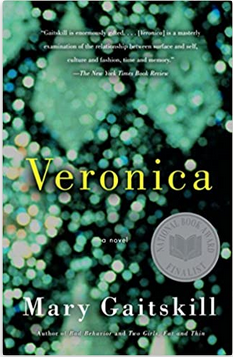
Novelist, essayist, and short story writer Mary Gaitskill penned a meditation on writing and reading titled “Will literature survive?” for the website UnHerd. “We have fallen out of love with good writing,” the subhead laments.

Gaitskill writes, “An element of style that I especially care about is description of the world that the writer creates on the page” . . . a dead giveaway that a reference to John Updike will be forthcoming, and it was:

“More recently, in 2019, Joyce Carol Oates came to Claremont McKenna where I was teaching and did an intimate Q&A. I brought up the writer John Updike; I was teaching a novel by him which was hard for students to read partly because he was sexist and backward in his racial attitudes, but even more because he described his worlds very, very densely. He would spend pages describing what a character sees driving down a country road at night. Students had a hard time even tracking it — they could, but they had to try. (Note: at least one of them, once he got the hang of it, loved it, which was great.)

“I wanted to hear what Oates had to say about it because she’s of an older generation; she and Updike were peers. What she said was (paraphrasing again): yes, John could describe anything and everything but no one wants to read that any more, because (directly quoting) “people have moved on”/  I was really surprised by this. “Moved on”? We’ve moved on from the world we live in? How is that possible?” asks Gaitskill, whose novel, Veronica, was a finalist for the National Book Award and National Book Critics Circle Award.

How is it possible? Attention span? The need for instant gratification provided by 40-second TikTok videos? Whatever the root cause(s), true readers are apt to share Gaitskill’s dismay.

A writer’s meditation on Updike’s meditation on the Resurrection

Chris Simmons penned a short “Meditation” for the Hickory Daily Record that considers Updike’s thoughts about the Resurrection:

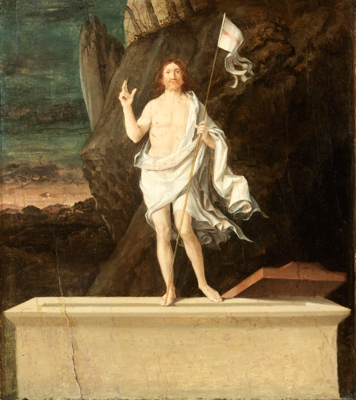
Risen Christ. 1510. Andrea Previtali.
Rhode Island School of Design Museum

“At 28, the novelist John Updike cut to the bottom line of the Resurrection. Updike would fear death throughout his life. His sober awareness of it surely led him to write ‘Make no mistake, if he rose at all, it was as his body; If the cells’ dissolution did not reverse, the molecules reknit, the amino acids rekindle, the Church will fall.’

“Updike realized that the Resurrection’s scandal, that a human could rise from the dead, must be true or the faith should be abandoned. He would have none of making it metaphor or redefining it to become less of a stumbling block. He seems to have believed that he could only be saved from eternal death by a Savior who had defeated it himself. At 76, as he approached its threshold, Updike asked his wife, “Are you ready for the leap?”

“It’s easy for the reality of the scandal to lose its punch in our gospel-saturated, yet post-Christian culture, especially in western North Carolina where many of us watched Billy Graham relentlessly invoke the Crucifixion during crusades from just about everywhere. We should sternly resist our own casualness with it in an age when many wrongly treat it as folklore. The Crucifixion was exactly the opposite. The Romans opposed Christianity so strongly partly because early Christians, much like Updike, were so focused on reality itself.”

New Yorker piece ponders father-son writers

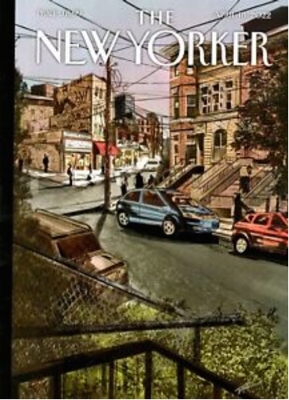
Tad Friend‘s musings on who gets custody of the family tales in “With father and son writers, who gets to tell the family story?” appeared in the April 18, 2022 issue of The New Yorker.

Friend writes, “When I was young, I admired no writer’s stories more than John Updike’s. Book jackets sporting his woodsy tousle and horndog smile were everywhere, like portraits of a Balkans despot. Updike surrounded us; in some thermostatic way, he established the climate. I was already a watchful white guy, and I already wrote for the Harvard Lampoon, as he had. All I had to do was move to New York, sum up the culture, and reap the hosannas. Easy-peasy.

“When I got to New York, burning with the prescribed low steady fever, I met with a New Yorker writer who’d been hired out of Harvard three years earlier, another Updike in utero. I’d sent him my clips, hoping he’d say, “You should start here tomorrow!” Scratching his ear meditatively, he in fact said, “You know what I’d do if I were you? I’d move to a place like Phoenix and write for an alternative newspaper. Learn how power shapes a midsize American city, and how to report, and all the facets of our craft. And then, after ten years or so, if you still have a mind to, return to New York.”

To make a long story short, “In 1998, a dozen years later than the Updike Protocol had prescribed, I joined the staff of The New Yorker. One of my first stories was about two workmen in Sun Valley who’d dug up a jar of gold coins on land owned by Jann Wenner, the Rolling Stone co-founder; each schemed to take the treasure, but Wenner ended up with it. Day wrote, ‘It may be rather nineteenth century of me, but I wondered what The New Yorker’s goal was in publishing it. To show the triumph of a New Yorker who didn’t care?’ After I stopped responding to these irksome questions, he stopped posing them.”

Friend’s latest book is In the Early Times: A Life Reframed.

Updike’s Couples makes a reading list on transformative love

Literary Hub recently published a recommended reading list “From Eve Babitz to Raven Leilani, Readings on Solipsistic, Transformative Love” by Lillian Fishman. Surprisingly, Updike’s 50-year-old novel Couples makes the list. Fishman writes,

“A novel apparently about sex, Couples is actually about something much more interesting: how adultery itself—’its adventure, the acrobatics its deceptions demand, the tension of its hidden strings, the new landscapes it makes us master’—can breathe life into a prematurely settled existence. Though he describes a number of affairs among the couples of Tarbox, Updike follows most closely behind Piet, whose womanizing is never premediated but who falls into one affair-adventure after another, believing his talent is that he genuinely loves every woman he touches. Sincere and special in the way it expresses how we explain ourselves to ourselves, and deeply forgiving of our failings, especially when they occur in the service of reanimating a life.

Also recommended are books by Raven Leilani, Annie Ernaux, Eve Babitz, Celia Paul, Peter Stamm, Kathleen Collins, and Sheila Heti. Fishman, who was born nearly 30 years after Couples was published, is the author of Acts of Service (Hogarth Press).

Indian scholar publishes essay on Updike’s S.

Raghupati Bhatt’s critical essay, “John Updike’s Indian Connection,” was published in the International Journal of Scientific and Research Publications Vol. 4: 7 (July 2014). It is now completely downloadable online.

“The reader finds that Updike’s women characters have reached a new height in S.,” Bhatt writes. “She is searching her own identity. She is trying to develop her personality. She is groping her way out. She seems determined. She is not uncertain or totally submissive. She is not only an object of pleasure but she is out to enjoy the pleasure. She has given up the petty fears of morality, the social status and the family attachments. S. is representative of this woman against the background of religious commune and oriental philosophy. Updike has taken full notice of the women’s movements and the feminist critics.”

Link to download the article.

Updike’s Witches are reappraised 330 years after Salem

In “Revisiting The Witches of Eastwick 330 Years After Salem” for the Chicago Review of Books, Chicago-based writer Sara Batkie writes, “Fifty-odd years ago, covens were the locus of Satanic activity in such movies and books as Rosemary’s Baby and Suspiria. But the rise of second-wave feminism and women in the workforce in the late ’70s and early ’80s gave way to a gentler, more domestic spellcaster, a trend arguably initiated by John Updike’s 1984 novel The Witches of Eastwick and the film adaptation three years later.”

After giving credit where she thinks credit is due, Batkie offers a refrain that’s familiar to Updike readers: “Most of his previous work was steeped in middle class realism, bound by such earthly concerns as which friend’s wife to sleep with and the masculine urge to escape from familial obligations. The inner lives of women were not often foregrounded, to put it generously, though Updike was one of our most skilled sensualists, and it’s clear he admired the ‘fairer sex,’ even if he didn’t always understand them.”

Batkie suggests that maybe Updike added witchcraft to his first real attempt to write about the inner lives of women in order to “hedge his bets. If something didn’t ring true to his female readership, it could be attributed to the three women’s unique powers.”

Batkie gives the film higher marks than the novel when 2022 feminism is the standard, but concludes, “So where does that leave us today, post-third-wave and likely post-Roe? Though neither Updike nor [director George] Miller set out to predict our fracturing present, both versions of The Witches of Eastwick now feel like a warning, or at least a precaution. Magic has its limits, both personally and politically. A woman’s right to bodily autonomy is no longer a fringe belief, no matter what men in power like Alito might think.”

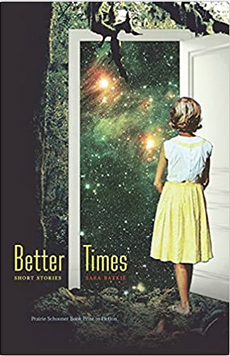
Batkie is the author of Better Times: Short Stories, which won the 2017 Raz/Shumaker Prairie Schooner Book Prize in Fiction. Read her whole Chicago Review of Books essay here.

Fellow psoriasis sufferer cites Updike’s bravery

In a review for The Guardian [U.K.], “Skin by Sergio del Molino review—a meditation on psoriasis and the psyche; A sufferer writes about how the skin condition affected figures as diverse as Joseph Stalin, John Updike and Cyndi Lauper,” Houman Barekat notes that del Molino was 21 when he first experienced psoriasis symptoms.

Barekat summarizes the affliction: “a chronic autoimmune condition that causes an overproduction of epidermal cells, resulting in scaling on the surface of the skin” that “appear in red blotches that sometimes crack and bleed.” Barekat identifies the accompanying related symptoms—arthritis, back pain, chronic fatigue—and zeroes in on del Molino’s contrast between the way that the disease affected Stalin (and his two henchmen who also had psoriasis) and Updike:

“Conversely, on a happier note, Updike credited his psoriasis as the driving force of his talent, remarking in his memoirs that: ‘Whenever in my timid life I have shown some courage and originality it has been because of my skin.'”

Updike famously wrote about his psoriasis in “At War with My Skin,” which was first published in The New Yorker and then became one of the central essays in Self-Consciousness: A Memoir (1989). Handwritten jottings that appear to be the start of the essay are on display at The John Updike Childhood Home in Shillington, Pa.

Del Molino also referred to Updike in his Dec. 16, 2021 opinion piece that was published in The New York Times: “Very few dared to write in any depth about their illness. John Updike is one exception. He dedicated a novel and part of his memoirs to psoriasis, and it was thanks to those that I became aware of my own monstrous nature. I wrote a book to explain myself through these figures. My life, like theirs, is governed by my skin condition.” Part of that quote appears as well in del Molino’s first-person account written for Asharq Al-Awsat on Dec. 25, 2021 titled “What Makes Me a Monster.”

ShortList writer lists books that would make great movies

As 2021 was coming to a close and people were starting to anticipate doing things again given relaxed COVID restrictions, like going to movies and concerts again, Marc Chacksfield came up with a wish list of “brilliant” books that he thought would also make for great cinema. His ShortList article suggests:

1—The Secret History, by Donna Tartt
2—The Power of The Dog, by Don Winslow (a different novel from the Netflix film)
3—Invisible Man, by Ralph Ellison
4—Not Fade Away, by Jim Dodge
5—We, by Yevgeny Zamyatin
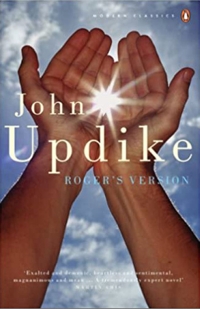
6—Roger’s Version, by John Updike
7—The Inheritance of Loss, by Kiran Desai
8—The Easter Parade, by Richard Yates
9—Paris Trance, by Geoff Dyer

Of Roger’s Version, Chacksfield writes, “John Updike’s The Witches of Eastwick was a big screen smash when it was adapted by director George Miller at the end of the Eighties. As such, it’s surprising that more of his novels haven’t been given the cinematic green light. Roger’s Version would be perfect—taking in middle age disillusionment, the sexual allure of a younger woman and questions pertaining to the existence of God. See, someone make it already!

Edward Sorel paints a devilish portrait of Vidal, Updike, and Roth

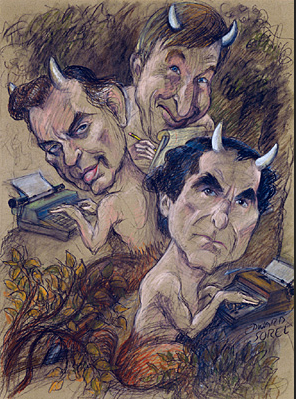
John Updike’s two Time magazine cover portraits are in the National Portrait Gallery, but he’s also depicted on The Laureates of the Lewd, a 1993 pastel by Edward Sorel that was created as an original illustration for a Gentleman’s Quarterly article.

From the National Portrait Gallery, Smithsonian Institution website:
“Sorel’s three roguish satyrs—Gore Vidal, John Updike, and Philip Roth—were gamboling around the literary landscape making mischief and money in the late 1960s. As James Atlas pointed out in his Gentleman’s Quarterly article “The Laureates of the Lewd,” Updike’s 1968 book Couples, followed by Vidal’s Myra Breckinridge and Roth’s Portnoy’s Complaint brought the literary side of the Sexual Revolution to a new level of uncensored candor. American erotic life was out in the open again, in all its complexity and variety. But these books were as much about disillusionment as sex, reflecting the turmoil of generational conflict, a revolution in birth control, a controversial war, protests, assassinations, and race riots. Roth himself noted that if Portnoy’s Complaint had not appeared at the end of a decade ‘marked by blasphemous defiance of authority and loss of faith in the public order, I doubt that a book like mine would have achieved such renown in 1969.'”