The argument over Updike’s literary legacy

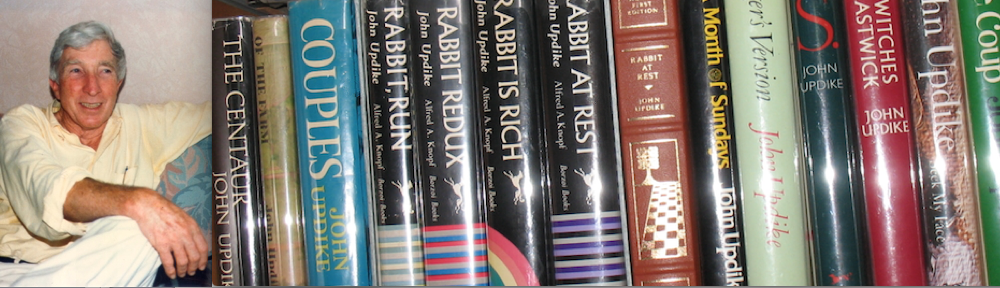
Shortly before The John Updike Society convened in Reading, Pa. for their 6th Biennial Conference, Jonathan Clarke published a piece in City Journal titled “John Updike and the Politics of Literary Reputation.” In it, he assesses the current problem: Updike’s fall from literary grace during a time of “cancel culture” and the #metoo movement.
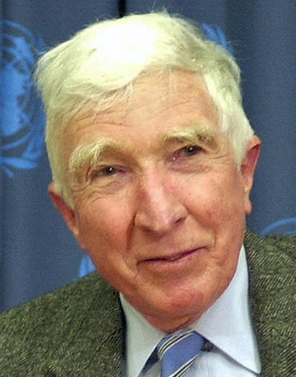
“His is a striking case study in the politics of literary reputation in a time of generational upheaval,” Clarke writes. “Updike has not been a victim of cancel culture. He merely represents the ancien regime.”

Clarke suggests that “Updike’s self-effacing public manner now looks like a tactical error in the long game of literary reputation. Philip Roth and Toni Morrison never tired of singing the song of themselves—and why not, in the end, when the world is so crowded and busy? It’s not that Updike was modest about his talent; it’s simply that he embodied the cultural style we associate with American Protestantism. The vanquishing of that once-dominant mode has contributed to a growing incomprehension of Updike’s work.”

Read the whole article.

Of course, questioning Updike’s status as a writer of stature is nothing new. Those who have followed the critical response to Updike’s work will think immediately of John Aldridge’s early claim that Updike might be a great stylist but that he “has nothing to say.”

In 2014, The New Republic took up the issue again in a debate between English comedian, novelist, and TV personality David Baddiel and literary critic-biographer Jeffrey Meyers: “John Updike: Tedious Suburbanite, Literary Great.” Prompting the debate was the release of the Adam Begley biography, Updike.

Baddiel argues on the “for” side. He begins, “Let’s begin by making one thing clear. John Updike was the greatest writer in English of the last century. Unquestionably, he was the best short story writer; I would argue the best novelist, certainly of the postwar years; one of the very best essayists and in the top 20 poets.” On the negative side, Meyers calls Updike’s New Yorker contributions “made-to-order” and dismisses the magazine entirely as a group of editors and contributors who engaged in “mutual admiration” and “quarrelled over a semicolon but encouraged facile content and ironed out all traces of distinctive style.” Meyers concludes, “Updike, cherishing every scrap of his personal life and striving for mythical significance in his daily doings, fell back on the trivial and tedious details of his small-town childhood.” Ironically, in his biography of Hemingway, Meyers doesn’t take that author to task for mining his own adolescence to create a series of stories set in Michigan, or later stories and novels that also reflect Hemingway’s lived experiences. So maybe it all comes down to a long-debated aesthetic question: what is a suitable subject for art?

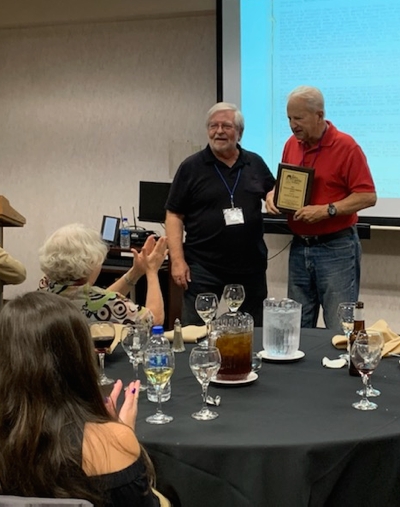
Updike Society honors two Daves and two Jims

At the 6th Biennial John Updike Society Conference in Reading and Shillington, Pa., four members were surprised with awards in appreciation for their longtime service.

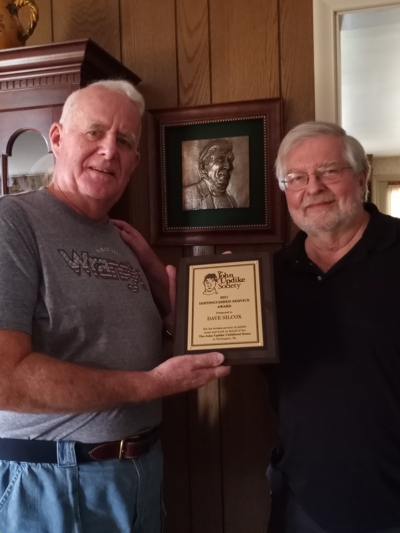
The board members for this 501c3 nonprofit organization voted unanimously to honor David W. Ruoff and Dave Silcox for their invaluable service. Society members often remarked about the “two Daves” that do so much for The John Updike Childhood Home, and with great enthusiasm and energy, so the awards were “a no brainer,” according to society president Jim Plath.

The first distinguished service award was presented back in 2010, and the sixth Distinguished Service Award was given to Ruoff at the Friday, Oct. 1, 2021 conference dinner. The plaque he received praised Ruoff for “extraordinary docent work and other services to The John Updike Childhood Home.” Plath told the audience that from Day 1, when Ruoff began renting the single-story annex to the house that was built by Dr. John Hunter for his practice, he has been giving tours of the house to people who emailed, phoned, or just knocked on his door. Instead of just admitting them in and showing them around, Ruoff would tell them stories of growing up on that same street and having Updike’s father for a teacher. Some he would drive to other Updike sites in Shillington . . . and even Plowville. And for international pilgrims on the Updike trail, Ruoff would often surprise them with local delicacies like ring bologna and Tom Sturgis pretzels—Updike’s favorite.

Numerous people over the years have made donations to the society based on their interaction with Ruoff, who makes no secret of his love for John Updike, the Updike house, and the society dedicated to preserving Updike’s legacy. Of the 1001 things he does for the society, perhaps most appreciated are the many times he’s had to go down to the house in the middle of the night to check to make sure everything was okay. The building has a sensitive alarm system that can be triggered by very little movement, and it sometimes requires someone to interact with police. Ruoff has done all of that and more for too many years to count, Plath said.

The other “Dave” honored with a Distinguished Service Award—Dave Silcox—has an even longer history with the society. In fact, the details of launching the society were “hatched” in his dining room when he hosted Plath, Jim Schiff, and Jack De Bellis after they all spoke at a Reading Library tribute to John Updike. Silcox, who was Updike’s Shillington contact for roughly 10 years, helped Updike with all things, large and small. He’s done the same for the society, including recommending the right people for the right jobs. But perhaps his greatest contribution comes as a result of his being an avid collector. Silcox has been instrumental in developing the museum’s collection of artifacts and letters, acting as a go-between in many cases. Many of the exhibits currently on display would not have been possible without him. Silcox couldn’t attend the dinner, but Plath presented him his plaque at his Shillington home.

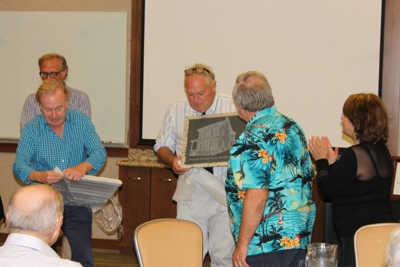
The surprises continued on Saturday night, when Michael Updike and Updike Society board members Sylvie Mathé, Biljana Dojčinović, and Marshall Boswell announced that they had a presentation to make. They told people in attendance that they wanted to recognize the “two Jims” that have done so much to move the society forward: President Jim Plath, for his work coordinating the house restoration and creation of a museum, and Vice-President Jim Schiff, for ten years of service through his editorship of The John Updike Review and the role that he played in securing support from his family foundation to purchase and fund the house.

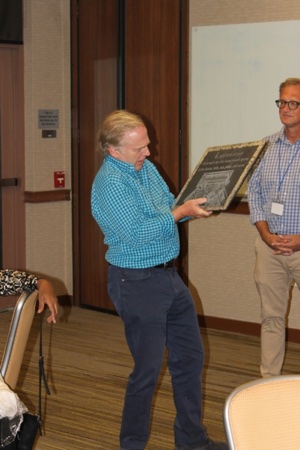
The awards were framed, commissioned chalkboard slate carvings from sculptor Michael Updike, whose works both Jims have long admired. Plath appropriately received a carving of the Updike house, under which is an Updike quote, taken from the last line of “Grandparenting,” the final story in The Maples Stories: “Nobody belongs to us, except in memory.”

Schiff, who had been tapped by the Updike Literary Trust to edit a volume of selected letters, has spent the past five years elbow-deep in letters. For him, Michael Updike carved a letter slot with letters coming through it, featuring another Updike quote: “Once each day this broad mouth spews Love letters, bills, ads, pleas, and news.”

Postponed Updike Society conference finally in the books

Forty-seven members donned masks to see each other again at the 6th John Updike Society Conference in Reading and Shillington, Pa. from Sept. 30-Oct. 3—a conference that had been scheduled for 2020 but postponed because of COVID-19. With pandemic numbers still high, all attendees were required to submit proof of vaccination with their registration materials and urged to wear masks indoors.

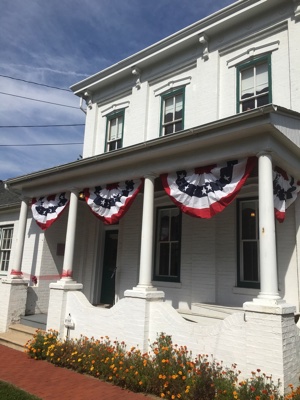
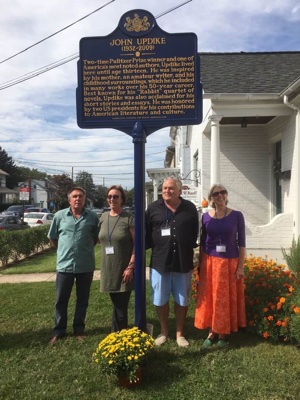
The event was COVID-free, but the pandemic still cast a large shadow. More registrants and speakers than usual were forced to cancel, and any conference hiccups or glitches could be directly traced to COVID. But attendees looked past all that and reveled in each other’s company, happy to witness the dedication of the Pennsylvania Historic Marker and unveiling of the National Registry of Historic Places plaque at the John Updike Childhood Home, 117 Philadelphia Ave., in Shillington. In the end, the consensus was that the conference—the second directed by Alvernia communications professor Sue Guay—was another memorable experience.

Because of COVID, organizers sought to “go small” and decided to spread things out over three locations. Alvernia University hosted the conference for Oct. 1 events and provided all bus transportation. New partner Governor Mifflin School District hosted sessions at the high school just blocks from the Updike house on Oct. 2, and the society stayed at the Courtyard Marriott Reading for morning sessions on Oct. 3. The “vibe” was good, and members who had been eager to attend the grand opening of the John Updike Childhood Home immediately after the marker dedication ceremony were impressed by what they saw . . . and later enjoyed a side-porch reception at the house.

Member Greg EplerWood and local historian George Meiser teamed on Friday to handle the microphone for a bus tour of Berks County Updike sites. At a stop at Weaver’s Orchards and the Plowville farmhouse, Ed Weaver talked about living in the farmhouse now and his memories of growing up with Updike children visiting the area. At a stop at the Plowville church and cemetery, Michael Updike led a group to the Hoyer and Updike family headstones and talked about the marker he made for his father. At a stop at the cemetery high above Shillington, described in an Updike poem, members walked to find some of the headstones mentioned. And of course the bus drove past the new “Rabbit Run” signs posted along the nearby highway.

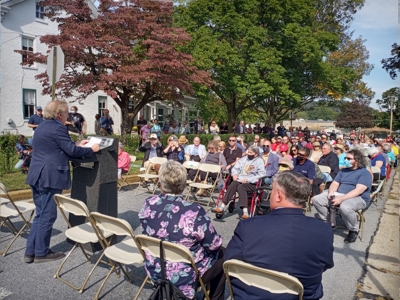
On Saturday, an estimated 200 people turned out for the marker dedication ceremony and grand opening tours of the house. William Lewis spoke as a representative of the Pennsylvania Museum & Historical Commission, telling the crowd that getting “one of these” is no small feat.

Honored guests included State Senator Judy Schwank, Berks County Commissioner Michael Rivera, Shillington Councilman Alec Ernest, Shillington Mayor Andrew Hivner, Shillington Chief of Police Brett Hivner, Gov. Mifflin School District Superintendent Bill McKay and Asst. Superintendent Lisa Templin Hess, local historians Meiser and Myrtle Council, Updike house restoration expert Bob Doerr, former Updike classmates and neighbors Barbara Hartz and Joan Youngerman, and all four of Updike’s children: Elizabeth, David, Michael, and Miranda. As the line formed to have a first look inside the house, member volunteers answered questions and kept the crowd moving along, while remaining members followed John Updike Childhood Home education director Maria Lester on a walking tour of 5-Corners Updike-related sites—including Grace Evangelical Lutheran Church, where the Updikes attended. Pastor Colleen Cox, of Grace Evangelical, offered the marker dedication invocation.

James Schiff, tapped by the Updike Literary Trust to edit a “selected letters” collection, delivered the opening keynote, while award-winning writer Max Apple was the closing keynote speaker.

For more photos, go to the John Updike Society and John Updike Childhood Home Facebook pages.