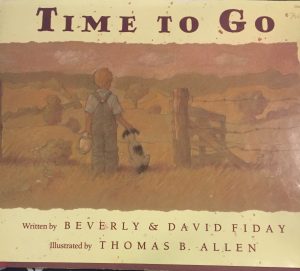
 Author(s): Beverly and David Fiday
Illustrator/Photographer: Thomas B. Allen
Publisher and Year: Gulliver Books and Harcourt Brace Jovanovich in 1990
Number of Pages: 29
Genre: Realistic fiction
Analysis:
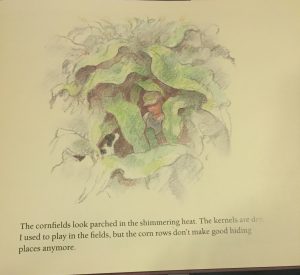
This is a story about the day a young boy is moving out of the farm house he has lived in his whole life, and he is going around the farm remembering what everything used to be like. He talks about how the henhouse use to have chicks and now it is empty, and he talks about how he used to ride on the tractor with his father but it now sits still. In the end, the young boy promises that he will one day move back to the farm, but for the time being he has to go.
This book can act as a window for students to learn about the harsh realities of poverty, who may have never lost something due to economic hardships. For some children, this book may give them hope for better days to come, if they too have lost something due to their family’s financial state. This story is also portraying the hardships that farm owners and families have recently been experiencing due to industrialization and the poor economy. The illustrations in this book are a little blurry and have a dark color scheme, which symbolizes the disappointed and gloomy mood of the story. On each page, the illustrator uses the left side of the page as a depiction of the current, bleak, and run-down conditions of the farm and the right side shows how lively and beautiful the farm once was. The main character is a white male, but is often drawn with his back to the reader and if facing front, he has little to no details on his face, which could be the illustrator’s way of trying to make the main character seem like a relatable character. However, if this is the case, then the illustrator is reiterating that the white male is the norm for society.
When first reading and looking through the book, it seems like a sad story about a child moving but there are deeper messages that the reader can take away from this such as accepting a large change or loss. Overall, this story does a great job of explaining loss and poverty to younger kids. I also believe the message of hope and optimism is also apparent, especially at the end of the book, which shows children that they should never give up hope.
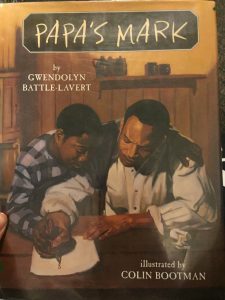 Author(s): Gwendolyn Battle-Lavert
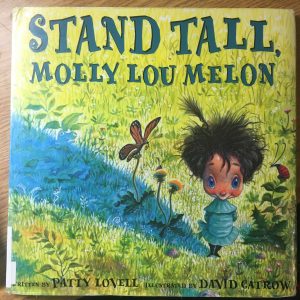 Title: Stand Tall Molly Lou Melon
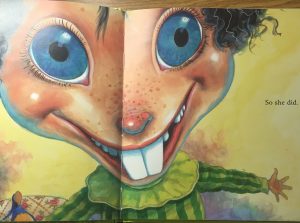 e did” shows the reader that Molly Lou Melon took her grandmother’s advice to heart. The lack of frames in the illustrations allows the reader to connect to Molly Lou Melon on a personal level. Ideologically, this book has many layers. One layer shows that if people stand up to bullies, the bullying stops. Each time Ronald Durkin bullied Molly Lou Melon, she did something that all her other classmates loved. Eventually Ronald Durkin stopped bullying her. The second layer teaches children to love who they are and what they look like. Molly Lou Melon has a lot of self confidence when it comes to doing anything. Molly Lou Melon’s grandmother teaches her that she can accomplish anything if she carries herself with confidence, and that’s just what she does. This book teaches children to value self confidence and individuality.
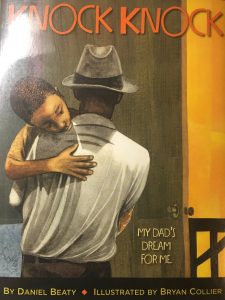 Author: Daniel Beaty
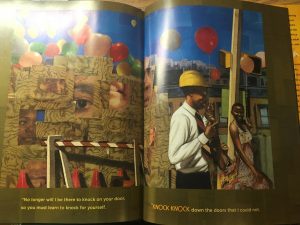 he couldn’t, as well as knock to open the doors to his dreams. This element ties into the game they used to play when he as a child. Ideologically, this book has many important lessons. While it speaks to the children who have lost a parent, it also aims to show hope, the importance of making good decisions, and to not let a past define a future. This book speaks to all children who may have the odds stacked against them. Some people may believe that this book is stereotypical because the father, an African American, is sent to jail. However, I believe that this book is great for all children, regardless of their situation.
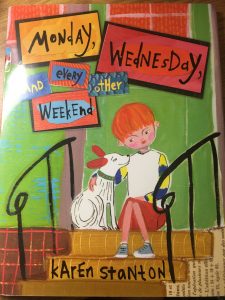 Author: Karen Stanton
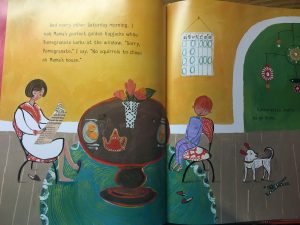 e days that Henry will spend there. The author and illustrator uses Pomegranate to display most of the emotions felt by children during times of divorce within their family. For example, Pomegranate runs away and Henry knows just where to find him. Henry runs to his old house, “the house where we all used to live together,” and finds Pomegranate there. However, she portrays the main character Henry as happy and well adjusted to his new life, but does not underplay the emotions Henry experiences. The author also portrays each parent positively, listing the perks of living in each house. While searching for the dog, the illustrator creates a map that allows the reader to see the town in which Henry lives. The dots on the map show where Henry goes to find his dog. This book handles the feelings surrounding divorce in a positive way. This book can be used by families who are struggling to establish a new way of living after divorce. This book is relatable to a lot of children who experience this shift in family dynamics.
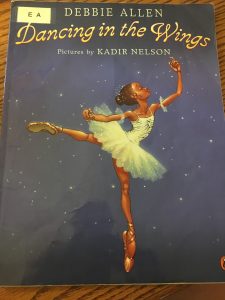 Title: Dancing in the Wings