Title: The New Girl… And Me
Author: Jacqui Robbins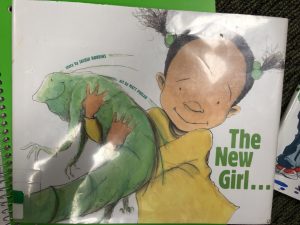
Illustrations: Matt Phelan
Publisher: Anthenum Books for Young Readers, 2006
Number of pages: 32 pages
Tags: Diversity, Emotion, Fiction, Friendship, Picture Book, K-5, Stephanie Prentice
Genre: Realistic Fiction
Analysis
When a new girl, Shakeeta, comes to school most of the girls are excited to show her around except for Mia. Mia remains reserved and watches the interactions between Shakeeta and the rest of her classmates. When Shakeeta is deliberately excluded from the game of soccer by a boy named DJ, Mia strikes up a conversation with Shakeeta as they are sitting together on the bench. The girls soon become good friends.
While the message of the story is positive, some events in the story can be taken in a negative view. For example, when DJ bullies Shakeeta at recess, the rest of the class follows his lead, laughing at his mean comments. This can lead children to believe that it is okay to bully people. In addition, Mia is originally scared of Shakeeta when she first arrives. Lastly, Shakeeta threatens to punch DJ when he makes fun of her name. This can teach children to believe that violence is the answer if they are being bullied. Lastly, Mia is originally scared of Shakeeta when she arrives in the classroom. This can be seen as stereotyping and profiling.
The illustrator does a good job of capturing the true emotions of children with their facial expressions and body language. The pale colors of the pictures and white backgrounds allow for readers to focus on the facial expressions and body language in different situations. Before Mia and Shakeeta have their first interaction with each other, they are deliberately placed on the opposite sides of the double page picture. This deliberate placement symbolizes the idea that they are not yet friends. On the next page, Mia asks Shakeeta about her iguana and they begin a lively conversation. As the girls dive deeper into their conversation, they move closer to each other on the bench, symbolizing their growing friendship. Mia’s first attempts to start a conversation, asking about Shakeeta’s iguana, can give students who are shy like Mia ideas on how to start a conversation with a new classmate. In addition, the illustrations bring in anelement of multiculturism without it being the main focus. This allows a diverse population of students see themselves in the story. The interracial friendship also adds an example of tolerance and acceptance.
This book can be used if a teacher is expecting a new student. It can open discussions of how to make a new student feel welcomed, but it is important to remember how the book can be viewed in a negative way while having discussions about this book. 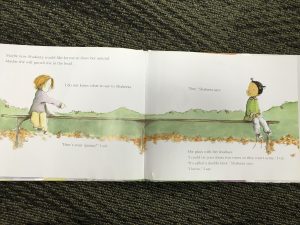
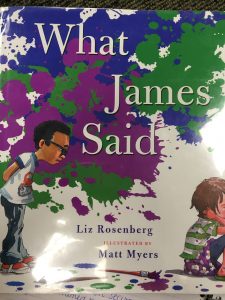
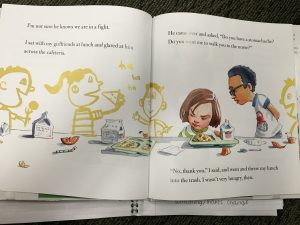 Perceptually, the images are very bright and enticing for the children. The use of faded watercolor pictures, such as in the picture below, allows the focus to remain on the narrator and James. The use of large text in certain areas allows the reader to recognize which points should be emphasized while reading the story aloud. Some of the illustrations resemble the ones that children would draw, making it very relatable for the readers. The layout of the text in relation to the pictures also allows the readers to follow the sequence very well, especially when the author is describing how each classmate heard the rumor about the narrator. Ideologically, this book shows the dangers of gossip and rumors and the effects they have on friendships. The misunderstanding during the “game of telephone” leads to the narrator’s feelings getting hurt by her best friend. Children who read this book are able to see the damage done by gossip and rumors. The ending of the book allows readers to see some things can be misunderstood and taken out of proportion. It also emphasizes the idea of friendship and its importance. The two sided story, the narrator and James’ actions, also show the different emotions when two friends are fighting. This book also gives an example of how children can solve problems with their friends. However, the way in which the narrator reacts is not recommended for children.
![IMG_9614 [405971]](https://blogs.iwu.edu/lrbmt2016/files/2016/05/IMG_9614-405971-300x220.jpg)
![IMG_9615 [405972]](https://blogs.iwu.edu/lrbmt2016/files/2016/05/IMG_9615-405972-300x175.jpg)
![IMG_9616 [405973]](https://blogs.iwu.edu/lrbmt2016/files/2016/05/IMG_9616-405973-234x300.jpg)
![IMG_9617 [405974]](https://blogs.iwu.edu/lrbmt2016/files/2016/05/IMG_9617-405974-220x300.jpg)
![IMG_9618 [405975]](https://blogs.iwu.edu/lrbmt2016/files/2016/05/IMG_9618-405975-217x300.jpg)
![IMG_9619 [405976]](https://blogs.iwu.edu/lrbmt2016/files/2016/05/IMG_9619-405976-178x300.jpg) Analysis: “The Red Tree” is about a young girl who feels trapped in a world of—what seems to be—never-ending sadness. It is not until she realizes that she has to take the good with the bad that her “red tree” grows. This book works well as a mirror for a lot of young girls who feel that they are trapped in a bubble of sadness or sorrow. In the beginning, the young girl feels helpless and almost like she has no power over her life. By the end of the book, she is rejuvenated and hopeful. The images of darkness and confusion seem to be an accurate representation of what sadness would look like if it was tangible.
Analysis: “The Red Tree” is about a young girl who feels trapped in a world of—what seems to be—never-ending sadness. It is not until she realizes that she has to take the good with the bad that her “red tree” grows. This book works well as a mirror for a lot of young girls who feel that they are trapped in a bubble of sadness or sorrow. In the beginning, the young girl feels helpless and almost like she has no power over her life. By the end of the book, she is rejuvenated and hopeful. The images of darkness and confusion seem to be an accurate representation of what sadness would look like if it was tangible.![IMG_9620 [405977]](https://blogs.iwu.edu/lrbmt2016/files/2016/05/IMG_9620-405977-300x238.jpg)
![IMG_9621 [405978]](https://blogs.iwu.edu/lrbmt2016/files/2016/05/IMG_9621-405978-300x238.jpg)
![IMG_9622 [405979]](https://blogs.iwu.edu/lrbmt2016/files/2016/05/IMG_9622-405979-222x300.jpg) Author/Illustrator: Oliver Jeffers
Author/Illustrator: Oliver Jeffers![IMG_9623 [405980]](https://blogs.iwu.edu/lrbmt2016/files/2016/05/IMG_9623-405980-169x300.jpg)
![IMG_9611 [405969]](https://blogs.iwu.edu/lrbmt2016/files/2016/05/IMG_9611-405969-300x210.jpg) Authors: Phillip and Hannah Hoose
Authors: Phillip and Hannah Hoose![IMG_9613 [405970]](https://blogs.iwu.edu/lrbmt2016/files/2016/05/IMG_9613-405970-300x148.jpg) Analysis:“Hey, Little Ant” is a story about a child that contemplates whether or not he should spare an ant’s life. After putting himself in the ant’s shoes, the boy sees that maybe he shouldn’t squish the bug after all. This text could primarily work as a window. It is common in America to carelessly step on small bugs, such as ants. This book could give us a glimpse of the bug’s perspective. This book also allows children to step out of the egocentric world that they live in, where everything is “I view it this way, so that’s how it must be.” In the story, the power somewhat shifts from the big and mighty kid to the ant, who ultimately could’ve convinced the boy not to step on him. When the ant tells the kid to imagine that he was the ant and the ant the kid, the boy starts to feel for the ant.
Analysis:“Hey, Little Ant” is a story about a child that contemplates whether or not he should spare an ant’s life. After putting himself in the ant’s shoes, the boy sees that maybe he shouldn’t squish the bug after all. This text could primarily work as a window. It is common in America to carelessly step on small bugs, such as ants. This book could give us a glimpse of the bug’s perspective. This book also allows children to step out of the egocentric world that they live in, where everything is “I view it this way, so that’s how it must be.” In the story, the power somewhat shifts from the big and mighty kid to the ant, who ultimately could’ve convinced the boy not to step on him. When the ant tells the kid to imagine that he was the ant and the ant the kid, the boy starts to feel for the ant.