Blogger is heavy into Updike after reading Begley’s bio

Yesterday a blogger responded to Heather Havrilesky’s New York Times Magazine piece on “794 Ways in Which BuzzFeed Reminds us of Impending Death” on PottedReads, “a blog about reading and writing.”

He begins, “Having rediscovered John Updike, never having deeply read his work, until now, my late middle age, after reading Adam Begley’s new biography, Updike, I don’t seem to be able to get enough of reading his work. I can’t say for certain why. Maybe it’s the way Begley wrote Updike by braiding his work with his life that made me interested in reading him again. Maybe because Updike was a writer, first and foremost, something I’ve always wanted, which must have made his loved ones suffer. My curiosity was renewed. Updike wrote about his experience without hardly any boundaries between his life and his fiction. That’s quite a feat that some think was a trick of style, and not art, which it truly is. It also occurred to me that I wasn’t ready to read Updike until now. I probably avoided him not unlike I avoid myself by usually doing what I have to do without doing what I need to do. Updike’s not a  chore, but a pleasure with a price, not unlike most good things. Yes, he created a crisis of confidence that’s anxious and distracting by making us focus on what’s important. Not pleasing others at the expense of ourselves, knowing the difference between fantasy and reality, and moving forward accordingly.”

He adds, “The beauty of Havrilesky’s essay lies not only in making me understand BuzzFeed, using Updike to do it, but by incorporating Updike’s fiction into herself so that she could tell us about how they’re connected and why. By writing this essay she made Updike hers, and translated her appreciation of his work to mine. I can’t tell where Updike finished, and Havrilesky starts. I envy her that feat. It’s Eucharistic, and what reading’s all about. Changing you from leading an everyday life into a liturgical one.

“Updike knew that about reading, and writing. That’s why he could write hard about his life. If he wrote soft, his fiction would be faithless. Instead, it’s not. Updike’s stories and novels are a modern-day spiritual reckoning. His readers don’t know where his life ends and his fiction begins. It’s intimidating because he writes so well, and painful because it’s true. It takes a mature personality to understand what Updike’s saying in such a unifying way, that you want to deny it, dismiss him, and turn away. If we don’t like it then that’s tough, and probably another reason why some critics have mistakenly judged Updike as a self-absorbed show off. He’s not. Updike aimed for transubstantiation . . . His mystery isn’t that he could turn bread and wine into the body and blood of Christ, but that he could turn our everyday lives into invincible prose, that we could own for ourselves.”

Read the full article, “Oh, what a feeling, Toyota!”
Begley tweets Gertrude and Claudius mini-review

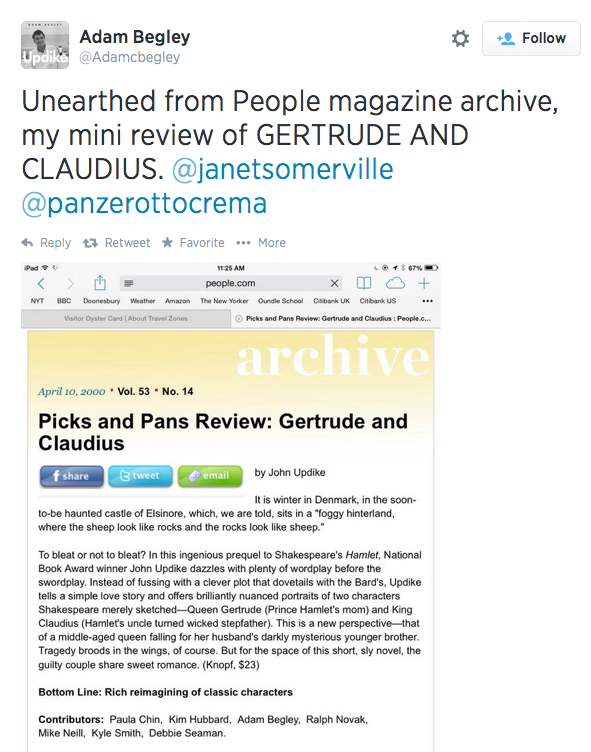
Screen Shot 2014-07-13 at 9.43.03 AMIf you’re following Adam Begley on Twitter you already saw this, but today the Updike biographer tweeted his recently unearthed mini-review of Updike’s Gertrude and Claudius from Vol. 53, No. 14 (April 10, 2000) titled “Picks and Pans Review: Gertrude and Claudius”:

“It is winter in Denmark, in the soon-to-be-haunted castle of Elsinore, which, we are told, sits in a “foggy hinterland, where the sheep look like rocks and the rocks look like sheep.

“To Bleat or not to bleat? In this ingenious prequel to Shakespeare’s Hamlet, National Book Award winner John Updike dazzles with plenty of wordplay before the swordplay. Instead of fussing with a clever plot that dovetails with the Bard’s, Updike tells a simple love story and offers brilliantly nuanced portraits of two characters Shakespeare merely sketched—Queen Gertrude (Prince Hamlet’s mom) and King Claudius (Hamlet’s uncle turned wicked stepfather). This is a new perspective—that of a middle-aged queen falling for her husband’s darkly mysterious younger brother. Tragedy broods in the wings, of course. But for the space of this short, sly novel, the guilty couple share sweet romance. (Knopf, $23)

Bottom Line: Rich remaining of classic characters

Contributors: Paula Chin, Kim Hubbard, Adam Begley, Ralph Novak, Mike Neill, Kyle Smith, Debbie Seaman.


Updike bio makes another recommended list

Before Adam Begley’s biography of John Updike, could Updike fans have imagined how many mid-year best-of reading lists there are?

Yet another one emerges—this time from The Guardian, offering a round-up of writers and staffers with their picks for summer holiday reading. And Mark Lawson, a Guardian columnist and theater critic, selected Updike as one of his best books.

“Two long-awaited lives that I couldn’t wait until summer to read were Updike by Adam Begley (Harper) – which gives equal weight to my favourite novelist’s life and books and the often eye-watering overlaps between them – and Roy Jenkins: A Well-Rounded Life by John Campbell (Jonathan Cape), which achieves an equally impressive balance between policies and peccadillos. Two works that I will read in the summer months are: John Carey’s memoir The Unexpected Professor: An Oxford Life in Books (Faber) and Philip Hensher’s novel The Emperor Waltz, which, from flicking, seems to continue his bold experiments with form.”

“Best holiday reads 2014 – top authors recommend their favourites”

Blogger cites Updike’s small, razor-sharp truths

The blog Short Story Magic Tricks is dedicated to helping would-be writers learn “tricks” from established writers. By the site’s own description, “At Short Story Magic Tricks we attempt to break down and analyze what we like about each story. . . . To that end, each post will highlight a different short story, featuring a favorite magic trick employed by its author.”

The featured Updike short story posted thus far is “Here Come the Maples,” and the “magic trick” is Updike’s capacity for “filling the story with small, razor-sharp truths.”

“In the hands of a lesser writer, this story could fall apart as a maudlin diary entry. But Updike sprinkles in all these little moments that make the reader feel the feelings of the protagonist. These details are so spot-on, the reader can’t help but relate and say, ‘Oh, yes, that’s it exactly. That’s how it was for me once too.’ The story is no longer a thinly veiled Updike autobiography; it stands in for the reader’s own personal history as well. And that’s quite a trick on Updike’s part.”

Read the full entry: “‘Here Come The Maples’ by John Updike”

Blogger likes Updike, hates Rabbit

Screen Shot 2014-07-11 at 9.23.09 AMYesterday blogger Kimberly Campbell Moore (Eleven and a Half Years of Books) posted an entry titled “Rabbit At Rest—John Updike” in which she reacts to the fourth book in the Rabbit tetralogy and offers links to her responses to the other Rabbit novels.

She begins, “First off, for those of you here to read more of my Rabbit rantings, this might be a slightly disappointing blog post. While I was still not overly fond of Rabbit, something about him had softened so something about myself softened as well. Once that did, I was able to really, finally, appreciate why people rave about the Rabbit books. Updike is amazing in Rabbit at Rest. I’m not going to go back and try to read the others with this realization, as I don’t care to spend any more time with Rabbit Angstrom. But! I can see better now the reasons.

So, this post will probably be more about Updike and his writing than my hatred for that asshole, Rabbit Angstrom.”

She concludes, “Try reading the first one, if you can get past Rabbit’s asshole status in that one, then maybe you can stick it out to this one and end the series with the best book of the quartet in my opinion.”

Somewhere in between, she admits, “I actually found this book compelling and very readable” . . . despite her feelings about Rabbit. If that isn’t a testament to a great writer, I don’t know what is.

Playboy writer tells of Updike refusal

Screen Shot 2014-07-11 at 9.16.14 AMThe August 2014 issue of Harper’s Magazine contains this letter from writer Lawrence Grobel telling of Updike’s refusal to grant him an interview for Playboy:

Rabbit, Refuse

In his review of Adam Begley’s biography of John Updike [“Agreeable Angstrom,” June], Jonathan Dee writes that Updike’s “life consisted of saying yes to everything, and of questioning nothing.” I read that with amusement, remembering how I tried, for years, to get Updike to agree to a Playboy interview with me. I corresponded with him about it and went to see him when he gave a talk at the Los Angeles Public Library. I had previously done interviews with James A. Michener, Elmore Leonard, Joyce Carol Oates, and Saul Bellow, and I thought just mentioning these writers would clinch the deal, but when I said to Updike, “Saul Bellow agreed,” he just looked at me and smiled wryly. “Yes, I read it,” he said.

Lawrence Grobel
Los Angeles

Stage version of Roger’s Version lauded

In a review that was published in The Tennessean on May 31, 2014, Amy Stumpfl wrote that the world premiere of the Blackbird Theater stage adaptation of Roger’s Version “captures Updike’s intoxicating brand of intellectualism and moral ambiguity with aplomb.

“Written and directed by Blackbird Artistic Director Wes Driver, this engrossing adaptation pits a self-satisfied divinity professor named Roger Lambert against Dale Kohler—an evangelical grad student who believes he can prove God’s existence through computer science. . . .

“Fairly heady stuff, to be sure. But don’t be intimidated by all the intellectual wordplay. Like most of Updike’s work, ‘Roger’s Version’ is firmly rooted in the physical world, taking on everyday issues of professional rivalry, resentment, sexual urges and marital discord.”

Here’s the full review. Below are photos of David Compton as Roger and Kristopher Wente as Dale, Wente with Corrie Miller (Esther Lambert) and Amanda Card, “the unlikely object of Roger’s guilty lust.” The photos come courtesy of Greg Greene, Managing Director for the Blackbird Theater.   Continue reading

TLS letter writer responds to the Begley bio

Dale Salwak, who teaches in the English department at Citrus College in Glendora, California, wrote a letter to the Times Literary Supplement editor that was published on June 27, 2014:

Updike’s real self

Sir, – Near the end of his review of Adam Begley’s biography of John Updike (June 13), James Campbell wonders how Updike would have reacted “to seeing the ‘sadly prurient’ details of his moral and mortal failings laid out on page after page so soon after his death in 2009”. In the foreword to his Self-Consciousness: Memoirs (1989) Updike answers that question. He would be repulsed: “to take my life, my lode of ore and heap of memories, from me!” And in a later piece, “The Man Within”, published in the New Yorker (June 26 and July 3, 1995), he adds: “The trouble with literary biographies, perhaps, is that they mainly testify to the long worldly corruption of a life, as documented deeds and days and disappointments pile up, and cannot convey the unearthly human innocence that attends, in the perpetual present tense of living, the self that seems the real one”.

DALE SALWAK
Department of English, Citrus College, 1000 West Foothill Boulevard, Glendora, California 91741.

On writers and their would-be-writer moms

Today the National Post posted a story by “Barbara Kay: We all know about John Updike. But what about his mother?” 

In it, she talks about her friend, David Siegel, an “evolving short-story writer” and his experience taking an Iowa Writer’s Workshop summer class from Robert Anthony Siegel in which a classmate was Siegel’s own 75-year-old mother, and that leads her to consider the relationship that Updike had with his own mother, also an aspiring writer who was published late in life after her son’s success, but who worked at becoming a writer when he was still a young boy.

“Perhaps Linda’s greatest gift to her son was her unconditional respect for the artist’s obligation to speak his own truth without regard to the feelings of those he writes about,” Kay writes.

Theater critic bristles at the maleness of Updike’s work

In reviewing a West End revival of Arthur Miller’s witch-hunt play, The Crucible, critic Ingrid D. Rowland bristled at another critic’s notation that “there were more women than men in the Old Vic audience for The Crucible.”

That led her to take exception with Updike’s “irksome insistence on calling women’s sitting bones ‘haunches'” and to name him, along with Norman Mailer, Saul Bellow, and Philip Roth, as standard bearers for the “apogee” of novelists whose works command a largely male readership. Here’s what she wrote in response to fellow theater critic Quentin Letts:

“Evidently, a large female spectatorship by definition diminishes the importance of the performance, just as female readership is still thought, in many quarters, to diminish the importance of books more than a generation after the apogee of Mailer, Bellow, Roth, and Updike (consider the last of these writers’ irksome insistence on calling women’s sitting bones “haunches”)—or their Britannic counterparts, Amis (Kingsley) and Fleming (Ian). Yaël Farber, The Crucible’s director, is guilty, for her part, not only of that feminine specialty, self-indulgence (so often termed “artistic license” in the hands of male counterparts, beginning with Paolo Veronese when he appeared before the Venetian Inquisition in 1573 in an unsuccessful attempt to defend the presence of two drunken Germans and a dog in a painting of The Last Supper), but indeed of elitist self-indulgence, keeping the people from their commuter trains in heedless pursuit of her artistic vision.”

“The Witches of West End”