David Updike begins Alvernia JU Scholar-in-Residency

Screen Shot 2014-08-13 at 9.49.57 AMAlvernia University announced in a press release that David Updike has officially accepted a position as the next John Updike Scholar in Residence at Alvernia, starting in August 2014.

As Alvernia states, “[David] Updike’s first duty as Scholar in Residence comes as the John Updike Society Conference returns to its original location at Alvernia University, October 2-4 [it’s 1-4, actually], 2014. Updike will talk about his father’s life ‘in pictures and prose’ during the conference’s only session open to the public:  Oct. 2, 2 p.m., in Francis Hall Theater.”

David Updike is the author of the short story collections Old Girlfriends and Out on the Marsh, as well as an illustrated quartet for young readers: A Winter Journey, An Autumn Tale, A Spring Story, and The Sounds of Summer. His short stories, as the release points out, have been published in The New Yorker, making him the third in his family to see his work appear in the magazine—the others, of course, being his father, John Updike, and paternal grandmother, Linda Hoyer Updike, who placed 10 stories in the prestigious magazine.

Here is the story on Updike’s appointment, as reported by WN.com.

Australian e-journal publishes opinion on Updike

ON LINE opinion, Australia’s e-journal of social and political debate, today published a piece on “Updike!”by Peter Sellick, who begins by saying that Updike’s death “precipitated a dilemma” in his household because for so many years his wife would buy him the latest Updike book for Christmas. But he quickly turns to observation, some of it based on his rereading of the LOA short stories and the Begley bio:

“Updike served up his immediate experience; all was grist for his mill. So much so that after telling his children that he was leaving the family of his first marriage, a painful episode for all, he published, soon after, an episode in the Maple stories, ‘Separating’ that was drawn with little disguise from the event. One wonders at the facility of a writer who could do such painful things to his family and then serve it all up in a short story to the New Yorker for a fairly large amount of money. One wonders about his facility for detachment! For Updike all of experience was fodder for his literature. He could be called the Vermeer (one of Updike’s favorite artists) of American letters, so intent was he on the gravity and beauty of the everyday. The glory of the small town of Shillington where he grew up was often celebrated in his short stories as if it were the centre of the universe.”   Continue reading

Begley: Updike’s last sin was writing

Adam Begley, in Scotland for the Edinburgh International Book Festival, gave an interview to Alan Taylor of The Herald that was assigned the somewhat titillating headline “The final sin of John Updike.”

In the long interview, which was published in the Saturday, August 9 online version, Begley covers a lot of ground and concludes that Updike had given up all but one of his vices—smoking, drinking, sleeping around. “‘It’s true, his last sin was writing,’ says Adam Begley. ‘This compulsion to take other people’s lives and use them for his own ends. Other than that, he had given up naughtiness.'”

Says Begley, “I didn’t think Updike’s biography was difficult to write because my training is in literary criticism and my inclination is towards literary criticism. What Updike offers to me is much more valuable that [Norman Mailer-esque] derring-do or political campaigns; punching one’s colleagues in the faces or biting their ears or stabbing your wife. What he did is write books that drew me to them like a magnet and stories that I could turn to.”

“The character who emerges from Begley’s book is complex and fascinating and, to a degree, elusive,” Taylor writes. “There was, for example, the public figure, who could turn on the charm as one might a light. He was studiedly polite and played the part of literary gent almost to the point of parody. By nature, Updike was also careful and cautious and conservative. For much of his life, moreover, he had a stammer and was plagued with psoriasis. And, having grown up as a single child in a family that always had to count pennies, he could never fall back on privilege.

“But there was also another side to him, observes Begley, that of the daredevil and the practical joker. As a teenager he would woo his pals with stunts, jumping on the running board of his parents’ old black Buick and steering it downhill through the open window. He was prone to tomfoolery, as if determined to draw attention to himself. He liked to leap over parking meters and would through himself downstairs as if he were part of a slapstick act. ‘So there is that contradiction in him,’ says Begley, ‘that is elemental in him and that biographers like and which they pretend they can explain, but can’t.”

Missing memes? Don’t forget to LIKE The John Updike Society on Facebook

Every story that appears on The John Updike Society website/blog is also posted on the Society’s Facebook page, but don’t forget to “Like” JUS on Facebook. Otherwise you’ll miss out on the John Updike quote memes posted there from time to time that are not added to this website. Why? Because Facebook is a lighter, more visually oriented medium.

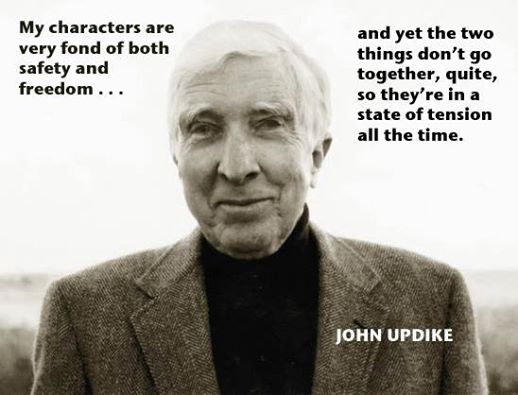
The top three favorites thus far? “My characters are very fond of both safety and freedom . . . and yet the two things don’t go together, quite, so they’re in a state of tension all the time.” That meme circulated to 31,520 people.

1544420_10152362622329273_2003041918_n

Continue reading

The Witches of Eastwick makes 20 Great Movie Speeches list

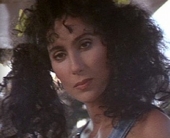
CherWe Got This Covered put out a list called “Ladies And Gentlemen: 20 Great Movie Speeches,” and compiler Sarah Myles ranked the speech by Cher-as-Alexandra in the 1987 film The Witches of Eastwick #5 on the list.

“There is a vast amount of great dialogue in the script for this horror-comedy—which is Michael Cristofer’s adaptation of the John Updike source novel. Three very different, single female friends unwitting summon a mysterious man to their small Rhode Island town, and all manner of mayhem ensues. Alexandra—played by Oscar winner Cher—is perhaps the more rational of the three women and, when Darryl Van Horne (the ridiculously good Jack Nicholson) begins to cause pain and injury, she goes to confront him in an effort to save her friends—prompting a blistering argument.

“‘Well, you know, I have to admit that I appreciate your directness, Darryl, and I will try to be as direct and honest with you as I possibly can be. I think—no, I am positive—that you are the most unattractive man I have ever met in my entire life. You know in the short time we’ve been together you have demonstrated every loathsome characteristic of the male personality and even discovered a few new ones. You are physically repulsive, intellectually retarded, you’re morally reprehensible, vulgar, insensitive, selfish, stupid, you have no taste, a lousy sense of humor, and you smell. You’re not even interesting enough to make me sick.’

“It is—quite simply—one of the most fabulous responses to a ‘bad guy’ in all of modern cinema. Who hasn’t wanted to dismiss an unpleasant soul using this combination of accurately observed insults? This speech is made all the more delicious by Cher’s almost nonchalant delivery—it’s as if she is attempting to swat an annoying fly which is proving itself to be nothing more than a fleeting distraction. The fact that she failed to consider the otherworldly powers at his disposal is almost irrelevant. For that one shining moment, Alexandra Medford is the master of of her own, beautifully articulated universe.”

Here’s the scene on YouTube.

Of course for fans of the novel, it’s Van Horne’s sermon that’s the rhetorical show-stopper.

A Book & A Read recommends The Coup and a Saharan Martini

Screen Shot 2014-08-07 at 1.21.03 PMYou’ve heard of dinner and a movie? Well, why not a book and a drink? That’s what led Toronto Star‘s Bruce DeMara to come up with a book and a compatible drink every Thursday this summer.

“Reading can be thirsty work. And so, every Thursday this summer, to acknowledge that prose can inspire our minds as well as what’s in our glass, we recommend a weekend read—a book that elicits the heat, the smell, the feel of summer—and a recipe for the perfect drink accompaniment.”

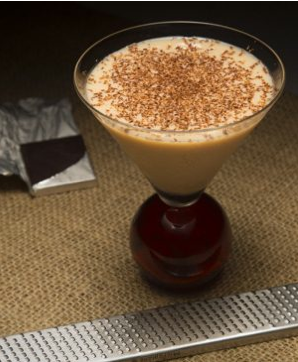
His recommendation for Thursday, August 7, 2014? John Updike’s 1978 satirical novel The Coup, set in the fictional sub-Saharan African nation of Kush, and a Saharan Martini, made from Amarula cream liquor and garnished with dark chocolate shavings. The recipe is included in the article, “A Book & A Read: The Coup’s desert setting will leave you parched.”

“This is a novel that will have you feeling parched from the opening pages,” DeMara writes. “Updike’s description of desiccated trees and animals, sun-blasted rock, blistering desert and withering heat is relentless. Although the protagonist is a devout Muslim and therefore an abstainer, the novel makes passing reference to Russian vodka, palm wine, guinea-corn beer and Kaikai.”

And why is it worth the read?

“As grim as the setting may be, the novel has much to recommend it, including an array of interesting characters—among them Ellellou’s four very different wives—and a comically absurdist tone. There’s an archly satirical streak throughout, skewering colonialism, consumerism, religion and Cold War geopolitics. Updike’s prose is, as always, challenging in its detail but evocative and rewarding.”

Pictured is the Saharan Martini, photo by Chris So.


In a new interview, Garrison Keillor cites Updike as a hero

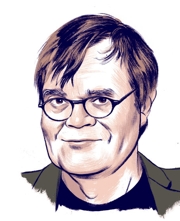
KeillorGarrison Keillor, the American humorist and writer best known for hosting “A Prairie Home Companion,” has featured poems by John Updike on his website, so it’s no surprise that he thinks highly of Updike.

In an interview published today, August 7, in the New York Times Sunday Book Review, Keillor was asked about his literary heroes:

“John Updike for his vast ambition and the Lutheran diligence that realized it. Edward Hoagland for his style and bravery and love of the world. May Swenson, again for bravery, independence, also wit. A.J. Liebling and Roy Blount Jr. as reporters who wrote literature: You can read them over and over and over. P.G. Wodehouse for sheer elegance and invention. Robery Bly, a wonderful poet into his 80s, a great old troublemaker.”

The illustration is by Jillian Tamaki, and you can read the whole interview here:  “Garrison Keillor: By the Book”


Ecenbarger updates Philly on Updike house progress

Screen Shot 2014-08-07 at 7.00.33 AMThis morning The Philadelphia Inquirer published a story on The John Updike Childhood Home—“Updike’s home to open as museum”—that was written by William Ecenbarger. If the name sounds familiar, perhaps you read about Ecenbarger’s tour of Updike country with Updike himself, with which Adam Begley chose to open the first chapter of his recently published biography. This time there was no drive, and Ecenbarger’s tour guide was curator Maria Mogford, who led him through the house that’s still in the “deconstruction” phase as it moves closer to becoming a finished product as one of America’s literary landmarks.

“When it opens, probably next year, the site will join childhood residences-turned-museums of other famed American authors,” Ecenbarger writes. “Mark Twain is forever linked to Hannibal, Mo.; William Faulkner to Oxford, Miss.; Emily Dickinson to Amherst, Mass. But in one respect, the building at 117 Philadelphia Ave. will stand out.

“More than any other American writer, Updike made his first home an ongoing setting, in intricate detail, for his 61 volumes of novels, short stories, poems, and essays. The house, where he lived with his parents and a grandparent and where he said his ‘artistic eggs were hatched,’ was also where many of his last stories are set.

“‘He said if he ever had a ghost, it would haunt this house,’ says Mogford, an English professor at nearby Albright College.”

But don’t let that stop you. Society president James Plath slept in the house on one visit and can vouch for the fact that it remains as happy a place as it was in Updike’s memory. Though the house isn’t finished yet, Mogford will still take people through it on private tours if the requested day and time mesh with her schedule. Hardhats are not required. Contact her via email at mmogford@albright.edu.


New England Historical Society on Updike

John-Updike-224x300The New England Historical Society recently posted an item about Ipswich’s “former, famous novelist resident” and the stir that Couples caused after it was published.

“Updike, who was himself a former columnist to the local newspaper, tried his hand at damage control, sending a letter to the newspaper flatly denying that Tarbox was Ipswich. But no one was buying it. . . .

“In the end, Updike found it convenient to head off on a European trip and move out of Ipswich altogether to the tonier environs of Beverly Farms. But he would continue to visit Ipswich throughout his life, lunching at one of the downtown clubs and avoiding the scowls from some residents that would follow him until he died.”

Here’s the full article, “John Updike in Couples Titillated America, Infuriated his Neighbors”