Berks-Mont promotes David Updike conference talk

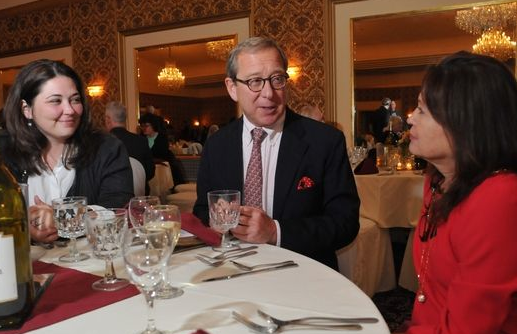
As with the previous John Updike Society conference hosted by Alvernia, plenary sessions that would appeal to local residents are “open,” and Berks-Mont recently posted a story on David Updike’s upcoming conference talk at 2 p.m. on Thursday, October 2 in Francis Hall Theater.

“There will be family pictures and some artwork, along with my own narrative and excerpts from my father’s writing as well as his mother, Linda Grace Hoyer, who was born and died in Plowville and published two collections of short stories,” Updike said.

Updike also mentioned The John Updike Childhood Home, which the society owns and is in the process of turning it into a museum and literary center.

“I am happy his home is being turned into a museum. I hope it has a useful life beyond the occasional tourists, something like a writing center for local students manned by college students,” Updike said.

The details of management will be decided by the board, which consists of JUS board members plus the curator and a representative of the Updike family—with Elizabeth Cobblah Updike serving the first term. Right now, the house is still a “deconstruction” zone. Then comes the construction, and finally decisions pertaining to the running of the museum and extent to which the house can be used as a literary center.

But the general consensus is that the house should indeed be used by writers and students. Before the society board voted to establish a board to run the house, they approved remodeling of the annex to include an education room, where classes could meet, lectures could be given, and a video on Updike in Pennsylvania could be shown on a TV monitor.

“David Updike will share photos, narrative and excerpts at upcoming conference”


Final program set for 3rd Updike conference

On October 1-4, 71 members of The John Updike Society will convene in Reading, Pa., for the Third Biennial John Updike Society Conference. The Friday Night at the (Reading Public) Museum reception will be held at the museum and sponsored by Albright College. The Wednesday night reception, the membership meeting, and the closing keynote address by Adam Begley will be held at the Abraham Lincoln Hotel, the conference hotel. All other sessions will be at Alvernia University, host to this year’s conference.

Program

For the conference, members are traveling from eight different countries and 20 states.

Olinger Stories republished, reviewed

Screen Shot 2014-09-24 at 7.25.06 AMApart from the poem “Ex-Basketball Player” and short stories like “A&P,” Updike isn’t taught much in American high schools because of the language and sexual content that’s sprinkled liberally throughout his Rabbit series and other classics. But that may change with the republication of Olinger Stories by Everyman’s Pocket Classics, which will be released on October 7, 2014.

Ironically, we received a review copy smack in in the middle of Banned Books Week, and the handsome, bargain-priced ($16 SRP) hardcover with Updike’s hand-picked stories gives high school teachers a classroom-worthy book—one that Updike himself considered “his signature collection, the volume of short stories that communicated his freshest impressions of life as it came to him in hardscrabble Berks County, Pennsylvania, in the 1930s and ‘40s,” as a publisher’s note reminds us. Updike once told an interviewer, “If I had to give anybody one book of me, it would be the Olinger Stories.”

There’s a delightful world of language, of place, and of finding one’s place in the world to discover for readers new to Updike. But this new volume may work for scholars as well, because, as the publisher’s note continues, the “text of the stories reprinted here are those that Updike published in The Early Stories, which he deemed definitive,” along with a foreword to the original 1964 Vintage paperback “altered only to incorporate a few small changes made by the author after its initial publication.”

Included, in order, are the stories “You’ll Never Know, Dear, How Much I Love You,” “The Alligators” (which is already being taught in some high schools), “Pigeon Feathers” (also being taught), “Friends from Philadelphia,” “A Sense of Shelter,” “Flight,” “The Happiest I’ve Been,” “The Persistence of Desire,” “The Blessed Man of Boston, My Grandmother’s Thimble, and Fanning Island,” “Packed Dirt, Churchgoing, a Dying Cat, a Traded Car,” and “In Football Season.” Right now, Amazon.com is selling the collection for $10.12.   Continue reading

Rabbit Is Raunchy? Parents say it’s not for middle school

Screen Shot 2014-09-18 at 10.58.28 PMIn Rancho Cucamonga, which sounds like a made-up place, “Parents were shocked when they discovered a novel with erotic dialogue was being checked out and read by their children in their middle school’s library,” according to a CBS Los Angeles report.

The novel was Rabbit Is Rich, and the reaction is no surprise. Even Updike scholars would probably tell their pre-teens to hold off on that one until high school or college.

The principal removed the book from the school’s library. “After the investigation, if it is determined that the book had been checked out by other students, those students’ parents will be notified”—which sounds a little like people with sexually transmitted diseases having to notify all their partners.

The book apparently was donated, which is why it flew under the radar. Bottom line:  Rabbit Is Rich won the Pulitzer Prize and it’s a great book. But at what age?

“District Investigates After 12-Year-Old Gets Novel With Sexual Passages FRom School Library.” 

Alvernia catalogs Updike holdings, welcomes researchers

Franco Library at Alvernia University, which houses The John Updike Society Archive (renamed, apparently, John Updike Collection), has catalogued the holdings digitally and made them available online so scholars and researchers can see the full range of items in the collection and decide whether there are materials that might be of use/interest.

In fact, archivist Gene Mitchell says that if any Society members email him to set up an appointment while they’re in Reading to attend The Third Biennial John Updike Society Conference, he will make arrangements to have those materials ready and waiting.

Here’s the link to the John Updike Collection.

More debate on Updike’s stature

Screen Shot 2014-09-13 at 9.07.32 AM

It’s funny how one appraisal leads to another, or a conversation . . . or a debate.

William Deresiewicz’s essay-review of Updike for The New Republic has already inspired a favorable response from National Review, that other side of the aisle publication. That’s encouraging, because these days Updike appears to be one of the few subjects that a liberal or conservative can agree upon.

Now Peter J. Leithart (First Things) weighs in with “Painter of Surfaces,” posted online on September 10, 2014, which oddly enough has nothing much to do with Updike’s painterly style.

“No one has to defend Updike’s skill as a writer,” Leithart writes, “and he was surely a success, as Deresiewicz’s rapid-fire summary indicates. . . . Updike’s reputation suffers more because he was, in Deresiewicz’s words, ‘an unembarrassed, unreconstructed middle-American. . . . Updike’s life and work are testaments to the idea that mid-American values, beliefs, and sensibilities are adequate to address and interpret modern experience.’ That cannot be forgiven.

“Nor can Updike’s theological conviction. . . . But he, like the non-judgmental God of his novels, stays on the surface. Updike will be remembered as a chronicler of his times, but Deresiewicz doesn’t convince me that his novels have the depth to be of enduring importance.”

National Review is Looking at Updike, Again

“It’s not cool to like the writing of John Updike,” National Review‘s Michael Potemra declares in “Looking at Updike, Again.” “But it’s the right thing to do.”

Wasn’t that what actor Wilford Brimley told us about eating oatmeal?

Potemra explains that the “anti-feminist rap against Updike deserves, in our current cultural plight, a little more attention. The locus classicus of this opinion was the famous phrase of David Foster Wallace, who quoted a female friend’s gibe that Updike was ‘a penis with a thesaurus.’ Now, David Foster Wallace has basically been canonized as a secular saint, and to be dismissed by him in this fashion amounts to having the phrase NOT. COOL. branded on your forehead.”

Potemra was apparently inspired to reconsider Updike after reading a New Republic book review of Adam Begley’s Updike by William Deresiewicz, whom he quotes:

“Updike—and Mailer, and Roth, and the other men (and women) of their generation—were situated at a complicated juncture in the history of sexuality. They came of age before the revolution, but not so long before that they couldn’t try to join it. Sexual freedom descended on them not as a birthright, but as a miracle. Of course they went a little wild. When the Pill came out in 1960, the oldest member of the baby boom was fourteen. Updike was 28. If he spent a lot of time thinking about sex, it’s not a big surprise. Updike, like his contemporaries, was also too early for feminism. That may not be conducive to the most progressive attitudes . . . but it also means that Updike stood between the old and new Victorianisms.”

Potemra adds, “Deresiewicz is pointing to something important: Updike, as a man of his generation, did not view ideologizing about men and women to be his basic calling in life. It was sufficient for him to watch men and women, to notice, and to record his observations in some of the best prose ever produced by an American writer.”

Maine playhouse stages The Witches of Eastwick

Screen Shot 2014-09-13 at 8.28.25 AMPlaying now through September 27 at John Lane’s Ogunquit Playhouse in Maine is a staged musical-comedy adaptation of the movie based on Updike’s novel, The Witches of Eastwick.

From the Ogunquit Playhouse website:

The Witches of Eastwick are the original “desperate housewives!” The Ogunquit Playhouse is proud to be selected by Cameron Mackintosh to be the American Northeast premiere of his hit stage adaptation of The Witches of Eastwick, the sexy new musical comedy based on the Warner Brothers hit motion picture starring Jack Nicholson, Michelle Pfeiffer, Susan Sarandon and Cher.

Brewing and stewing about their dull lives, three small town New England women wish for the man of their dreams – and they get far more than they bargain for when all hell breaks loose and the devil incarnate, Darryl Van Horne, arrives to liven things up! Come on over to the dark side with this hysterical and devilish show, with its beautiful original score, that was declared “musical comedy heaven” by London’s Daily Mail. Three sexy witches and one lucky devil will leave you asking the question – “Trick or treat?”

Running time: 2 hours and 30 minutes with intermission.

“High caliber production . . . sex, sass and wicked good fun!”—BroadwayWorld Boston

“A rollicking, slightly raunchy, really fun romp of a show!”—Portsmouth Herald

Flashback: Reacting to September 11th

The September 11, 2014 issue of The New Yorker included a piece titled “Reacting to September 11th,” which tells of the first issue published after 9/11 in which “Updike and eight writers grappled with the September 11th attacks.”

“‘A four-year-old girl and her babysitter called from the library, and pointed out through the window the smoking top of the north tower, not a mile away.’ That’s how John Updike found out about 9/11, according to the Talk of the Town story he wrote for the September 24, 2001 issue of this magazine.”

Updike’s complete September 24, 2001 column is available online here.

“From the viewpoint of a tenth-floor apartment in Brooklyn Heights, where I happened to be visiting some kin, the destruction of the World Trade Center twin towers had the false intimacy of television, on a day of perfect reception,” Updike wrote.

“As we watched the second tower burst into ballooning flame (an intervening building had hidden the approach of the second airplane), there persisted the notion that, as on television, this was not quite real; it could be fixed; the technocracy the towers symbolized would find a way to put out the fire and reverse the damage.

“And then, within an hour, as my wife and I watched from the Brooklyn building’s roof, the south tower dropped from the screen of our viewing; it fell straight down like an elevator, with a tinkling shiver and a groan of concussion distinct across the mile of air. We knew we had just witnessed thousands of deaths; we clung to each other as if we ourselves were falling.”

A.O. Scott writes on the Death of Adulthood

Film critic A.O. Scott dips one toe in familiar waters and the other in American literature to discuss what he perceives as “The Death of Adulthood in American Culture,” which was published on September 11, 2014.

Both Philip Roth and John Updike are mentioned—Roth, more so than Updike.

“While [Leslie] Fiedler was sitting at his desk in Missoula, Mont., writing his monomaniacal tome [on Love and Death in the American Novel], a youthful rebellion was asserting itself in every corner of the culture. The bad boys of rock ‘n’ roll and the pouting screen rebels played by James Dean and Marlon Brando proved Fiedler’s point even as he was making it. So did Holden Caulfield, Dean Moriarty, Augie March and Rabbit Angstrom—a new crop of semi-antiheroes in flight from convention, propriety, authority and what Huck would call the whole ‘sivilized’ world.

“From there it is but a quick ride on the Pineapple Express to Apatow. The Updikean and Rothian heroes of the 1960s and 1970s chafed against the demands of marriage, career and bureaucratic conformity and played the games of seduction and abandonment, of adultery and divorce, for high existential stakes, only to return a generation later as the protagonists of bro comedies. We devolve from Lenny Bruce to Adam Sandler, from Catch-22 to The Hangover, from Goodbye, Columbus to The Forty-Year-Old Virgin.