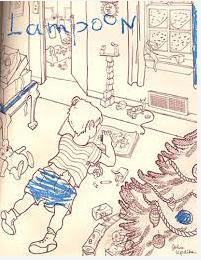
Online essay considers John Updike’s Religion

Screen Shot 2015-03-15 at 10.22.14 AMRecently The Witherspoon Institute Public Discourse website featured a post by Gerald R. McDermott in the “Literature, Religion and the Public Square” subsection on “‘A Rather Antinomian Christianity’: John Updike’s Religion.” 

“How could a man be so religious and yet be so enthusiastic for infidelity?” McDermott asks.

“The answer seems to lie in his religion. It was a strange sort of Christianity that rejected the structures of traditional faith, choosing divine comfort while rejecting divine commands. In other words, it was gospel without law, grace without repentance, the love of God without the holiness of God.

“To be sure, Updike held on to parts of historic Christian belief. He rejected materialism as a failure to make sense of emotion and conscience, and defended Christ’s divinity against his first wife’s Unitarianism. At the same time, he took from Kierkegaard the idea that Christian faith is subjective, not a conclusion from rationality or objectivity. So he insisted that resurrection from the dead is ‘unthinkable’ to the modern mind, that God can be known only as ‘the self projected onto reality’ by our natural optimism, and that the closer one moves toward Christianity the more it disappears, ‘as a fog solidly opaque in the distance thins to transparency when you walk into it.’

“Updike’s Christianity was a religion of self-affirmation. His greatest fears were of death and its threat of nothingness. But religion, he wrote, ‘enables us to ignore nothingness and get on with the jobs of life.'”

Updike makes a Pi Day reading list

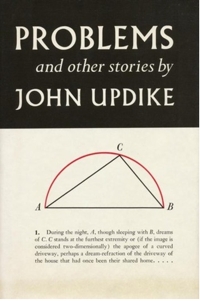
ProblemsPaste Magazine today featured a booklist post from Tyler Kane on “8 Entertaining Math-Inspired Reads for Pi Day.”

Topping the list was An Abundance of Katherines by John Green, better known for The Fault in Our Stars. Right behind him was John Cheever’s The Geometry of Love, followed by Thomas Pynchon’s Gravity’s Rainbow, David Foster Wallace’s Infinite Jest, Michael Crichton’s Jurassic Park, The Number of the Beast by Robert A. Heinlein, John Updike’s Problems, and Brandon Sanderson’s The Rithmatist.

Of Problems, Kane writes, “Abandoning your family is as easy as simple math in John Updike’s bummer tale of domestic frustration. You’re treated to pages of a logic puzzle, dealing with the causes and effects that occur when A, B and C interact. Here, we see our main character juggling laundry, his children’s expenses and psychiatric visits—all in a new life with a younger woman. The worst part? This all looks easier on paper.”

Updike biography named L.A. Times Book Prize finalist

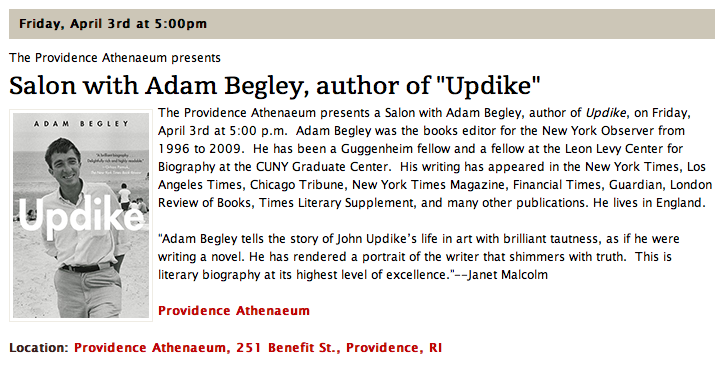
Finalists for the L.A. Times Book Prizes were announced today, and Adam Begley’s Updike is one of five books in the running to win the award for biography. The others are Robert M. Dowling’s Eugene O’Neill: A Life in Four Acts, Kirstin Downey’s Isabella: The Warrior Queen, Stephen Kotkin’s Stalin: Volume 1 – Paradoxes of Power 1878-1928, and Andrew Roberts’ Napoleon: A Life.

It remains to be seen whether the lack of a colon in Begley’s title will help or hurt.

The other nominees can be found here:  “T.C. Boyle, LeVar Burton lead L.A. Times Book Prizes.”

Roger’s Version stage adaptation nominated for major award


Screen-Shot-2014-06-01-at-7.02.34-AM-300x235Wes Driver
‘s stage adaptation of Roger’s Version, which was named Nashville Scene‘s Best Original Drama 2014, has been nominated for the American Theatre Critics Association’s ATCA/Steinberg New Play Award.

Driver, who is Blackbird Theater’s artistic director, premiered Roger’s Version on May 30, 2014 at the Blackbird Theater in Nashville, Tenn.

“Stage version of Roger’s Version lauded”

“Preview of staged Roger’s Version applauds director and writer”

“Blackbird Theater brings “Roger’s Version” to the stage”

Michael Updike: Moran’s haul wasn’t trash

We received the following note and accompanying materials from Michael Updike, who notes that the bags that Paul Moran famously hauled away from his father’s Beverly Farms curbside contained much more than trash, and offers an important donation if Moran will donate his part to The John Updike Childhood House:

Dear John Updike Society,
As you know my father, as a young aspiring cartoonist, sent off fan letters asking established cartoonist for original artwork. I have enclosed a letter to Harold Gray of The Blondie strip that has miraculously survived.
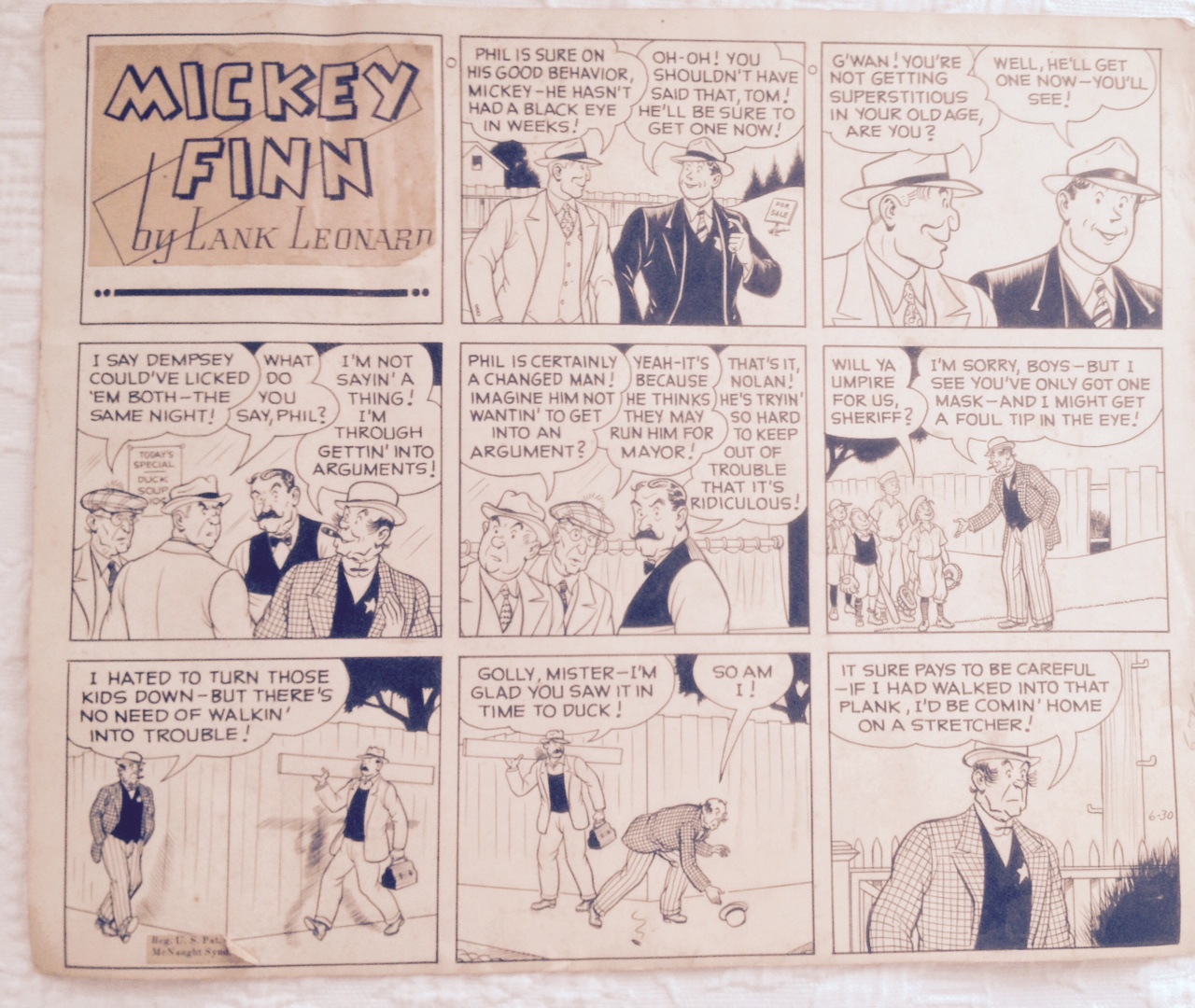
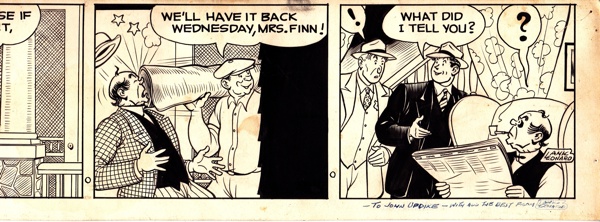
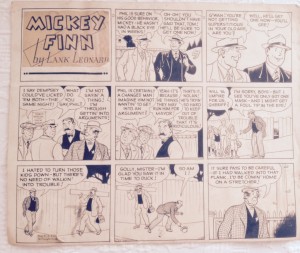
The most famous successes to these letters were original works by Saul Stienberg and James Thurber. These were in the exhibit of JHU items at the Boston conference and mentioned in Due Consideration P.612 . Another bit of booty was this original Mickey Finn strip by Lank Leonard. It is signed in cartoon capitals “-TO JOHN UPDIKE-WITH ALL THE BEST FROM Lank Leonard”. It has been kicking around our house ever since I remember. At some point (circa mid seventies) the last three panels went missing. The tape had long given way. I assumed they were lost for good to the far corners of the house or thrown out. Recently, to my great surprise, the lost panels showed up on The Other John Updike Archive. I can only assume that my father took them during the divorce and they went to the trash shortly before or after his demise. My siblings and I would love to see the two parts of this comic reunited after forty years of separation. We would happily donate our half of the work to the John Updike House if the other owner would donate as well.
Thanks very Much
Michael
Unknown

Unknown-1

January 2, 1948

Mr. Harold Gray
c/o New York News Syndicate
220 East 42nd Street
New York 17, New York

Dear Mr. Gray:

I don’t suppose that I am being original when I admit that ORPHAN ANNIE is, and has been for a long time, my favorite comic strip. There are many millions like me. The appeal of your comic strip is an American phenomenon that has affected the public for many years, and will, I hope, continue to do so for many more.

I admire the magnificent plotting of Annie’s adventures. They are just as adventure strips should be–fast moving, slightly macabre (witness Mr. Am), occasionally humorous, and above all, they show a great deal of the viciousness of human nature. I am very fond of the gossip-in-the-street scenes you frequently use. Contrary to comic-strip tradition, the people are not pleasantly benign, but gossiping, sadistic, and stupid, which is just as it really is.

Your villains are completely black and Annie and crew are practically perfect, which is as it should be. To me there is nothing more annoying in a strip than to be in the dark as to who is the hero and who the villain. I like the methods in which you polish off your evil-doers. One of my happiest moments was spent in gloating over some hideous child (I forget his name) who had been annoying Annie toppled into the wet cement of a dam being constructed. I hate your villains to the point where I could rip them from the paper. No other strip arouses me so. For instance, I thought Mumbles was cute.

Your draughtsmanship is beyond reproach. The drawing is simple and clear, but extremely effective. You could tell just by looking at the faces who is the trouble maker and who isn’t, without any dialogue. The facial features, the big, blunt fingered hands, the way you handle light and shadows are all excellently done. Even the talk balloons are good, the lettering small and clean, the margins wide, and the connection between the speaker and his remark wiggles a little, all of which, to my eye, is as artistic as you can get.

All this well-deserved praise is leading up to something, of course, and the catch is a rather big favor I want you to do for me. I need a picture to alleviate the blankness of one of my bedroom walls, and there is nothing that I would like better than a little momento of the comic strip I have followed closely for over a decade. So–could you possibly send me a little autographed sketch of Annie that you have done yourself? I realize that you probably have some printed cards you send to people like me, but could you maybe do just a quick sketch by yourself? Nothing funny, just what you have done yourself. I you cannot do this (and I really wouldn’t blame you) will you send me anything you like, perhaps an original comic strip? Whatever I get will be appreciated, framed, and hung.

Sincerely,

(Signed, ‘John Updike’)

John Updike
Elverson P. D. #2

Moran did the Updike world a huge favor when he saved all those bags from the dumpster, and the Society would have loved to bid on them. They would have made for terrific exhibits for The John Updike Childhood Home at 117 Philadelphia Avenue in Shillington, Pa., where Updike said his “artistic eggs were hatched.” Hopefully they’ll end up in a public, not private, collection.

The John Updike Society is committed to building a world-class author home museum, and anyone with materials to donate or offer for sale should contact Society president James Plath, jplath@iwu.edu. We are a 501c3 non-profit organization so all donations are tax deductible, and all donors will be acknowledged at the point of exhibit. We are also planning a donor wall where all who donate $500 or more, cash or in-kind, will be honored.

JUS board adds Dojčinović and Luscher

Because The John Updike Society went very quickly from an author society of 35 members to a 501 c 3 non-profit organization of 250+ members with a six-figure budget and the responsibility of restoring and maintaining The John Updike Childhood Home, the board decided at their October 4, 2014 board meeting to alter the composition and election structure of the board to reflect current sound practices among non-profits of similar size and mission. It was decided that two new board members would be added, with a nominating committee composed of board members bringing forth names of candidates who fit the current needs of the board. Board members then voted and extended an invitation to the two who received the most votes: Biljana Dojčinović, Associate Professor, Dept. of Comparative Literature and Theory of Literature, Faculty of Philology, University of Belgrade, Serbia, and Robert Luscher, Professor of English, University of Nebraska at Kearney. Both accepted and begin serving three-year terms immediately, joining current board members Jim Plath (president), Jim Schiff (vice-president and editor of The John Updike Review), Peter Bailey (secretary), Marshall Boswell (Treasurer), and directors Sylvie Mathé and Don Greiner.

At the October meeting, the board also determined that two positions should be converted into general membership seats, to be decided by an election in which all members vote. The first three-year position to be filled is the seat vacated by Jack De Bellis, who resigned last year in order to make way for “new blood.” The board is grateful for De Bellis’s tireless service and will miss his presence. But he will continue to advise on an informal basis. Members soon will receive calls for nomination from the secretary regarding the election.

Biljana2Biljana Dojčinović is the director of the national project Кnjiženstvo—theory and history of women’s writing in Serbian until 1915 and editor-in-chief of Knjiženstvo, A Journal in Literature, Gender and Culture. She has been a member of The John Updike Society since its founding and a member of the editorial board of The John Updike Review since 2010. Her Ph.D. was focused on the narrative strategies in John Updike’s novels, and in 2007 she published a monograph in Serbian on Cartographer of the Modern World: The Novels of John Updike. She is also the author of numerous essays on Updike’s works and other topics, as well as five more academic books.

Luscherphoto3Rob Luscher is the author of John Updike: A Study of the Short Fiction and “Updike’s Olinger Stories: New Light among the Shadows. He has also published essays on Updike and his short fiction in the Dictionary of Literary Biography, the Blackwell Companion to the American Short Story, Eureka Studies in Short Fiction, and The John Updike Review. Beyond Updike, his scholarship focuses on the short story sequence, with published essays on volumes of short fiction by Ernest Gaines, Mary Wilkins Freeman, Clark Blaise, and Robert Olen Butler. He has been a member of The John Updike Society since its founding, and in addition to teaching at the University of Nebraska at Kearney he also serves as Faculty Coordinator of the Thompson Scholars Learning Community.

Boston Common offers tour of Updike’s old North Shore home

Screen Shot 2015-02-23 at 9.12.20 AMThe current owners of a grand Georgian home on the North Shore where Updike lived for years have opened the house for a Boston Common Magazine tour, complete with three photos of the Haven Hill house as it looks now:

“A Tour of John Updike’s Former North Shore Home”

The article, written by Alexandra Hall, begins with a quote from Updike:  “‘Every novelist becomes, to a degree, an architect,’ wrote the revered John Updike in 1985. ‘A novel itself is, of course, a kind of dwelling, whose spaces open and constrict, foster display or concealment, and resonate from room to room.’

“It’s a telling analogy from a man who viewed both his writings and his homes as such personal endeavors. And when design consultant Suzanne Eliastam was approached by the new owners of one of the late author’s most beloved abodes—a grand Georgian home on the North Shore named Haven Hill, where Updike lived for hears—she took that sentiment to heart in redecorating it.”

We’re told that one of its “most impressive pieces is something Updike left behind:  a huge mirror, almost 10 feet tall, framed in wood with gold leaf. It shared space in the living room with the original fireplace, both of which were left untouched while the room was renovated.”

Paul Moran decides to sell The Other John Updike Archive

Screen Shot 2015-02-22 at 2.28.47 PMAt one time Paul Moran said he wasn’t interested in the money, but just wanted to find a good home for the Updike materials he famously scrounged from the author’s curbside in Beverly Farms.

That time has apparently passed. Now he’s wanting $250,000 for the contents of all the trash bags he hauled away, with the blog he used to showcase the items—The Other John Updike Archive—thrown in. Moran says that bids will be accepted until 5 p.m. on March 31, 2015.

It would have been nice to have those materials for The John Updike Childhood Home at 117 Philadelphia Avenue, but $250,000 is an insane amount of money . . . more than the Society paid for the house itself.

Still, if there’s an extremely wealthy person out there who has enough disposable income to spend it on disposed-of Updike items, the Society, a 501 c 3 non-profit, would be happy to be the beneficiary!

Here’s a link to the post announcing the sale, with detailed visuals of what we may never see again.