Physics blog features Updike poem

Neutrinos

Physics Central, which links to American Physical Society Sites, yesterday posted “Physics in Verse: A John Updike Poem about Neutrinos.”

“There is a long history of poets taking Nature as their muse, from the call of the sea to the draw of the wild. But poems about physics phenomena are harder to find,” Tamela Maciel writes. “Updike was not a physicist, but he did a remarkable job describing the current view of the physics community, as this article from Symmetry magazine unravels.”

Cosmic Gall
by John Updike
Neutrinos, they are very small.
They have no charge and have no mass
And do not interact at all.
The earth is just a silly ball
To them, through which they simply pass,
Like dustmaids down a drafty hall
Or photons through a sheet of glass.
They snub the most exquisite gas,
Ignore the most substantial wall,
Cold-shoulder steel and sounding brass,
Insult the stallion in his stall,
And, scorning barriers of class,
Infiltrate you and me! Like tall
And painless guillotines, they fall
Down through our heads into the grass.
At night, they enter at Nepal
And pierce the lover and his lass
From underneath the bed—you call
It wonderful; I call it crass.

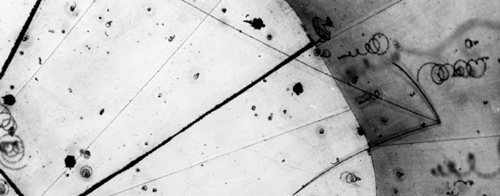
Pictured is “The first observation of a neutrino-induced reaction in a hydrogen bubble chamber. An invisible neutrino arrives from the right and strikes a proton where the three tracks join. The proton, a muon, and a pion then fly off in different directions.”


Author writes about Updike Country

Screen Shot 2015-05-09 at 1.45.00 PMIn a post for the “Idle Chatter” department of The Smart Set, from Drexel University, Morgan Meis reports on “Updike Country; In the semi-rural suburbs of southeastern PA, finding—and living in—Rabbit Angstrom’s middle America.”

“John Updike always wrote beautifully about this part of the world. The middle class houses. The certain kind of red clay. The specific attitude of a person who grew up around here, in the vicinity of Reading.

“If John Updike were still alive and driving around Limerick he’d write something about the beautiful pseudo-cloud coming from the cooling tower of the Limerick plant. He’d say, the white powder of that cloud drifts over the farmland and the strip malls all the same. It dusts the heads of the locals on their way out of the bar on Township Line Road. It dusts everything. You can’t see or feel the dust. It does not harm. But it’s heavy nonetheless. It keeps you here even when you want to pass on through. . . .”


JUS president invested as an endowed chair

Screen Shot 2015-05-09 at 1.31.27 PMOn May 3, John Updike Society president James Plath was invested as the R. Forrest Colwell Chair of English at Illinois Wesleyan University, where he has taught for the past 27 years. The appointment is for six years, renewable for five-year terms thereafter. The committee cited his work on Hemingway and Updike, his work with student organizations, and his long-term service on both major committees and the Faculty-Staff Recognition Committee.

Here is the article.

Updike is still on The Onion’s satirical radar

As a fellow lampooner, John Updike would no doubt appreciate his inclusion in The Onion‘s tongue-in-cheek story of the “Top Prom Trends For 2015.”

“Here are this year’s most popular prom trends:

Live streaming feed for students who couldn’t get date
Moment of silence to honor our fallen heroes overseas
The Centaur replacing Rabbit Redux as this year’s most popular John Updike–based prom theme
Adult chaperones given two minutes at start of dance to explain why exactly they chose to spend night off doing this
Cash bar for dates 21 and over
Viennese Waltz continues to supplant American-style tango as preeminent dance
King and queen required to break at least five social boundaries in order to be crowned
More DJs ending night with special father-son dance
After-party held right in lobby of hospital ER
Many students are following up their prom experience with unprotected intercourse”

Fluff piece cites Rushdie-Updike feud

In “‘As usual, words fail him’—6 great literary feuds,” a glorified “list” story meant to entertain, The Telegraph’s Morwenna Ferrier and Rupert Hawksley offer a fluff piece that doesn’t go into much detail and didn’t involve much research. But it’s worth noting that Updike gets a mention:

Salman Rushdie vs John Updike

“Rushdie, as we know, is no stranger to controversy, but his battle with John Updike tops all his feuds.

“In 2006, Updike denounced Rushdie’s novel, Shalimar the Clown, writing ‘Why, oh why did Salman Rushdie, in his new novel call one of his major characters Maximilian Ophuls?.’ Rushdie responded to Updike’s query in The Guardian: ‘Why, oh why… ? Well, why not? Somewhere in Las Vegas there’s probably a male prostitute called “John Updike”.’ He went on to describe Updike’s latest, Terrorist, as ‘beyond awful,’ and suggested Updike should ‘stay in his parochial neighbourhood and write about wife-swapping, because it’s what he can do.’ Because what’s a little quibbling between literary giants…”

Blogger contemplates The Centaur

Screen Shot 2015-04-30 at 8.33.32 AMBlogger Jeffrey Keeten, whose interest in books goes beyond reviews, has posted a review of Updike’s novel The Centaur. “I’m not really sure why people have quit reading John Updike,” he muses (though there’s really no justification for thinking so). “I could not put down this flawed, but wonderful book.”

Though his review is mostly plot summary, Keeten remarks, “The novel in many ways is brilliant, reflecting an author’s mind that is brimming with intelligence and convoluted thoughts, maybe the inspiration for the labyrinth of George’s own mind.”

Paying their dues . . . and yours?

Thanks to the 60 members of The John Updike Society who paid their 2015 dues promptly, and to the members who added a donation for our continuing work on The John Updike Childhood Home:  Gerald J. Connors, Steven J. Malcolm, Elizabeth Updike Cobblah, Livia Lloyd-Hawkins, Robert M. Luscher, Joseph Moser, Joseph Truitt, Bryan L. Bodwell, Mary Carol Fee, Kevin R. Fox, Richard Seabrook, Kevin Schehr, Carole and Richard Sherr, Jay Althouse, Kasuko Kashihara, Sylvie Mathé, Deana and Gardiner “Gary”  Rigg, and Rev. Leslie Smith.

That makes 60 down, and 200 to go. And for people wanting to join the society, dues are  a remarkably low $25 per year for regular members and $20 per year for retirees and graduate students. Send your check (made payable to The John Updike Society) along with name, preferred snail mail and email address, and phone (to contact only if your information becomes outdated) to: James Plath, Dept. of English, Illinois Wesleyan University, Bloomington, IL  61702-2900.

The New Republic on why we need physical books

Screen Shot 2015-04-20 at 7.55.17 AMIn “Object Lesson,” a consideration of “Why we need physical books published in the New Republic, William Giraldi inevitably turns to Updike:

“There was little that escaped the Updikian caress, and he wrote more than once about the pleasures and peculiarities of book collecting. In an essay called “The Unread Book Route,” about A History of Japan to 1334, Updike wrote: ‘The physical presence of this book, so substantial, so fresh, the edges so trim, the type so tasty, reawakens in me, like a Proustian talisman, the emotions I experienced when, in my youth, I ordered it.’ Leave it to the unerringly sensual and curious Updike to a) refer to book type as ‘tasty,’ and b) think as a youth that he needed to know something about Japan prior to 1334.

“Updike’s point about the Proustian talisman is a crucial one for bibliophiles: Their collections are not only proof of their evolution but monuments to their past, fragrant and visual stimulators of recall.”

Sex-on-the-page article includes Updike (of course)

In a story written for The Sacramento Bee books section, writer Sam McManis considers “Sex on the page: Often cringe-worthy, occasionally uplifting.” The pun was most certainly intended, considering some of the examples McManis cites as less than effective—among them this passage from Updike’s Brazil: “…he felt his cashew become a banana, and then a rippled yam.”

Updike’s contemporary and rival Philip Roth also gets “ribbed” for a passage from “The Humbling,” in which he attempts to describe a threesome: “It was as if she were wearing a mask on her genitals, a weird totem mask, that made her into what she was not and was not supposed to be. She could as well have been a crow or a coyote…”

“‘Good sex is impossible to write about,’ [Martin] Amis once told the Washington Post. ‘[D.H.] Lawrence and Updike have given it their all, and the result is still uneasy and unsure. It may be that good sex is something fiction just can’t do—like dreams. Most of the sex in my novels is absolutely disastrous. Sex can be funny, but not very sexy.”

“Yet the late Updike, twice a Pulitzer Prize winner, once told NPR’s Fresh Air that writing about ‘sexual transactions’ is realism at its core and a window into the human condition.

“‘For many people it’s the height of, what they see, of ecstasy and poetry is in their sexual encounters, who, for the record, had the Bad Sex ‘Lifetime Achievement Award’ bestowed upon him in 2008, a year before his death. ‘And furthermore … human personality does not end in the bedroom, but persists. Not all lovemaking is alike. Anyway, it seemed a writer should clearly be free to describe it.'”

Katie Roiphe is more complimentary of Updike’s attempts in a 2010 New York Times Book Review essay, especially the passages from the Rabbit novels. A “top-form” passage is cited: “…a little gauge inside his ribs doubles and redoubles his need for pressure…there is no love in it, love that glances and glides along the skin, he is unconscious of their skins, it is her heart he wants to grind into his own, to comfort her completely.’

“Roiphe credits Updike’s ‘unnerving gift: to be frank and anesthetizing all at once, to do poetry and whorehouse,” and gently scolds a newer generation of great American writers…for being passive and sexually ambivalent.”