Updike inspired fine press publisher

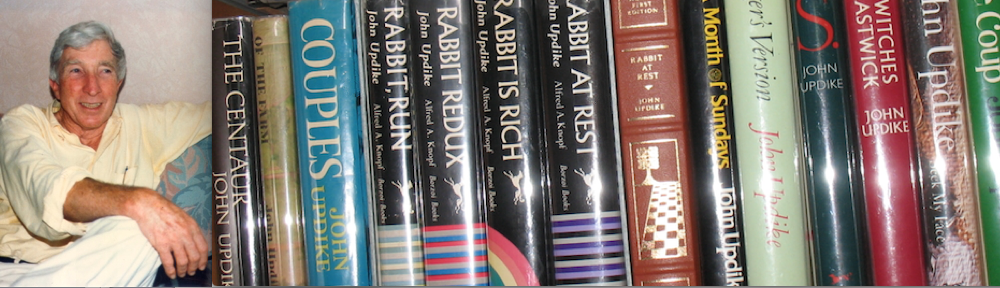
10801923_575518042584588_3734138739554104525_nJohn Updike Society members may know Andrew Moorhouse from the last two conferences he attended, at which he modestly suggested he was not an academic but “only” an Updike fan, a reader, and a lover of books.

But it turns out that his love of books has made him one of the most respected fine press publishers in the United Kingdom. And John Updike inspired him.

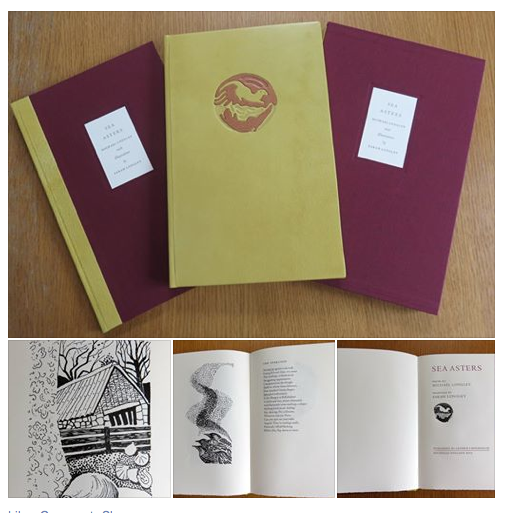
“The American author John Updike said: ‘A book is beautiful in its relation to the human eye, to the human hand, to the human brain and to the human spirit,’ and it is this quote which encouraged me to get involved in Fine Press publishing,” Moorhouse wrote in an article that appeared yesterday in The Irish Times: “Michael Longley’s Sea Asters: publishing as a work of art.”

In the article, Moorhouse talks about how he started Fine Press Poetry in 2013 and how his first three books—two featuring British poet Simon Armitage and this third release, Michael Longley’s Sea Asters, illustrated by the author’s artist daughter—came to be. The article also contains several poems by Longley, who was recently announced as winner of the Griffin International Poetry Prize.

Moorhouse’s forthcoming publication is Andrew Motion’s Ted Hughes Award-winning Coming Home poems. Fine Press Poetry, which specializes in creating letterpress editions of poems accompanied by illustrations by wood engravers and artists, is based in Rochdale, England.
Screen Shot 2015-06-06 at 8.12.53 AM

New Stephen King novel alludes to Updike et alia

Screen Shot 2015-06-03 at 7.04.25 AMStephen King, the master of horror who debuted with Carrie (1974), has turned to the newspaper headlines and a trio of literary masters for the subject of his new book. Finders Keepers is about a psychopath’s obsession with writer John Rothstein (a mash-up of John Updike, Philip Roth, and J.D. Salinger), whose “fame comes from his Runner books, a trilogy that tips its hat to Updike’s Rabbit novels,” says Guardian writer James Smythe.

“Finders Keepers by Stephen King—writers, beware your fans”

Winter 2015 issue of JUR is published

JUR3-2small2Watch your mailboxes, John Updike Society members. Volume 3, Number 2 (Winter 2015) of The John Updike Review has been published and mailed. The issue features a stunning cover photo by Ara Guler and two plenary talks from the Third Biennial Conference: “The Bulgarian Poetess: John and Blaga,” by Ward Briggs and Biljana Dojčinović, and “Starting Out at Chatterbox: The Apprenticeship of John Updike,” by Donald J. Greiner. Also in this issue is the winning essay from the JUR’s Second Emerging Writers Prize—”The Long Goodbye: The Role of Memory in John Updike’s Late Short Fiction,” by Matthew Shipe—and “Engendering Pleasure: Sringara Rasa in John Updike’s S.,” by Pradipta Sengupta.

Editor James Schiff has done another fantastic job, and his innovative Three Writers feature, in which three invited writers are asked to contribute an essay on the same Updike story, novel, poem or essay, this issue spotlights the short story “Gesturing”: Robert M. Luscher’s “Motions of Meaning: John Updike’s ‘Gesturing,'” Dario Sulzman’s “‘I Feel I’ve Given Birth to a Black Hole’: Existential Motifs of Bachelorhood in John Updike’s ‘Gesturing,'” and Kathleen Verduin’s “Gestures of Reflection.”

Rounding out the issue is Matthew Shipe’s review of Bob Batchelor’s John Updike: A Critical Biography.

The John Updike Review is published twice a year by the University of Cincinnati and The John Updike Society and is based at the University of Cincinnati Department of English and Comparative Literature. To subscribe to The John Updike Review, simply join The John Updike Society (https://blogs.iwu.edu/johnupdikesociety/). Membership ($25 regular, $20 grad students/retirees) includes a subscription to the journal. Institutional subscriptions are available through EBSCO.

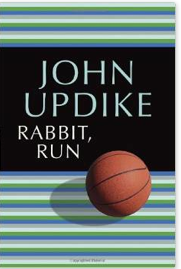
BPR Summer Book Club taps Rabbit, Run

Screen Shot 2015-05-30 at 1.05.03 PMWGBH-Boston has announced “Reading Hearts: The BPR Summer Book Club,” a three-month, no boundaries, interactive book club hosted by Alex Beam. In other words, you can read along, and listen in on the conversation with callers about each of the books, if you don’t feel like calling in yourself.

The June entry is Barefoot, by Elin Hilderbrand. For July, readers are asked to tackle Updike’s Rabbit, Run, and the communal read for August is Pack of Two: The Intricate Bond between People and Dogs, by Caroline Knapp.


The article quotes Amazon.com in summarizing Rabbit, Run as the July entry:

Rabbit, Run is the book that established John Updike as one of the major American novelists of his—or any other—generation. Its hero is Harry ‘Rabbit’ Angstrom, a onetime high-school basketball star who on an impulse deserts his wife and son. He is twenty-six years old, a man-child caught in a struggle between instinct and thought, self and society, sexual gratification and family duty—even, in a sense, human hard-heartedness and divine Grace. Though his flight from home traces a zigzag of evasion, he holds to the faith that he is on the right path, an invisible line toward his own salvation as straight as a ruler’s edge.”

Updike a quick read? Arts.Mic thinks so

Screen Shot 2015-05-29 at 6.35.11 AMJune is soon upon us and it’s come to our attention that a year ago Rachel Grate of Arts.Mic shared “14 Brilliant Pieces of Literature You Can Read in the Time it Takes to Eat Lunch.”

Margaret Atwood’s “Happy Endings” comes in at #1, followed by John Updike’s “Pygmalion.”

“Inspired by the story of Pygmalion from Ovid’s Metamorphoses, the story follows a sculptor who falls in love with a statue he carves. Updike transforms the narrative’s message to reveal the narcissism we all bring to love.

“Updike makes every sentence of this brief piece count, nonchalantly surprising his readers with a new twist in every paragraph. Soon, we begin to wonder how much of a relationship is based on who the other person really is and how much is based on how we transform them.

“Read it for free here,” courtesy of The Atlantic online. The story appeared in the July 1981 issue.

Only one of the American Nobel laureates made the Arts.Mic list:  Ernest Hemingway (“Hills Like White Elephants”).

Paris Review blog post recalls Cheever’s Updike scare

Today The Paris Review uploaded a blog post by Dan Piepenbring which featured the photo below of John Updike and John Cheever on The Dick Cavett Show and an entry from Cheever’s journal, circa 1974, 1978, that’s here titled, “False Alarm.”

It begins, “The telephone rings at four. This is CBS. John Updike has been in a fatal automobile accident. Do you care to comment. I am crying. I cannot sleep again. I think of joining Mary in bed but I am afraid she will send me away.”

Later, Cheever writes, “As for John he was a man I so esteemed as a colleague and so loved as a friend that his loss is indescribable. He was a prince. I think it not difficult to kiss him goodbye—I can think of no other way of parting from him although he would, in my case, have been embarrassed. As a writer of his generation I think him peerless; and his gifts of communicating, to millions of strangers, his most exalted and desperate emotions was, in his case, fortified by immense and uncommon intelligence and erudition.”

It would be Cheever, Updike’s senior by two decades, who would die first, in 1982. Here’s a link to the October 14, 1981 Dick Cavett Show featuring the two luminary Johns.

Screen Shot 2015-05-27 at 3.50.04 PM

Thesis on Updike and Mailer sport inferences now online

Screen Shot 2015-05-26 at 6.30.20 AMA 1972 thesis “Submitted to the Faculty of the Graduate School at The University of North Carolina at Greensboro in Partial Fulfillment of the Requirements for the Degree Master of Science in Physical Education” is now available online.

Click here to access Kathryn Jane Upshaw’s “John Updike and Norman Mailer: Sport Inferences,” which was filed in September 1972. To navigate past the title page, click on the right center edge to move forward, and the left center edge to go backward. “Through the analysis of the lives and writings of modern contemporary American authors John Updike and Norman Mailer, the allusions to sport were studied with a view toward understanding the inferences of that phenomenon on the development of the novel’s elements of plot, character, and setting. Furthermore, sport inferences were studied in light of style.”

The author studied Updike’s The Poorhouse Fair, Rabbit, Run, The Centaur, Of the Farm, Couples, and Rabbit Redux, and Mailer’s The Naked and the Dead, Barbary Shore, The Deer Park, An American Dream, and Why Are We in Vietnam? 

Guardian writer includes RABBIT REDUX among 100 best novels

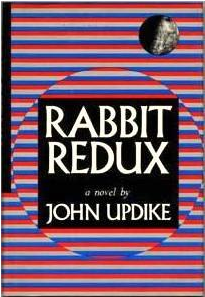
Screen Shot 2015-05-25 at 11.53.01 AMRabbit, Run gets all the attention, and Rabbit Is Rich and Rabbit at Rest earned Pulitzer Prizes. But Guardian writer Robert McCrum says Rabbit Redux is his favorite—which is why he included it at #88 on his list of “The 100 Best Novels.”

“Harry ‘Rabbit’ Angstrom, the account of whose life and times adds up to more than half a million words, is often placed with honor, and a measure of irony, next to America’s great literary protagonists such as Huck Finn, Jay Gatsby and even Captain Ahab,” McCrum writes. “Rabbit Redux was published in the US by Alfred A Knopf, a great literary house and a natural home for a novel that, from the title down, nodded to the Anglo-American literary tradition. Anthony Trollope (see No 22 in this series) published Phineas Redux in 1873, and Updike, who was steeped in English literature, would have enjoyed the allusion. Other critics have noted its ‘Dickensian’ ambitions.

“The Angstrom series had many inspirations, including Sinclair Lewis’s Babbitt. Updike, who also venerated Lewis, always spoke warmly about his admiration for Marcel Proust, though ‘Rabbit’ has little to do, explicitly, with A la Recherche du Temps Perdu. Ian McEwan [who, summarising Updike’s achievement on his untimely death in 2009, compared him to Saul Bellow (see No 73 in this series) as ‘a master of effortless motion—between first and third person, from the metaphorical density of literary prose to the demotic, from specific detail to wide generalization, from the actual to the numinous, from the scary to the comic’] described Updike’s ‘Rabbit’ novels as his ‘masterpiece.’ Philip Roth, a sometime writer, declared Updike to be America’s ‘greatest man of letters, a national treasure,’ while, for Lorrie Moore, Updike is ‘our greatest writer,’ though she prefers his short stories.”