In Memoriam: Gerald “Jerry” Potts

PottsGeraldCLR_20160120We are saddened to report the sudden death January 18, 2016 of Gerald R. “Gerry” Potts, a  classmate of John Updike’s who was a four-sport athlete at Shillington High School (football, basketball, track, and baseball). He was 85.

Potts, who graduated ahead of Updike and the Class of 1950, kept in touch with Updike later in life, especially after the Reading Eagle published a story naming him as a possible model for Harry “Rabbit” Angstrom. Updike sent him a postcard saying, no, he wasn’t, and Potts, who believed in the society’s mission, donated his Updike letters to the Updike archive at Alvernia several years ago.

Screen Shot 2016-01-20 at 8.44.40 AMPotts retired in 1980 but has been an active community member for all of his life, serving on the Shillington Borough Council, the Shillington Zoning and Planning Commission, and the Governor Mifflin School Board, among other organizations.

Here is his obituary. Potts is pictured (left) on his front porch in 2011 with Dave Silcox, Updike’s Shillington contact in whose dining room the first formative meeting of the society took place. The society offers sincere condolences to his wife, Shirley, and children Lori, Richard, and Andrew, all of Shillington.

Services will be 9:30 a.m. at the Edward J. Kuhn Funeral Home, 739 Penn Ave., West Reading. Contributions may be made to Governor Mifflin School District, ℅ Funds for Future Athletic Endeavors, Attn: Pat Tulley, Athletic Director, 10 S. Waverly St., Shillington, PA  19607.

Author Strout names Updike book childhood favorite

Screen Shot 2016-01-15 at 7.34.29 PMEntertainment Weekly often finds ways to enliven interviews, and in “Books of My Life: Elizabeth Strout on Madame Bovary, The Journals of John Cheever, and other favorites,” writer Isabella Biedenharn asked Strout to name the book she loved in school (Madame Bovary), a novel she read in secret (The Man Who Had Everything), the book that “cemented” her as a writer (the works of Alice Munro and William Trevor), the book that changed her life (The Journals of John Cheever), a classic she’s never read (The Grapes of Wrath), and her favorite book as a child:

Pigeon Feathers and Other Stories, by John Updike. For each answer she offers a brief explanation, and here’s what she had to say about the Updike book:

“I was probably around 8 when I found a copy of it on our coffee table. I am sure much of it I didn’t understand, but I had a real sense that this was how grown-ups were, and I was thrilled by it.”

Strout is the author of such books as My Name Is Lucy Barton: A Novel, (2016), The Burgess Boys: A Novel (2014), Olive Kitteridge (2008), Abide with Me: A Novel (2007), and Amy and Isabelle: A Novel (2000).

Updike-edited gift recalled

Screen Shot 2016-01-06 at 8.56.22 AMIn the online “Books: The gift I’ll never forget” section of The Guardian, Sloane Crosley recently shared “The book that reminded me America could be magical too.”

It was 1999 and Crosley, who was studying in Scotland and reluctant to leave, recalled how she “fell in love with Edinburgh so intensely” that she “literally fell (first night, Victoria Street, knees skinned). A magical place that smells of salt, hops and sewage, and features a sizable castle sticking up in the middle, Edinburgh was mind-blowing to a young American.”

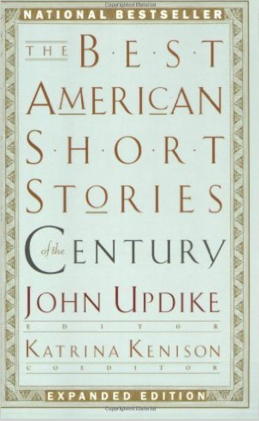
She talks about how her parents, never good gift-givers, found the perfect way to welcome her home. “There, waiting on my bed, was a 775-page brick of a book. The Best American Short Stories of the Century, edited by John Updike and inscribed by my father: ‘Welcome to America – we’re not so bad.’

“I had not spoken to my parents about how sad I was to leave Scotland. I had barely spoken to them about how much I loved it. But still, they knew. Not only that, they acted on that knowing without laundering it through their own impulses. They did not buy me thistle-patterned linens or play bagpipe recordings. This was a gift truly for me; 100 reminders of why home was still beautiful and funny and complex.”

Commonweal staff picks Updike Selected Poems

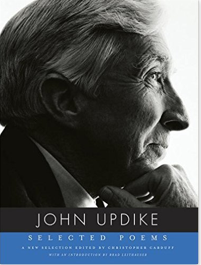
Screen Shot 2016-01-06 at 8.38.20 AMOn a blog post from Commonweal‘s Rand Richards Cooper we get “Staff Picks: The Poetry of John Updike.” John Updike: Selected Poems was one of his 2015 favorites.

“A book I’m glad to have read this year. . . . It brings me back to a day thirty years ago, when I took a bus out to Seton Hall University to hear Updike read. In a smallish lecture room he stood behind a lectern and, in a quiet voice adorned with the slightest lisp, he read . . . poems. The audience was surprised and perhaps a bit restive. Turns out Updike had agreed to do the reading only on the condition that it be poetry and not prose,” Cooper writes.

“Like his prose, Updike’s poetry—much of it written in variations on the sonnet—highlights his skill in noticing the world, and his life in it, in trenchant and surprising ways. The poems convey wry humor, exquisite attentiveness to daily life, and an abiding preoccupation with mortality and time.”


Ten Books PBS loved in 2015

Screen Shot 2015-09-28 at 5.00.49 PMJohn Updike’s Selected Poems made the list of “10 Books We Loved in 2015” by PBS NewsHour.

“John Updike: Selected Poems,” edited by Christopher Carduff
Mike Melia, senior broadcast producer

“He’s one of the most prolific American writers, but John Updike was not known as a poet. His novels, stories and essays fill volumes. Now, there is a new collection of his verse. A highlight, for me, is ‘Endpoint,’ a series of poems written in the last years of his life. They may be my favorite things he ever wrote. Here’s a stanza from ‘Spirit of 76’:

Be with me, words, a little longer; you
have given me my quitclaim in the sun,
sealed shut my adolescent wounds, made light
of grownup troubles, turned to my advantage
what in most lives would be pure deficit,
and formed, of those I loved, more solid ghosts.

Papers needed for May 26-29 ALA in San Francisco

Screen Shot 2016-01-06 at 7.39.15 AM

PROPOSALS NEEDED FOR ALA

Last year in Boston The John Updike Society sponsored two panels, and we hope to get enough participants for two this year as well. Young scholars especially are encouraged to submit proposals or short abstracts. ALA is a great chance to network, to get a taste of what other societies are doing, and to meet fellow Updike enthusiasts. And yes, to get your foot in the academic door.

This year’s ALA will be held May 26-29 at the Hyatt Regency, 5 Embarcadero, in San Francisco, Calif. The hotel is right by a cable car stop, within walking distance of Chinatown, and a few blocks away from a bus route that takes you to all the piers, including the jumping off points for the Golden Gate Bridge park and Alcatraz.

Any topic is suitable, even comparative studies. The society must send a final program to ALA by January 30, so to give us time to do that we need to receive all proposals and abstracts by January 20. Everyone who presents must register for the conference.

Send abstracts or proposals to James Plath, jplath@iwu.edu.

Keillor reads Updike poem on Writer’s Almanac

The featured poem for Friday, Nov. 27, 2015 on The Writer’s Almanac with Garrison Keillor is Updike’s “Tools.” It’s in print format with a link to download Keillor reading the poem. It’s easy to see why Keillor chose this particular poem for Black Friday, the biggest retail shopping day of the year.

“Tools” begins, “Tell me, how do the manufacturers of tools / turn a profit? I have used the same clawed hammer / for forty years. The screwdriver misted with rust / once slipped into my young hand, a new / householder’s.”

The Writer’s Almanac with Garrison Keillor:  “Tools,” by John Updike


Angell book offers Updike insights

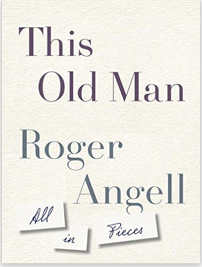
Screen Shot 2015-11-27 at 2.43.39 PMOn November 17, 2015, Doubleday published This Old Man: All in Pieces by Roger Angell (320pp., cloth, SRP $26.95), and Updike Society member Bruce Moyer says that the selected writings from the acclaimed New Yorker writer and editor include editorial notes for John Updike.

One of the reviewers at Amazon.com seconds the notion: “Personal observations such as the insight into John Updike are gems on their own.”

Amazon is currently selling the book in hardcover/cloth for $17.51, or 35 percent off list price.

Updike included in Berks County mural

John Updike is represented in a new mural on the wall behind a music stage at the Berks County YR Club in Wyomissing, but it took a little prodding from YR Club manager Virginia Griffith for him to be included. She had commissioned three sisters who operate an arts business called Turquoise—Melissa, Ashley and Courtney Reed—but the sisters weren’t familiar enough with Updike to have painted him initially in their mural.

As Reading Eagle correspondent Carole Duran reports, “Courtney was asked to include John Updike, the Pulitzer Prize-winning author who was born in Shillington. She wasn’t born yet when Updike was publishing his ‘Rabbit’ series, and was not familiar with the writer. After her research, she painted the book jacket of Rabbit, Run.” Courtney, 27, the youngest of the sisters, was born before the last of the high-profile Rabbit novels, Rabbit at Rest, was published in 1990, but it only goes to prove that The John Updike Childhood Home might be needed to keep Updike alive for future generations of Berks Countians.

Don’t squint too hard to locate the original hardcover dust jacket. Courtney used a later paperback edition, and you can see it just to the left of the clock post.

Unknown

David Updike on The Maples Stories

Screen Shot 2015-11-20 at 7.26.57 AMDavid Updike “shared the story of a summer in his life, as pieced together from various books written by his father, John,” Gerold Shelton wrote in a Dispatch-Argus story. Although his father drew heavily on his own life for his fiction, Updike told an audience at Augustana College that determining what’s real and what’s invented about his family’s past in The Maples Stories (first published in paperback as Too Far to Go) is difficult.

“I think it’s true in its essence,” he said, “but not in its details.”

Updike, who has had two short story collections of his own published, was quoted as saying that having a famous writer for a father meant that he could get his manuscript read right away. “I think it was helpful initially, but maybe a bit distracting later one. Overall, it has been a positive influence.”