De Bellis featured in WDIY interview

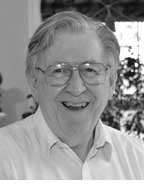
jackdebellis-webJohn Updike Society cofounder and former director Jack De Bellis, whose John Updike Encyclopedia and John Updike’s Early Years have been indispensable for Updike scholars, was featured in an interview on WDIY, Lehigh Valley’s Community NPR Station, on Dec. 6, 2016.

Asking the questions was Lehigh Valley Discourse host John Pearce.

Here’s the audio link.

Updike wrote to oppose John Lennon deportation

screen-shot-2016-12-11-at-6-38-17-pmA City Pages article on music by Jay Boller titled “Hey Prude: How one penis-fearing Minnesotan tipped the FBI to John Lennon” tells of the reaction that started an FBI file that grew until it deportation became a threat for the former Beatle. Featuring himself and mate Yoko Ono naked on the album cover for Two Virgins (1968) was only the beginning. It was his anti-war voice that was the loudest and his involvement with experimental drug-use that gave the FBI its opening.

However, “Minnesota’s own Bob Dylan would join dozens of rational stars—including Jasper Johns, Joan Baez, and John Updike—in writing letters of support for Lennon to the INS, which began deportation efforts in 1972.

For the whole story, click here.

Review of The Violet Hour cites Updike

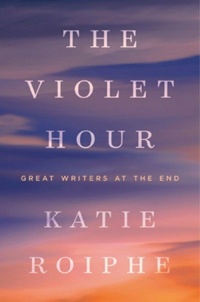
VioletHourKatie Roiphe included John Updike in her book The Violet Hour, so it’s no surprise that a review of that book would cite Updike, as Shirley Hershey Showalter did for The Christian Century. In “Death’s call and our response,” published October 2, 2016, she writes,

“Kalanithi uses a quotation from Montaigne as an epilogue: ‘If I were a writer of books, I would compile a register, with a comment, of the various deaths of men: he who should teach men to die would at the same time teach them to live.’ The quotation could apply to Katie Roiphe’s book also. The Violet Hour takes up Montaigne’s challenge but with less confidence in the outcome. Roiphe roiled cultural waters in the 1990s withThe Morning After: Sex, Fear, and Feminism. The Violet Hour defies genre, mixing memoir, journalism, biography, and literary criticism as it ponders the dying of six writers—Sigmund Freud, John Updike, Dylan Thomas, Maurice Sendak, James Salter, and Susan Sontag.”

Later, she writes, “Updike is the only practicing Christian in the group. His lifelong devotion to the Book of Common Prayer and the Episcopal Church present a puzzle to Roiphe. She’s not tripped up by the apparent contradiction of his adulteries; she has a special interest in his linking of adultery and immortality: ‘I have a soft spot for those who try to defeat death with sex.’ It’s irony, not sex, that makes it difficult for her to understand Updike’s religious life.

“She explains in an endnote that Updike’s biographer Adam Begley helped her see continuity where she could only see confusion. Updike’s final book of poems, Endpoints, includes these lines about clergymen: ‘comical purveyors / of what makes sense to just the terrified.’ Roiphe settles on this explanation: ‘Updike approached everything under the sun with irony, including his deeper passions, his beliefs, his sources of marvel and awe.'”

Here’s the full article.
On editors (and Updike’s take on them)

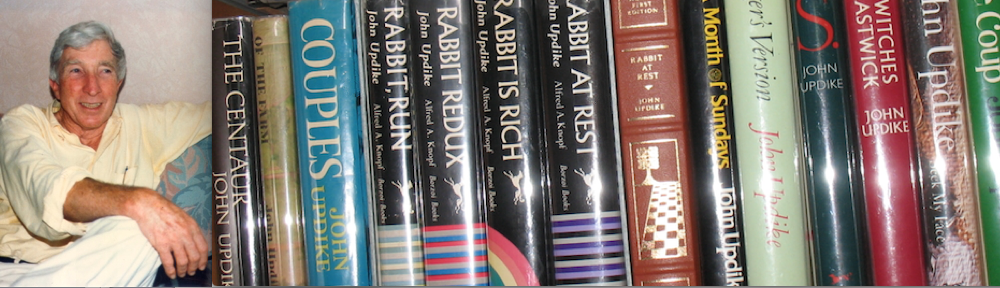
Rosemary Goring, literary editor for The Herald (Scotland), considered the writer-editor relationship in an essay, “Is writing on the wall for editors?”

“Great editors helped make the name of their writers,” she wrote. “Perhaps the most famous, Max Perkins, was Hemingway’s literary right hand, and that of F. Scott Fitzgerald too. Raymond Carver might never have reached the limelight but for the unsentimental and vigorous reshaping his editor Gordon Lish demanded. And those who wrote for the New Yorker will never forget the firm but courteous intervention of an editor such as William Maxwell, himself a fine novelist, who saved many authors from embarrassing themselves with a glitch or a cliche or a tired sentence. One of the New Yorker‘s regular contributors, John Updike, was rare in admitting he was always delighted to be edited. If someone wanted to suggest improvements, he was more than happy to consider them.”

Essay on Kierkegaard quotes Updike

kierkegaardWriting on “Cruel Intentions” for TLS (Times Literary Supplement), Will Rees discusses the life of Danish philosopher and theologian Soren Kierkegaard at some length and draws upon Updike at one point:

“John Updike famously argued that Kierkegaard’s works owe much to the art of novel-writing. After all, they are written by and about fictional characters whose world views they attempt to occupy from within. In a way that would please the contemporary teacher of creative writing, Kierkegaard does not tell – he shows. But we mustn’t get carried away; we do Kierkegaard a disservice if we simply appreciate his books. By departing from the normal philosophical form, they arguably tighten rather than slacken the demand on our attention, because arguments are present, but one must search for them, and often they reside in what Kierkegaard’s characters do not or cannot say – in the implicit gaps in their imperfect world views.”


Golf dreamers (and writers): a North Shore man remembers Updike

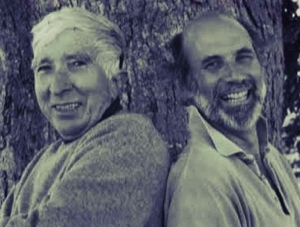
updike-shem“I met John Updike in 1980, at a PEN/New England gathering,” recalled Dr. Steve Bergman, Professor of Medical Humanities at NYU Medical School. “I was shocked to see him–I’d never met a writer before. I overheard him telling Tim O’Brien the writer that he wanted to play golf that week and would Tim be interested? Tim said yes. They needed another for a foursome,and I introduced myself, and was accepted,” Bergman wrote on his blog, Samuel Shem: Conversation, Events & Book Talk. Shem is his pen name.

“Over the years, I would say we became best friends. Not that John would show much feeling, really, but I would often ask him to read something I was working on, and he’d talk about his work–and he used a character named Toby Bergman, editor of the local paper in Witches of Eastwick, who ‘breaks his leg’ (Bergman my real name) and in my next novel, The Spirit of the Place, there was, in return, one “Toby Updike, editor of the local paper, who breaks his leg.” Marvelous man.

Bergman concluded, “In a rough time, when he hadn’t heard from me in a while, he would always call–to talk about golf, or when we could next lunch at the Harvard Faculty Club (I was a member and they had a great buffet). He scheduled the next drop-off of a few cartons of his memorabilia at the Houghton Library just across the street, so it was convenient. I have this photo on my desk, of him and me in golf gear. I miss him to this day.”

You can “read up” on Bergman-Shem at Goodreads.

Member’s book on Updike’s fiction now available for pre-order


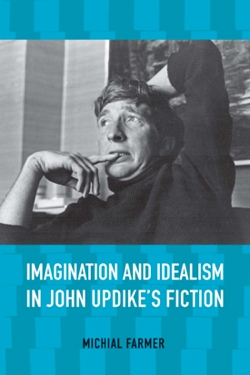
farmerbookMichial Farmer
, who presented a paper on “The Failure of Moderation in Buchanan Dying and Memories of the Ford Administration” at the Fourth Biennial John Updike Society Conference in Columbia, S.C., has written a book on Imagination and Idealism in John Updike’s Fiction that is now available for pre-order from Camden House and Amazon. The book (236pp., cloth) is scheduled for March 2017 publication.

From the Boydell and Brewer website:

“Concentrating on the role of the imagination in Updike’s works, this book shows him to be an original and powerful thinker and not the callow sensationalist that he is sometimes accused of being.

“This book looks past the frequently discussed autobiographical nature of John Updike’s fiction to consider the role in Updike’s work of the most powerful and peculiar human faculty: the imagination. Michial Farmer argues that, while the imagination is for Updike a means of human survival and a necessary component of human flourishing, it also has a destructive, darker side, in which it shades into something like philosophical idealism. Here the mind constructs the world around it and then, unhelpfully, imposes this created world between itself and the ‘real world.’ In other words, Updike is not himself an idealist but sees idealism as a persistent temptation for the artistic imagination. Farmer builds his argument on the metaphysics of Jean-Paul Sartre, an existentialist thinker who has been largely neglected in discussions of Updike’s aesthetics. The book demonstrates the degree to which Updike was an original and powerful thinker and not the callow sensationalist that he is sometimes accused of being.”

Michial Farmer is Assistant Professor of English at Crown College, Saint Bonifacius, Minnesota.

Updike cited in New Yorker piece on presidents in the novel

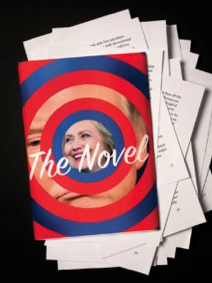
screen-shot-2016-12-11-at-2-59-23-pmIn a pre-election piece written for The New Yorker’s Life and Letters section (October 31, 2016), Thomas Mallon considers “2016: The Novel” and mentions Updike in the process.

“In my novel Finale, set during the last years of Ronald Reagan’s Presidency, I never, except for a few pages in the epilogue, entered Reagan’s consciousness, not because I felt there was nothing there but because what was there looked so smoky and unseizable. In John Updike’s Rabbit at Rest, Harry Angstrom muses upon the fortieth President: ‘You never knew how much he knew, nothing or everything, he was like God that way, you had to do a lot of it yourself.’ I decided that Reagan, who had eluded capture by his authorized-access biographer, Edmund Morris, was best approached from the outside, through puzzled observers, both admiring and detracting, from Nancy Reagan to Christopher Hitchens—rather the way Gore Vidal gave us his novelized version of Abraham Lincoln, in 1984.”

Updike called “the voice of the middle class”

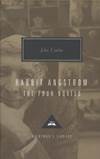
sub-updikeIn an essay on books written for Signature: Making Well-Read Sense of the World, Keith Rice contemplates “American Pastoral and 9 Novels of Suburban Desolation,” among them Updike’s Rabbit Angstrom, the four-novel collection:

“John Updike is arguably the voice of the middle class and suburban angst and his Rabbit series is his master-stroke. Over the course of four novels, Updike traces the life of Harry ‘Rabbit’ Angstrom, a onetime high school basketball star coming to terms with his adult life while trapped in loveless marriage and the confines of a boring sales job. Two of the four Rabbit novels (Rabbit Is Rich and Rabbit at Rest) were Pulitzer Prize winners.”

Other volumes that made the list (“novels” is a misnomer):

Revolutionary Road, by Richard Yates
The Corrections, by Jonathan Franzen
Ordinary People, by Judith Guest
The Dinner, by Herman Koch
The Age of Miracles, by Karen Thompson Walker
Little Children, by Tom Perrotta
The Lovely Bones, by Alice Sebold
The Stories of John Cheever, by John Cheever
American Pastoral, by Philip Roth