Updike Society program set for ALA

The John Updike Society will sponsor one roundtable discussion and one panel of papers at the American Literature Association conference in Boston, Mass., on May 25-26, 2017:

Did Updike’s Rabbit Angstrom Anticipate or Parallel the Rise of Trump Voters?
9:00-10:20 a.m., Thursday, May 25

  • Moderator: James Plath, Illinois Wesleyan University
  • Jerome Loving, Texas A&M University
  • Marshall Boswell, Rhodes College
  • Scott Dill, Case Western Reserve University
  • Quentin Miller, Suffolk University
  • Richard G. Androne, Albright College

John Updike: Comparatively Speaking
2:20-3:30 p.m., Friday, May 26

  • Chair: Sylvie Mathé, Aix-Marseille University
  • “The Work of Mind: John Updike’s Fiction and Ian McEwan’s Saturday,” Biljana Dojčinović, University of Belgrade
  • “’That a marriage ends is less than ideal’: Revisiting Updike’s Maples Stories,” James Schiff, University of Cincinnati
  • “The ‘Personal’ in John Updike’s Pennsylvania and His ‘Dialogues’ with Kenzaburo Oe: The ‘I-Novel’ Tradition of Japan and the Writers’ Reading in the Societies Divided,” Takashi Nakatani, Yokohama City University

A business meeting of the Society is scheduled for Thursday, May 25, from 10:30-11:50 a.m. All are welcome to attend, but must register for the conference. Here’s the entire program.

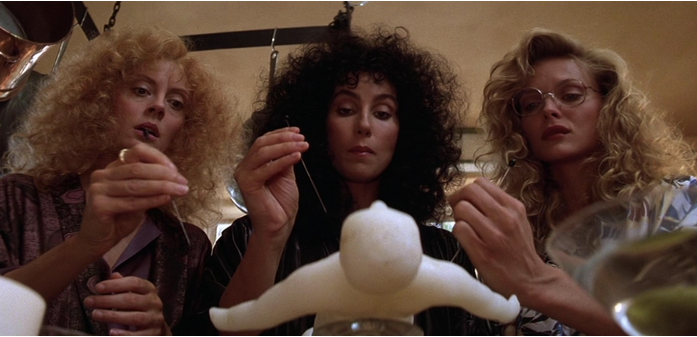
Witches of Eastwick film retro-reviewed

You know a film still has currency when it sparks the headline, “The Devil is a F**kboy: Revisiting ‘The Witches of Eastwick,'” with the subhead “Thirty years later, George Miller’s diabolical feminist parable feels relevant as hell. Gird your cherries.”

Meg shields writes, “Miller is a man of many talents: he wrote Babe; directed its weird and wonderful sequel; helmed the academy award winning Happy Feet franchise; and even served as producer and second unit director on the Sam Neil-starring sailboat thriller Dead Calm. In 1983, in between Mad Max sequels, Miller directed a segment for the Twilight Zone movie, which saw a bug-eyed John Lithgow feverishly trying to shoot a gremlin off the wing of a commercial airliner. Enamoured by his experience with Amblin Entertainment, and with an adapted screenplay of a recent work by American literary treasure John Updike in his possession, Miller made the (admittedly rocky) move to Hollywood. And so, we were blessed with The Witches of Eastwick.”

“Darryl is, categorically, a shit lord: oozing with faux feminist sympathy as greasy and insincere as his joke of a ponytail. He’s the kind of guy who takes gender studies courses just to hit on women; a sneezy alt-bro who uses disingenuous ‘wokeness’ as a buff for disarming sexual conquests.”

“Eastwick’s is a hazy, effortless magic,” she concludes, “whose exposition takes a backseat to the joyous interplay and collective power of female friendship. To ask for extrapolation is to fundamentally misunderstand Miller’s focus: a very real examination of toxic masculinity and sexual power dynamics, couched, deliciously, within occult ambiguity.

The Poorhouse Fair reviewed in retrospect

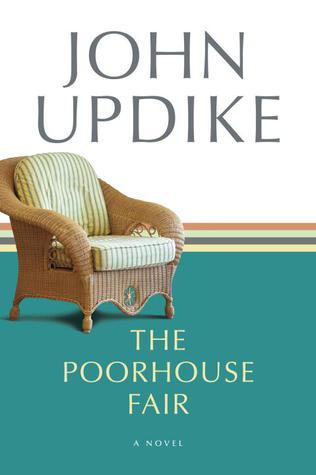
Fifty-seven years after Updike’s first novel, The Poorhouse Fair, was published, it’s still attracting attention. Ray Greenblatt reviewed it last summer for the blog North of Oxford.

“Since John Updike’s oeuvres have come to an end, it is fitting to revisit his very first novel,” he writes.

“John Updike’s short novel of one hundred and fifty pages is equally divided into three chapters. Each chapter contains a dozen sections or more offering glimpses of the people and events at the poorhouse fair as it moves through the day. This kaleidoscopic effect is often intensified by certain fascinating techniques,” he writes.

“Some of Updike’s sentences are bedrock declarations, such as what products sold best at the fair . . . . Or unique personification . . . . Or pure fanciful imagery . . . .

“Late in the novel to underscore the pouring out of the long day and the jagged energy of those tending and attending the fair, Updike uses a stream-of-conscious[ness] method. . . ,” he adds, offering examples from the text.

“Reputations fluctuate. Hemingway, dead now a half-century, in the future might be known for:  a book on bull-fighting or big game hunting; a few stories still unique ninety years later; or A Moveable Feast, nearly an afterthought to him. John Updike has been a factory of endeavor:  two Eastwicks, three Bechs, four Rabbits just in the genre of novel. Will the multiple weights of these works dominate? Time will winnow literature, that and changing culture. Sometimes first is best; I firmly believe that The Poorhouse Fair will endure.”

Read the entire review.

Book on famous stutterers includes chapter on Updike

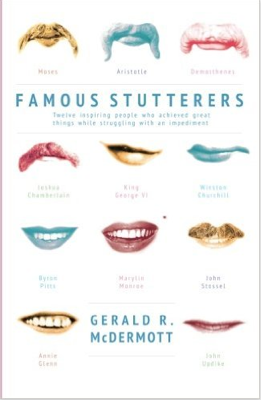
In Chapter 12 of Famous Stutterers, author Gerald R. McDermott begins,

“Until John Updike (1932-2009), no one had ever described stuttering with such dead-on precision. Once he compared it to a traffic jam. ‘I have lots of words inside me: but at moments, like rush-hour traffic at the mouth of a tunnel, they jam.’

“He painted a picture of facial tics that will make any relative of a stutterer groan with recognition.
Viewing myself on taped television, I see the repulsive symptoms
of an approaching stammer take possession of my face—an
electronically rapid flutter of the eyelids, a distortion of the mouth
as of a leather purse being cinched, a terrifying hardening of the
upper lip, a fatal tensing and a lifting of the voice

“All stutterers will nod knowingly when they hear him refer to that ‘untrustworthy’ part of himself that ‘can collapse at awkward or anxious moments into a stutter.’ They might smile at his philosophical conclusion that stuttering is a sign of the ‘duality of our existence, the ability of the body and soul to say no to one another.’ Or his reflection that a stammer is the acknowledgement of unacknowledged complexities surrounding even the simplest of verbal exchanges.”

Other famous stutterers included in the book are Moses, Aristotle, Demosthenes, Joshua Chamberlain, King George VI, Winston Churchill, Byron Pitts, Marilyn Monroe, John Stossel, and Annie Glenn.

Amazon link

Artist includes Updike book in lauded painting

In a Reading Eagle article titled “Amity Township artist paints a picture of Berks,” Ron Devlin muses that any list of things that define Berks County, Pa. would have to include “Pennsylvania Dutch delicacies like scrapple, ring bologna, shoofly pie and dippy eggs.”

But the list would also have to include “Luden’s Cough Drops, a 5th Avenue candy bar and Godiva chocolate” along with “Tom Sturgis Pretzels,” he writes.

“John Updike, Pulitzer Prize-winning author of Rabbit, Run, and ’80s street artist Keith Haring—both grew up in Berks—are musts on the artistic list,” along with singer Taylor Swift, he says.

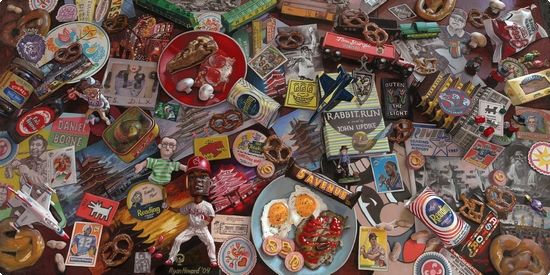
Have a look at what Amity Township artist Steve Scheuring thought defined Berks County enough to include in the 3×6′ painting he did as an homage.

“A stickler for detail,” Devlin writes, Scheuring bought every item in the collage and arranged them meticulously “in intricate patterns that tell a story.” He admits “the copy of Updike’s Rabbit, Run near the center of the painting is not an original first edition. It’s a library copy he bought online for $40, a fraction of what an original sells for.”

Scheuring’s Berk’s County “has been named one of the 10 finalists in International Artist Magazine’s Art Challenge 2017. A photo and an article appear in the magazine’s February issue.

Scheuring is a largely self-taught artist who has exhibited at Penn State Berks’ Freyberger Gallery, the GoggleWorks Center for the Arts, and the Allentown Art Museum. The above photo is by Susan Keen of the Reading Eagle. Below is a photo of Scheuring by photographer Ben Hasty from the Eagle article “Steve Scheuring raises ordinary life to the level of art.”

Rabbit, Run in the running for Britain’s favorite 2nd novel

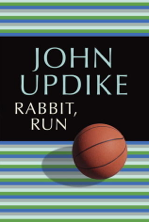
The Royal Society of Literature is polling people to discover Britain’s favorite second novel, and John Updike’s Rabbit, Run is in contention.

“In selecting the books for the voting list, we have used the following criteria:

  • Each book is the second full novel published by its author (not necessailry the second novel the author has written). Novellas, collections of short stories and any non-fiction works are not counted.
  • The writers may be living or dead and may come from any nation.
  • The books may have been written in any language, but must be available in English. The second novel judgement is based on order of original publication, not order of publication in translation.
  • Novels written by members of the RSL Council, or by the RSL’s Presidents and Vice-Presidents, have been excluded, as have all the novels entered for the 2017 Encore Award.
  • We hope that the voting list overall includes a varied and fascinating range of novels. We realise that lots of great novelists are missing from the list – usually because we felt that their second novel is not well-known or accomplished enough to attract many votes. We apologise in advance for any glaring omissions – and look forward to hearing your views.”

Here’s the link to the story and the Society’s Facebook page, where discussions are taking place.

The tough competition includes:

Pride and Prejudice
Fahrenheit 451
The Plague
Through the Looking Glass, and What Alice Found There
The Awakening
Oliver Twist
The Mill on the Floss
The Scarlet Letter
Their Eyes Were Watching God
One Hundred Years of Solitude
The Shipping News
The Crying of Lot 49
The Fountainhead
Harry Potter and the Chamber of Secrets
Lord of the Rings: The Fellowship of the Ring
The Adventures of Tom Sawyer
Ben-Hur
The House of Mirth

and, ironically, Infinite Jest . . . by Updike hater David Foster Wallace. 

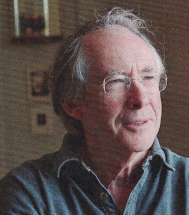
Ian McEwan talks about the Updike influence

In a Culture segment for Five Books, novelist Ian McEwan “talks about the books that have helped shape his own—from the biography of a scientific genius to a treatise on the end of time—and the importance of finding ‘mental freedom.'”

Here are the exchanges having to do with the Updike influence:

Would you go to Updike for sex, if not Larkin?
I think some of the descriptions of sex in Updike are extraordinary. I could never follow him down his route because his gift is one I’ve never hoped to emulate, which is the visual. In a sense he almost debunks or destroys the thing he’s describing, because of his clinical eye, but it does take my breath away. In this realm he’s a master of the hyper-real.

Talk a little about John Updike if you will, who died not long ago, in 2009. Your third book is Rabbit at Rest, the fourth of his ‘Rabbit’ novels.
Updike has been a very important writer for me, the one I’ve admired most, read most, and returned to most often. I was deeply touched by his death. I felt that we had conversations unfulfilled – we got to know each other a little in the last six or seven years of his life, and we had a correspondence.

What was he like, his character?
He was impenetrably courteous. At first, quite difficult to get beyond his very gentlemanly, polite and considerate shell. He protected himself. Behind this shell was all of his work. It was easier to get a more intimate Updike by writing letters. If I wrote, I’d get a response by return of post, apologising for being so quick, just as I would be apologising for my delayed replies. He said it was the only way he could keep his desk clear. But of course it was not that at all. This was a highly organised mind with boundless creative energy. He could turn in 1200 words of fiction in a day, write a review or an essay, and still address his correspondence.

You’ve called him ‘the greatest novelist writing in English at the time of his death’. What is it about Updike that deserves that praise?
Great sentence-maker; extraordinary noticer; wonderful eye for detail; great fondler of details, to use Nabokov’s phrase. Huge comic gift, finding its supreme expression in the Bech trilogy. A great chronicler, in the Rabbit tetralogy, of American social change in the 40 years spanned by those books. Ruthless about women, ruthless about men. (Feminists are wrong to complain. There’s a hilarious streak of misanthropy in Updike). He reminds us that all good writing, good observation contains a seed of comedy. A wonderful maker of similes. His gift was to render for us the fine print, the minute detail of consciousness, of what it’s like in a certain moment to be another person, to inhabit another mind. In that respect, Angstrom will be his monument.

You say feminists are wrong to criticise him, but there is that criticism – that he has a ‘male gaze’. Do you face the same challenges when you write female characters?
I have done occasionally. It means nothing to me. This is a visual form. Remember Conrad’s exhortations in the preface to The Nigger of the Narcissus: ‘I am trying…by the power of the written word…to make you see.’

Harry ‘Rabbit’ Angstrom was, I gather, an inspiration for Michael Beard, the protagonist of Solar?
I crouched in Updike’s shadow. I set myself the problem of having an unsympathetic hero, and enticing a reader to stay in his company for the length of a novel. With Rabbit, Updike showed us how this is achieved. Rabbit is not the nicest of men, his is a narrow consciousness, he’s of limited education, deeply ungenerous in the private life – remember how he makes love to his son’s wife? Grumpy, irritable, bigoted in some respects, and yet somehow Updike succeeds in making him the prism through which 40 years of American social change is observed, and 40 years of close shifts within family relations, adulterous affairs and the tragedy of a lost child.
How does he do this? Well, he invents an altered or heightened realism. He gives Rabbit his own – Updike’s – thoughts, and yet somehow he makes them plausibly Rabbit’s. Rabbit has reflections on mortality that could only be, in any realistic frame, Updike’s. But he makes them Rabbit’s; he shoehorns them into this limited mental space. It’s a rhetorical trick. In short, what Updike succeeds in doing is to make Rabbit interesting. He might not be good, but he’s interesting, and we travel with him for that reason alone. I can’t claim for a moment to have come anywhere near this with Michael Beard, but that was the example at my side.

When I feel my faith flagging in the whole enterprise of fiction – and all writers experience this – a few pages of Updike will restore my energies and optimism.

“Ian McEwan recommends Books That Have Helped Shape His Novels”
Essay on Dylan Thomas references Updike

In “Poetics in the Fiction of Dylan Thomas,” published in North of Oxford, Ray Greenblatt notes how in A Child’s Christmas in Wales (1952) “Thomas’ poetic style is revealed in the prose as well: vivid imagery, alliteration, purposeful run-on lines, many adjectives, humor, strong emotions from joy to sadness. In most of these stories Dylan is his own narrator; we even observe him growing up from his pre-teens into a young man in his twenties . . . . Thomas writes impressionistic stories about his life (or at least about a boy named Dylan) in Wales.”

“Dylan Thomas died so young, but in his short life he excelled in poetry and short fiction. One hears echoes of James Joyce in Thomas’ emotional display of young characters’ feelings of love. Thomas would undoubtedly have read this Celtic forerunner whose work began to dominate the world in 1916 with his first novel A Portrait of the Artist as a Young Man. Yet, Thomas’ prose in turn influenced American writers who came after him. J.D. Salinger, in Europe during World War Two, could have read Thomas. Salinger employed American colloquialisms used by the young as Thomas did the British. And another echo is heard in the writing of John Updike who attended Oxford in 1954, just after Thomas’ death. Updike often describes the woodlands and the sea in his work against which young people interact. We can only conjecture what further influences Dylan Thomas might have disseminated to the literary world had he lived longer.”

Updike’s Rabbit tetralogy interests TV screenwriter

Could we see a TV adaptation of Updike’s Rabbit tetralogy in the future?

We would if it were up to Andrew Davies, whose BBC1 adaptation of Les Miserables is expected to air next year.

The 80-year-old screenwriter announced at a Radio Times Covers Party this week that his bucket list includes bringing to the small screen Vikram Seth’s A Suitable Boy, John Updike’s Rabbit tetralogy, Charles Dickens’ Dombey and Son, and a “mash up” of Alison Lurie books, as reported by Ben Dowell for Radio Times.

See a clip of Davies talking about future projects he hopes to bring to light.