Updike’s rawly titled Cunts fails to draw auction interest

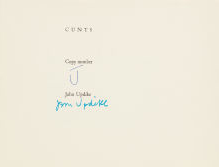
Screen Shot 2014-06-22 at 11.59.32 AMThis past April, Heritage Auctions of New York City featured one of only 26 signed and lettered copies of Updike’s ribald poem “Cunts,” which is subtitled “(Upon Receiving The Swingers Life Club Membership Solicitation).”

There were no bids, and the item did not sell. Here is the description:

John Updike. Cunts (Upon Receiving The Swingers Life Club Membership Solicitation). New York: Frank Hallmann, printed by Andrew Hoyem, [1974]. One of twenty-six lettered copies, out of a total edition of 276, signed by Updike (this is copy “J”). Oblong octavo. [4, blank], [17], [3, blank] pages. Publisher’s burgundy paper over boards, printed paper labels on front board and spine. Spine a bit sunned, minor rubbing to binding, text block a bit loose. A very good copy. [Together With]: [John Updike, contributor]. Cunts… New York: New York Quarterly, 1973. Summer 1973 issue, Number 15. One of 457 copies signed by Updike on page 65 of this issue (Cunts appears on pages 63-65). Octavo. 220 pages. Original wrappers. Minor rubbing, else fine. Both versions of this poem housed together in custom-built burgundy cloth clamshell case, with hidden drawer housing the New York Quarterly issue. From the collection of Alexander J. Jemal, Jr.

Russian director heralded for Centaur-inspired film

Yana_Skopina_01The Calvert Journal, A Guide to Creative Russia recently published an article on “Shooting Stars: five Russian female directors to watch,” and one of them—Yana Skopina—was heralded for her short film Milky Way Galaxy:

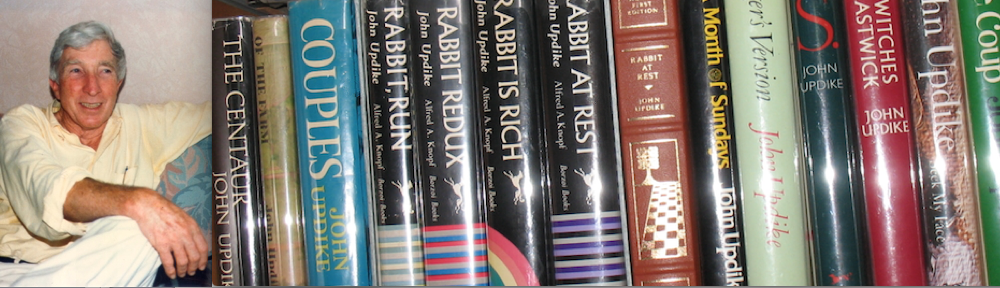
Milky Way Galaxy is based on John Updike’s novel The Centaur, which chronicles the complex relationships between a father and son. Shot on 35mm film, a rarity for a short, Skopina made the film as a tribute to Updike ‘In choosing the film’s color scheme, I studied the works of Andrew Wyeth extensively (an American realist painter). Updike and Wyeth were like twin brothers. They even had similar intonations.'”

“Shooting stars: five Russian female directors to watch”

Christian Scholars’ Conference includes Updike papers

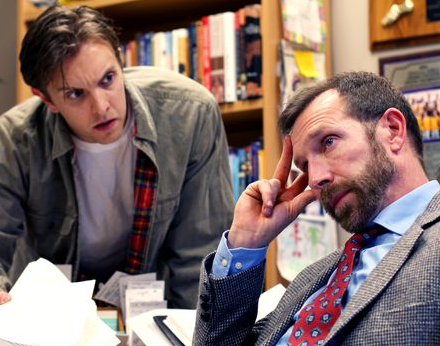
This past June 5-6, the Thomas H. Olbricht Christian Scholars’ Conference at Lipscomb University (Nashville, Tenn.) featured an emphasis on John Updike. In addition to  attending the world premier of “John Updike’s Roger’s Version,” which was announced in an earlier post, attendees could sit in on a session convened by Kimberly Reed (Lipscomb University) on “John’s Version: Updike and Christian Faith,” with panelists Ralph C. Wood (Baylor University), Ami McConnell (Sr. Fiction Editor, Thomas Nelson Publishers), and David Dark (Belmont University).

Another session on “John Updike and Christian Thought” was convened by Steve Weathers (Abilene Christian University) and featured papers on “Impudence and Desperation: John Updike and his Childhood’s Faith” (Mark Cullum, Abilene Christian University), “John Updike’s ‘Pigeon Feathers,’ Fear of Annihilation, and God” (Michael Potts, Methodist University), and “Run on Home: Updike’s Celebration of Ceremonies in ‘Packed Dirt, Churchgoing, a Dying Cat, a Traded Car'” (James W. Thomas, Pepperdine University).

A third session was offered on the topic of “The Flesh Became Word: A Discussion of the Themes From and Sciences Behind the Stage Adaptation of John Updike’s Roger’s Version,” with Greg Greene of Blackbird Theater convening a panel featuring the play’s director, Wes Driver, and Clifford Anderson (Vanderbilt University).

Here’s the link to the complete schedule.

Omnivoracious features Updike trivia

It’s come to our attention that in April, to promote Adam Begley’s biography, Updike, Begley supplied the readers’ website Omnivoracious with a brief bit of trivia:  “Five Things You Didn’t Know About John Updike.” 

But my guess is that most members will know the first and third “fun facts,” and anyone who attended the Second Biennial John Updike Society Conference in Boston will know the fourth one, and, if they were paying attention, the fifth!


Updike included in an Everyman’s Library fatherhood anthology

On May 13, Everyman’s Library published a volume in their Everyman’s Pocket Classics series that revolves around the theme of fatherhood.

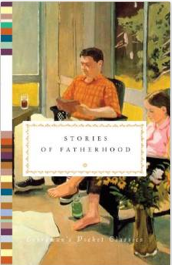
Stories of Fatherhood, edited by Diana Secker Tesdell, includes the John Updike short story “My Father’s Tears,” and is available in both hardcover and paperback.

Here’s the publisher’s description:

Screen Shot 2014-06-02 at 6.12.36 PM“Stories of Fatherhood gathers more than a century of classic short stories about having, becoming, loving, and losing fathers.

“Frank O’Connor’s hilarious tale of a tiny boy’s war against his paternal rival in “My Oedipus Complex” sits beside Ann Packer’s touching portrait of a man preparing for the wonder and terror of his first child’s birth. At the other end of the lifespan, John Updike’s “My Father’s Tears,” Jim Shepard’s “The Mortality of Parents,” and William Maxwell’s “The man who lost his father” bring us face to face with a loss that is like no other.

“In between, we encounter a full range of emotions connecting men and their offspring: tenderness and devotion, anxiety and incomprehension, admiration and regret. Powerful patriarchs cast a long shadow in Katherine Mansfield’s “The Daughters of the Late Colonel” and D. H. Lawrence’s “The Christening,” while Edith Wharton’s “His Father’s Son” sheds a more ironic light on the paternal legacy. E. L. Doctorow’s young protagonist, forced to write letters impersonating his dead father, arrives at a deeper understanding of him, while in Helen Simpson’s “Sorry?” an old man’s hearing aid seems to reveal what his children secretly think about him.

“Paternal bonds are forged outside biology, too: Graham Swift portrays a man wistfully seeking a substitute son, while Guy de Maupassant’s forlorn waif triumphantly acquires an ideal father. In these twenty stories, an array of great writers—ranging from Kafka, Joyce, and Nabokov to Raymond Carver, Harold Brodkey, and Andre Dubus—offers a wonderfully varied assortment of fictional takes on paternity.”

Read too, if you’re curious, a review/article by Peter Tonguette for The Christian Science Monitor: “‘Stories of Fatherhood’ offers 17 portraits of parenting from a very diverse group of writers.”

List price for the hardcover is $16.00, but Amazon.com is currently selling it for $12.19.


Preview of staged Roger’s Version applauds director and writer

Screen Shot 2014-06-01 at 7.02.34 AMFiona Soltes, writing for The Tennessean, published a preview of Wes Driver’s stage adaptation of Roger’s Version, which had its world premiere on May 30, 2014 and continues its initial run at Nashville’s Blackbird Theater through June 8.

Soltes notes that Driver received special permission from the Updike estate to adapt and stage the play, and quotes Clifford Anderson, director for scholarly communications in the Jean and Alexander Heard Library at nearby Vanderbilt University, as saying that Roger’s Version is “perhaps more relevant today” than it was when Updike published it in 1986.

“One thing that’s obviously different now is that, when Dale was trying to do this, we would have said it was an impossible task. . . . But I think what Updike had in mind, he was almost prescient in thinking that this would be something that scientists would be trying to do. That article [in Nature on ‘re-creating the history of the universe since the Big Bang through computer simulation’] has nothing to do with theology, but there is a very strong—much stronger than in the 1980s—theology and science discussion. In a way, this book was ahead of its time in projecting the themes that would become prevalent in that discussion.”

Anderson, Soltes writes, “has been impressed with the way Driver has cut to the ‘pithy aspects’ of the story while maintaining its drama. ‘It’s going to be quite innovative, and even sharpens the points of the book,’ he says.”

“‘Updike’s works are not known for making easy transitions to other media,’ Driver says. ‘But so much of this book already played out like great drama. . . . To me it cried out to be staged. To be incarnated. What a privilege that the Updike estate has let me do just that.'”

Pictured are actors Kris Wente (Dale) and David Compton (Roger) in a promo shot taken by Driver.

“‘Roger’s Version’ searches for truth at Blackbird Theater”

Updike materials exhibited at the Houghton Library through May 31

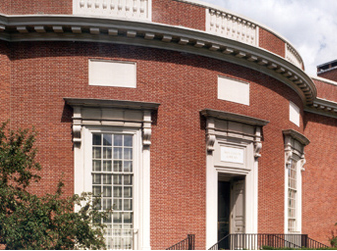
Screen Shot 2014-05-29 at 8.03.29 AMThe Houghton Library at Harvard University is the main repository for Updike materials, and through May 31 you can catch a glimpse of those materials in a ground floor exhibition (Chaucer Case). Here’s the description:

John Updike was in many ways an ideal Harvard student. He worked diligently at his studies, as evidenced by the marginalia recorded in the books he used in class (he graduated summa cum laude in 1954); he was an active member of the Harvard Lampoon, and served as president (nearly two-thirds of each issue during his senior year are attributed to him); he also remained a loving son, regularly writing amusing letters home to his parents in Shillington, Pennsylvania. Although Updike originally envisioned a career as an artist, there is evidence of the emerging professional writer; as a student, Updike received high marks on work that he would later submit to The New Yorker and other publications.

Updike began depositing his papers at Houghton Library in 1966; the collection was purchased by the library following his death in 2009. Updike meticulously shepherded his work through every stage of its publication, and the collection includes multiple drafts, prints and proofs of his novels, short stories, poems and essays, correspondence with colleagues, family, and friends, and Updike’s own copies of his books as well as books by other authors from his library.

The exhibition will be on display May 27, 28, 30 and 31. Click here for library hours.

Boston’s North Shore responds to Begley bio

This morning The Boston Globe printed an article titled “Updike found ‘the whole mass of middling, hidden, troubled America’ on North Shore,” in which residents who knew Updike react to what biographer Adam Begley had to say about that chapter in Updike’s life, and Begley is quoted as well. “My feeling is that Martha and John drew up the drawbridge,” Begley writes of the Beverly Farms move.

Screen Shot 2014-05-29 at 7.48.41 AMThere’s also a sidebar on “Updike’s North Shore homes” that has no text to speak of—just a briefly annotated list of addresses where John Updike lived from 1957-2007, with Adam Begley’s biography of Updike cited as the source.

Though the purpose of the articles aren’t stated, it’s clear that there’s plenty of interest in Updike and just as much pride that he called the Boston North Shore home for 50 years:

Little Violet, Essex and Heartbreak roads, Ipswich (1957-58)—The wood-frame cottage Updike and first wife Mary rented when they first moved to town.

Polly Dole House, 26 East St., Ipswich (1958-70)—Historic 17th-century home near downtown Ipswich, upgraded considerably while Updike lived there (pictured).

50 Labor-in-Vain Road, Ipswich (1970-74)—Larger home the Updikes and their four children lived in until John and Mary’s separation.

58 West Main St., Georgetown (1976-82)—After a brief stint living as a bachelor in Boston’s Beacon Hill neighborhood, Updike moved to Georgetown to be nearer his children.

675 Hale St., Beverly Farms (1982-2007)—The stately home near the water where Updike and his second wife, Martha, spent their later years together.

Let the literary pilgrimages begin. What other outcome could there be for an article like this?


Updike gets a mention in The Keillor Reader

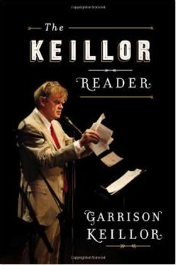
Screen Shot 2014-05-28 at 3.30.05 PMGarrison Keillor, the NPR humorist best known for his tall tales of Lake Wobegon, published a new book earlier this month, and member Larry Randen reports that John Updike is prominently mentioned in the introduction of The Keillor Reader:

“I think often of John Updike, who lovingly re-created the backyards and clotheslines of the 1940s small town and described a snowstorm as ‘an immense whispering’ and wrote beautifully of his father bidding him goodbye on a train platform and astonishing him by planting a kiss on his cheek. I last saw John on the New York subway, riding from 155th Street down to 72nd, a white-haired gent of seventy-five grinning like a school kid. At 110th a gang of seminarians boarded and crowded around him, chattering, not recognizing him, and he sat soaking it up, delighted, surrounded by material” (xxxi).

Randen says that he and his wife, Lollie, went to hear Keillor read from his new book at the Fitzgerald Theater in St. Paul, Minn., and that Updike also was mentioned during a Q&A session.

According to Randen, “The first question was: ‘Who is/was your favorite writer?’ Keillor said, ‘John Updike’ and offered a few sentences about how good Updike’s writing was and then added an anecdote about ‘The Last Time I Saw Updike a Couple Years Before His Death.’

“In his response to the first question he told the same account [as he included in the introduction] but added that ‘the seminarians were excitedly arguing about Karl Barth, a favorite neo-orthodox theologian who was also a favorite of Updike’s; the students had just come from a lecture about Barth and were caught up with discussing issues about Barth, pro and con, and hearing this pleased Updike to no end as he sat there anonymously soaking the moment up and smiling, perhaps, because another generation had discovered Barth.”

Here’s a link to the Amazon.com sell-page for The Keillor Reader, where you can “look inside” and see the table of contents and a sample chapter.


Early review appears of the UK version of Begley’s bio

It’s not on the Internet, but thanks to David Lull we have a transcript of an early review of the UK version of Adam Begley’s Updike:

“Beautiful dreamer.” Jenny Needham. Northern Echo [Darlington (UK)]. May 5, 2014. 42.
Adam Begley provides the ideal companion to the life of writer John Updike
Non-fiction Updike by Adam Begley (Harper [pounds]25, eBook [pounds]25)

“For the second half of the 20th Century, John Updike bestrode the world of US fiction as the definitive man of letters. His best novels—notably the Rabbit tetralogy—invited comparison with the greats of the 19th Century.

“Effortlessly prolific, absurdly versatile and almost invariably wordperfect, his output included more than a dozen novels, around 100 short stories (many lodged with the New Yorker, his spiritual home), several hundred book reviews (ditto), collections of light verse, and writings on golf, art and all sorts of miscellaneous topics.

“He was the sort of writer who could turn even a frivolous magazine commission into a text of lasting beauty. Yet for all the prizes and adulation, he originally hoped to make it as an illustrator, and secretly wished that people took his serious poetry more seriously.

“In Adam Begley, Updike has a biographer worthy of his talents. A fine writer in his own right, Begley is empathetic but not uncritical, and organises his story thematically—golf, infidelities, travels abroad etc—rather than follow a strict chronology.

“Begley is a close reader of the texts, adept at teasing out both pointed literary insights and the biographical parallels between the life and the fiction. These, it turns out, are almost embarrassingly easy to find: adultery in the suburbs, the death of parents, the character of his children, the travails of being a grandparent. . . Updike ruthlessly pillages his and his loved ones’ personal lives for material.

“For me, the first two-thirds of the book could not have been bettered.

“But the final sections, detailing Updike’s late writings and death, have a disappointingly foreshortened feel.

“All in all, though, if you love Updike you’ll absolutely love this book.”

Note: To read the online reviews of Updike collected thus far (which now number 59), click here.