Blackbird Theater brings “Roger’s Version” to the stage

Roger'sVersionart

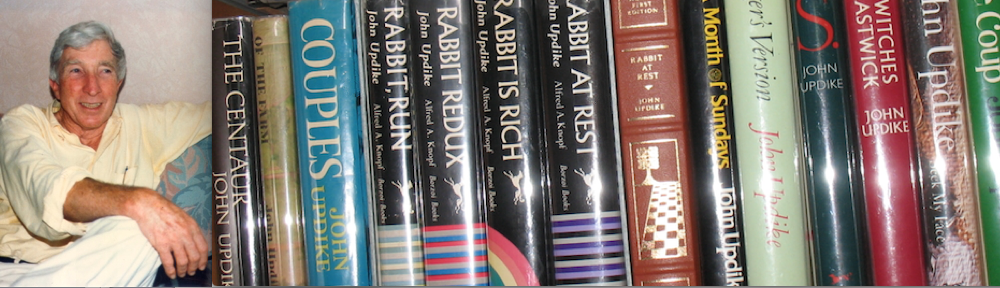
On May 30 Blackbird Theater of Nashville, Tenn., will conclude its 2013-14 season with the world premiere of Roger’s Version, a play adapted from the Updike novel of the same name.

“Having received special permission from the Updike estate, Blackbird Artistic Director Wes Driver has written and will direct this original adaptation. . . ,” ArtsNash reports.

“There are plenty of stories that entertain you. Fewer that genuinely move you,” the director writes. “And then there are those very rare ones that, for some reason or other, cut you to the core—or seemingly raid your psyche—expressing your most deeply felt passions and perspectives. The characters are so vivid, you feel like you know them. Intimately. Because, truth be told, they seem to be reflections and extensions of yourself. That’s what Roger’s Version is to me.”

Here’s the full story, with photos.

Time to register for the 3rd Biennial John Updike Society Conference

In 2010, John Updike Society members convened in Reading, Pa., for the 1st Biennial John Updike Society Conference, and after visiting Suffolk University and Boston two years later, we return to Alvernia University October 1-4, 2014 for the 3rd Biennial John Updike Society Conference3rd Conference registration form

picture-12The John Updike Society is comprised of 260 members who live in 15 different countries, and our conferences have been an enjoyable time to meet new people and old friends, and to talk about all things Updike with like-minded individuals. Call for Papers extended

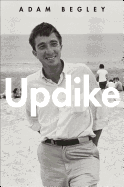
Adam Begley’s biography of Updike has been everywhere in the news, and Adam (right) will be our closing keynote speaker for the conference. Our other keynote speaker is Chip Kidd, who has been called the “rock star” of graphic designers because he has crafted so many iconic images, among them the cover for Michael Crichton’s Jurassic Park and, of course, many of John Updike’s dust jackets. He had a great deal of interaction with Updike, and we look forward to his and Begley’s remarks.

Alvernia University will welcome us back this year, with university president and society member Tom Flynn hosting a reception and members getting the chance to spend some time in The John Updike Society Archives at Alvernia.

This conference we celebrate the society’s acquisition of The John Updike Childhood Home, with an afternoon tour of the house, walking tour of Shillington, and picnic lunch on the Kiddgrounds of the house. We’ll also get to see the Reading Public Museum, where Updike’s interest in art and antiquities was partly shaped, and where The Drinking Girl that inspired him is again on display. The museum will even mount a special exhibit for us of items Updike mentioned which have since been in storage, and a reception there will be sponsored by Albright College, which has links to Updike—the most recent being their donation of wood from the old bleachers that was used to create new storm windows for The John Updike Childhood Home.

Every conference registrant will get a t-shirt commemorating their visit to the house, the first society event to be held there. As with the first conference, there will be a session featuring Updike classmates and another by the Updike family. We’ll also take a bus tour of the City Park, Pagoda, other Rabbit, Run sites, and sites that reflect the local flavor of an area that meant so much to John Updike.

The conference hotel is the historic Abe Lincoln in downtown reading, which is a safe walking distance from numerous restaurants and bars, among them The Peanut Bar, where a young John Updike hung out when he worked for the Reading Eagle newspaper.   Continue reading

Deadline extended for Third Biennial Conference paper submission

Academics are a busy lot, and with the semester just now ending for some, people are just now turning to thoughts of possible paper topics. As a result, The John Updike Society has extended its Call for Papers deadline for the Third Biennial John Updike Society Conference in Reading, Pa., hosted by Alvernia University October 1-4, 2014. The new deadline is JULY 15, 2014.

Call for Papers extended


The Other John Updike Archive is posting again

After a brief hiatus, The Other John Updike Archive is posting again:

“In Every Dream Home A Heartache”

“Will you still love me tomorrow?”

“And In The Beginning…”

Couples: The story you’re about to read is true…

“Celestial Seasonings (on being JUish)”

“Here’s looking up your old address”

Cape Fear Redux

“Ex Pat Updike? Not bloody likely!”

Updike house restoration draws Illinois interest

On May 7, 2014 The Pantagraph (Bloomington-Normal, Ill.) did a story on Updike Society president Jim Plath’s involvement with the ongoing restoration of The John Updike Childhood Home in Shillington, Pa.

For the curious:

“IWU professor helps save John Updike home.” 

The last time the newspaper published an item about the house it led to the donation of a handsome set of Updike first editions that will be on display at the house, once construction is completed. Who knows? Maybe this one will lead to more donations.

Begley weighs in with his Top 10 Updike short stories

In a story that appeared today, Updike biographer Adam Begley shared his picks for “Top 10 John Updike short stories” with The Guardian. Click on the link for details, but we won’t keep you in suspense for his picks:

“The Happiest I’ve Been” (1958)

“Separating” (1974)

“A&P” (1960)

“A Sandstone Farmhouse” (1990)

“The Blessed Man of Boston, My Grandmother’s Thimble, and Fanning Island” (1960)

“The Bulgarian Poetess” (1964)

“Bech in Czech” (1986)

“Problems” (1975)

“Here Come the Maples” (1976)

“My Father’s Tears” (2005)

Whether by choice or by happy accident, it’s worth noting that Begley’s list contains a story from every decade Updike worked as a professional writer.

Salon interviews Begley on Updike

On May 5, 2014, Salon published an interview that David Daley conducted with Updike biographer Adam Begley,

“Adam Begley on John Updike: ‘He believed he was doing something more important than the feelings of the people around him.'”

In it, Begley talks about the hazards of writing a biography and shares his thoughts on some of Updike’s friends and harshest critics, among them:

“[Christopher Lasch and Updike], I think, egged each other on, and pushed each other to greater academic feats. It’s weird enough that they were roommates, what’s even weirder is that they then both graduate summa, that Kit Lasch gets the prize for best thesis, and Updike gets the No. 2 prize. I mean, I don’t suppose that’s ever happened before in the history of Harvard, freshman year roommates getting No. 1 and No. 2 essay prizes, and graduate summa. It’s an extraordinary coincidence.”

“Jonathan [Franzen] has very harsh words for Updike. And I remain convinced—and I admire Jonathan’s work and I’m fond of Jonathan personally—but I believe that he’s suffering from a bit of anxiety of influence here. That he feels the need to denigrate Updike because his project is really not very different from Updike.”

“Let’s go back to 1996, ’97. David Foster Wallace is the flavor of the month. He’s just published ‘Infinite Jest.’ John Updike has just published a novel set a couple years in the future, which is somewhat eerily like the future world of ‘Infinite Jest.’ . . . So yes, I got David Foster Wallace [to review the novel], but no, I was not involved in the attempt to assassinate Updike . . . . David Foster Wallace was not a full-blooded critic of Updike. He had in his collection a heavily annotated copy of ‘Rabbit, Run.’ He is an Updike fan. But ‘Toward the End of Time’ is not a good novel.”