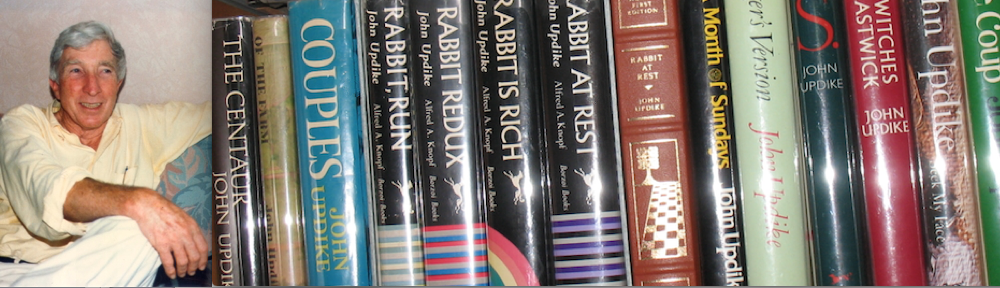
Garrison Keillor remembers Updike’s birthday

Although The Writer’s Almanac featured a poem by Tom Hennen yesterday, unabashed Updike fan Garrison Keillor still remembered the author’s birthday with a nice long biographical summary, lest anyone forget:

“It’s the birthday of writer John Updike (books by this author), born in Reading, Pennsylvania (1932). His father was a high school teacher, and his mother aspired to be a writer; Updike said: ‘One of my earliest memories is of seeing her at her desk. I admired the writer’s equipment, the typewriter eraser, the boxes of clean paper. And I remember the brown envelopes that stories would go off in — and come back in.’ As a boy, Updike wanted to be a cartoonist, not a writer. He cut out comic strips and sent fan letters to cartoonists, drew caricatures of classmates, made posters, and tried to draw cartoons like the ones he saw in his family’s copy of The New Yorker. As a teenager, he sent his cartoons to major magazines, including The New Yorker, and although he didn’t publish any there, he did earn five dollars selling a cartoon to a dairy journal. He went to Harvard, where he joined the staff of The Harvard Lampoon as a cartoonist, but ended up writing too. By graduation, he was fairly certain that he would become a writer instead of an artist. He said of writing: ‘It took fewer ideas, and I seemed to be better at it. There is less danger of smearing the ink.’

“Despite his intentions to become a writer, he got an art scholarship to study at Oxford. He was newly married, and he and his wife moved to England, where their first daughter was born. While he was at Oxford, he met E.B. and Katherine White, who were vacationing in England. They convinced him to apply for a job at The New Yorker, so after his time at Oxford, he moved to Manhattan to work as a staff writer for the magazine, writing the ‘Talk of the Town’ column. He was not a big fan of life in the city — he said, ‘The place proved to be other than the Fred Astaire movies had led me to expect.’ Two years later, the Updikes had a second child and decided to leave New York and move toIpswich, Massachusetts. Updike had just turned 25 years old.

“Soon after his move, he published his first books: a book of poems, The Carpentered Hen (1958); a novel, The Poorhouse Fair (1959); and a book of short stories, The Same Door (1959). Another son was born in 1959, and a daughter 19 months later. Despite the success of those early years — in 1960 he published Rabbit, Run, the first of his great books featuring Rabbit Angstrom — he underwent a spiritual crisis. He said, ‘These remembered gray moments, in which my spirit could scarcely breathe, are scattered over a period of years; to give myself brightness and air I read Karl Barth and fell in love with other men’s wives.’

“After the birth of his third child, he had rented an office above a restaurant in Ipswich, and spent several hours each morning writing there. Throughout his 50-year career, he remained devoted to that schedule, writing about three pages every morning after breakfast, sometimes more if things were going well. He said: ‘Back when I started, our best writers spent long periods brooding in silence. Then they’d publish a big book and go quiet again for another five years. I decided to run a different kind of shop.’ He wanted to publish about one book a year, and took Sundays off for church, although later in his career he sometimes worked on Sundays too. In 2008, he said, ‘I’ve become a beast of the written word, a monster of a kind, in that it’s all I can do.’

“Updike published more than 60 books in his lifetime, including 28 novels. His books include Couples (1968), Rabbit is Rich (1981), The Witches of Eastwick (1984), and The Complete Henry Bech (2001).

“He said: ‘At the point where you get your writerly vocation you diminish your receptivity to experience. Being able to write becomes a kind of shield, a way of hiding, a way of too instantly transforming pain into honey.'”
Boston Common offers tour of Updike’s old North Shore home

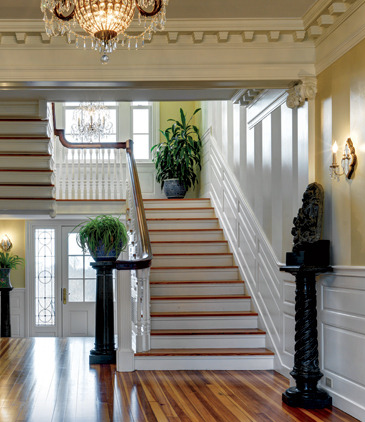
Screen Shot 2015-02-23 at 9.12.20 AMThe current owners of a grand Georgian home on the North Shore where Updike lived for years have opened the house for a Boston Common Magazine tour, complete with three photos of the Haven Hill house as it looks now:

“A Tour of John Updike’s Former North Shore Home”

The article, written by Alexandra Hall, begins with a quote from Updike:  “‘Every novelist becomes, to a degree, an architect,’ wrote the revered John Updike in 1985. ‘A novel itself is, of course, a kind of dwelling, whose spaces open and constrict, foster display or concealment, and resonate from room to room.’

“It’s a telling analogy from a man who viewed both his writings and his homes as such personal endeavors. And when design consultant Suzanne Eliastam was approached by the new owners of one of the late author’s most beloved abodes—a grand Georgian home on the North Shore named Haven Hill, where Updike lived for hears—she took that sentiment to heart in redecorating it.”

We’re told that one of its “most impressive pieces is something Updike left behind:  a huge mirror, almost 10 feet tall, framed in wood with gold leaf. It shared space in the living room with the original fireplace, both of which were left untouched while the room was renovated.”

David Updike on Growing up Updike

GrowingupUpdikeDavid Updike, the current John Updike Scholar in Residence at Alvernia University, is featured in a new Alvernia Magazine article titled “Growing up Updike” (pp. 20-24).

In it, he talks about what it’s like being the son of one of America’s most celebrated authors and shares memories of one particular family trip to Pennsylvania, where his father “took us to see his old house in Shillington, but was too shy to knock and ask to go in,” so he “walked us back to the playing field [at the high school behind the house] and the shelter where he used to play roof ball,” David writes.

“Even at an early age I could sense his disappointment that we seemed to underappreciate these places which, for him, held such sweet emotional weight—the memory of childhood, of his being seven, or so, and sprinting out of the side door of his house [at 117 Philadelphia Ave.] to join his friends in the Pennsylvania twilight, to play a final game of roof ball.”

DavidUpdike“It must have been a surprise to my parents, as it was to me, when I started to write short stories, and then odder still, had them accepted by The New Yorker. Photography, not writing, had been my preferred medium, and I knew well that my father had toiled for a decade or so—sending off countless cartoons, and spots, and light verse—before his poems were accepted by The New Yorker.

“I knew that my own success was somehow unjustified—unearned. I need not have worried, for in my mid-twenties things got more difficult, and I was languishing in New York, where I had moved for no very good reason . . . .”

Blogger shares Updike postcard

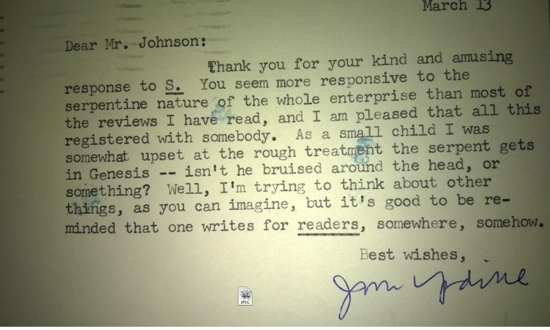
“Writing to Updike” is something that many readers and fans have done, and blogger  Jeffrey Johnson has shared his own experience, complete with Updike’s response to his letter. Johnson notes Begley’s comment that Updike had mailed out “thousands of print-crowded three-by-five postcards” over his lifetime, and says, “Three of those thousands of postcards were addressed to me, one in response to each of three letters I wrote to Updike about his books.

“The first of those letters, written in the mid 80’s on my college electric typewriter, was a reflection on the novel Roger’s Version. The letter began with the thought that Updike might prefer that his readers would not bother to write back. The first line of the postcard sent from Updike–which landed in the general delivery box of the South Chatham Post Office and was handed across the counter to me–was, No, letters like yours written back are always welcome.

“A few years later, in response to comments I sent on his next novel S. which, like Roger’s Version, was an inspired reworking of Nathaniel Hawthorne’s The Scarlet Letter, Updike sent a note:


Updikepostcard

An eye on Barth, Updike, and Baltimore

Screen Shot 2014-10-30 at 9.36.38 PMThe Millions published an essay titled “When Updike Met Barth,” by Nathan Scott McNamara, who teaches at Johns Hopkins University and serves as the Denis Family Curatorial Fellow for Special Collections Resource Center there. In the article, he includes Updike’s typed response. At the time, Updike was 34, and Barth was 36, but Updike was not inclined toward public speaking. But he accepted Barth’s invitation to come to Baltimore to do a reading.

“On Friday, April 18th, 1975, Updike arrived in Baltimore with, in his words to Barth, “A Martha Bernhard.” After he gave his talk, “The next morning, Barth and Shelley and Updike and Martha went on a literary tour of Baltimore. They visited Edgar Allan Poe’s grave. They went to the H.L. Mencken House. They got soft-shell crab for lunch. Then John and Martha got on a plane back to Massachusetts.”

“After Updike died, Martha, who married Updike in 1977, told Barth in a letter that this first trip was not only the beginning of her relationship with Updike, but also the occasion on which Updike changed his mind about readings. ‘He took to it,’ Martha wrote, ‘as he didn’t to teaching, and thus began a modest, but consistent reading schedule that he truly enjoyed.”

Reacting to this article, Baynard Woods contributed an item to the Wandering Eye page of Citypaper.com in which he details a 1967 trip to Baltimore that Updike made at the invitation of then-Hopkins’ prof John Barth.

The columnist writes, “Of course we’re always looking for literary bits about Baltimore, but the fascinating part of the Millions account is the long friendship that this trip inspired between two authors who, though as different as possible in style, immensely admired one another.”

The Other John Updike Archive shares more treasure

The Other John Updike Archive recently shared a torn and taped photo of Updike sitting in a boat, from the cover shoot for Hugging the Shore. But of great curiosity: Paul Moran has posted a photo of the shorts that Updike was wearing, along with the “cheap watch.” And he speculates why Updike would have held on to those particular items for so long, only to finally throw them out.

Here’s the link.

On writers and their would-be-writer moms

Today the National Post posted a story by “Barbara Kay: We all know about John Updike. But what about his mother?” 

In it, she talks about her friend, David Siegel, an “evolving short-story writer” and his experience taking an Iowa Writer’s Workshop summer class from Robert Anthony Siegel in which a classmate was Siegel’s own 75-year-old mother, and that leads her to consider the relationship that Updike had with his own mother, also an aspiring writer who was published late in life after her son’s success, but who worked at becoming a writer when he was still a young boy.

“Perhaps Linda’s greatest gift to her son was her unconditional respect for the artist’s obligation to speak his own truth without regard to the feelings of those he writes about,” Kay writes.

Beam us up, Michael

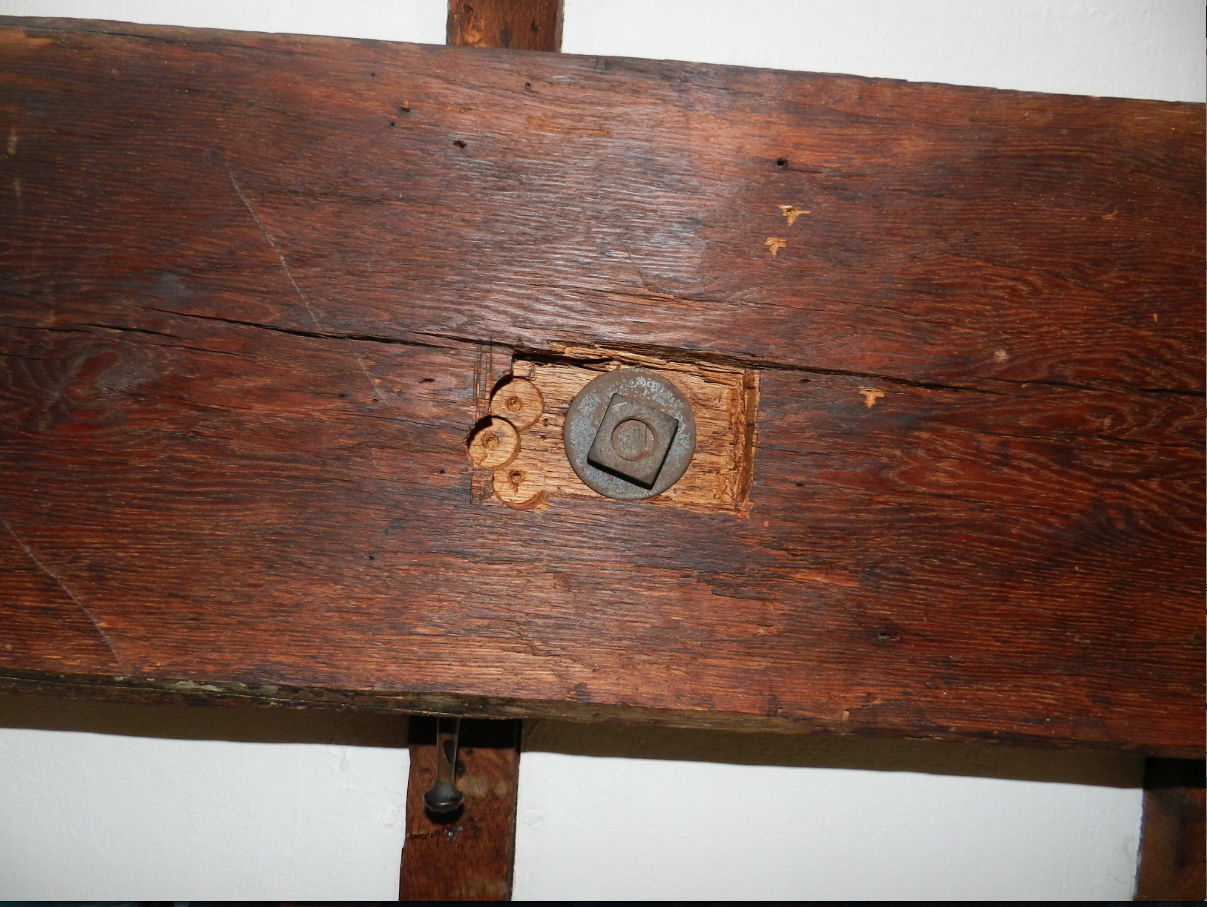
Screen Shot 2014-07-03 at 8.07.21 AMMichael Updike recently got a chance to look inside the Polly Dole House at 26 East Street in Ipswich where his father and family lived from 1958-1970, because the current tenants were moving out. And he took the opportunity to snap a photo of the nut and washer in the summer beam that his father described in an essay for Architectural Digest, “John Updike: The Houses of Ipswich,” which Begley cites in his biography:

“In the middle of the summer beam, a huge nut and washer terminated a long steel rod that went up to a triangular arrangement of timbers in the attic; at one point the whole house had been lifted by its own bootstraps. I used to tell my children that if we turned the nut the whole house would fall down. We never tried it.”


Omnivoracious features Updike trivia

It’s come to our attention that in April, to promote Adam Begley’s biography, Updike, Begley supplied the readers’ website Omnivoracious with a brief bit of trivia:  “Five Things You Didn’t Know About John Updike.” 

But my guess is that most members will know the first and third “fun facts,” and anyone who attended the Second Biennial John Updike Society Conference in Boston will know the fourth one, and, if they were paying attention, the fifth!


Updike materials exhibited at the Houghton Library through May 31

Screen Shot 2014-05-29 at 8.03.29 AMThe Houghton Library at Harvard University is the main repository for Updike materials, and through May 31 you can catch a glimpse of those materials in a ground floor exhibition (Chaucer Case). Here’s the description:

John Updike was in many ways an ideal Harvard student. He worked diligently at his studies, as evidenced by the marginalia recorded in the books he used in class (he graduated summa cum laude in 1954); he was an active member of the Harvard Lampoon, and served as president (nearly two-thirds of each issue during his senior year are attributed to him); he also remained a loving son, regularly writing amusing letters home to his parents in Shillington, Pennsylvania. Although Updike originally envisioned a career as an artist, there is evidence of the emerging professional writer; as a student, Updike received high marks on work that he would later submit to The New Yorker and other publications.

Updike began depositing his papers at Houghton Library in 1966; the collection was purchased by the library following his death in 2009. Updike meticulously shepherded his work through every stage of its publication, and the collection includes multiple drafts, prints and proofs of his novels, short stories, poems and essays, correspondence with colleagues, family, and friends, and Updike’s own copies of his books as well as books by other authors from his library.

The exhibition will be on display May 27, 28, 30 and 31. Click here for library hours.