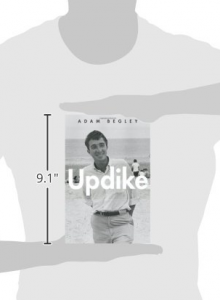
Another list includes the Begley bio

The New Statesman posted “Books of the Year: NS friends and contributors choose their favorite reading of 2014,” and Leo Robson, a freelance writer who contributes regularly to the NSFinancial Times, and the Times Literary Supplement,  included Updike in his round-up:

“Books of the year tend to be submitted too early to acknowledge November and December releases, so it’s only right to single out a book from late 2013, Nina Stibbe’s hilarious Love, Nina: Despatches from Family Life (Penguin, £8.99). The freshest piece of new fiction I read was the 250-page narrative about a gay bookshop that runs through Philip Hensher’s patchwork novel The Emperor Waltz (Fourth Estate, £18.99). A genuine surprise omission from the recent shortlists, it’s Hensher’s third book on the trot – after King of the Badgers and Scenes from Early Life – that hasn’t had its due. I’m eternally grateful to Adam Begley for his diligent and stylish Updike (Harper, £25), which answered a thousand questions.”


Begley bio makes Washington Post notable list

The Washington Post published a list of “50 notable works of nonfiction,” and it’s no surprise that the much-praised biography Updike, by Adam Begley, made the list.

Entries are alphabetical, so Updike comes near the end, and the annotation is short but sweet:

“Begley not only chronicles Updike’s life but also manages to produce a major work of criticism.”

You have to be a subscriber to access the full story, but The Wall Street Journal also included Updike in a round-up of “Gift Books: Biography.” Here’s what they had to say about Begley’s bio:

“Elegantly written as well as psychologically acute, both John Lahr’s Tennessee Williams: Mad Pilgrimage of the Flesh (Norton, 765 pages, $39.95) and Adam Begley’s Updike (Harper, 558 pages, $29.99) superbly chronicle the second half of the 20th century from the vantage point of two very different American authors. Tennessee Williams, the consummate outsider, said he wanted to speak the truth as he saw it, but his romance with the theater brought him pleasure as well as self-consuming pain. Copiously drawing on Williams’s stunning letters and journals, Mr. Lahr balances quotation and interpretation, sympathy and criticism, in this searing and unforgettable portrait of the artist who gave voice to the repressed, the reviled and the restless. And in his fond but gimlet-eyed depiction of John Updike, a consummate insider, Adam Begley depicts the celebrated author as professional writer and proficient evader. Mr. Begley’s Updike comes across as vigorously self-confident and tacitly aggressive, as well as frank and furtive. As the author notes, “biography ought to give a sense of what its subject was like to shake hands with,” and he accomplishes just that in this lucid, elegant and not-to-be missed book.”

Begley bio is an Amazon Best Book of 2014

Screen Shot 2014-11-09 at 6.23.42 AMAmazon.com jumped on the best books bandwagon with a list of the Top 100 books of 2014, and Adam Begley’s bio, Updike, measured up pretty well at #11:

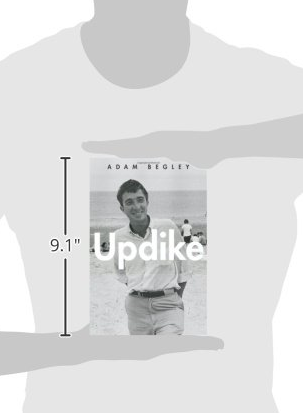
Updike is Adam Begley’s masterful, much-anticipated biography of one of the most celebrated figures in American literature: Pulitzer Prize-winning author John Updike—a candid, intimate, and richly detailed look at his life and work.

In this magisterial biography, Adam Begley offers an illuminating portrait of John Updike, the acclaimed novelist, poet, short-story writer, and critic who saw himself as a literary spy in small-town and suburban America, who dedicated himself to the task of transcribing “middleness with all its grits, bumps and anonymities.”

Updike explores the stages of the writer’s pilgrim’s progress: his beloved home turf of Berks County, Pennsylvania; his escape to Harvard; his brief, busy working life as the golden boy at The New Yorker; his family years in suburban Ipswich, Massachusetts; his extensive travel abroad; and his retreat to another Massachusetts town, Beverly Farms, where he remained until his death in 2009. Drawing from in-depth research as well as interviews with the writer’s colleagues, friends, and family, Begley explores how Updike’s fiction was shaped by his tumultuous personal life—including his enduring religious faith, his two marriages, and his first-hand experience of the “adulterous society” he was credited with exposing in the bestselling Couples.

With a sharp critical sensibility that lends depth and originality to his analysis, Begley probes Updike’s best-loved works—from Pigeon Feathers to The Witches of Eastwick to the Rabbit tetralogy—and reveals a surprising and deeply complex character fraught with contradictions: a kind man with a vicious wit, a gregarious charmer who was ruthlessly competitive, a private person compelled to spill his secrets on the printed page. Updike offers an admiring yet balanced look at this national treasure, a master whose writing continues to resonate like no one else’s.
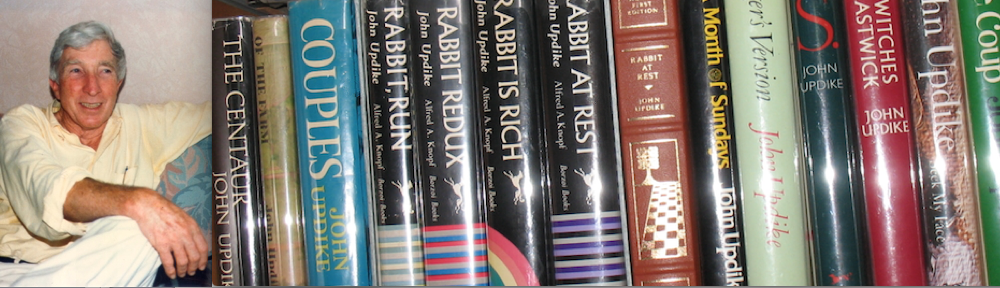
Updike makes another best novels of all time list

The Telegraph in September (how did we miss that?) posted “100 novels everyone should read; the best novels of all time from Tolkien to Proust and Middlemarch,” and Updike made the list:

43 The Rabbit books by John Updike
A former high school basketball star is unsatisfied by marriage, fatherhood and sales jobs.

Updike contemporary Ian McEwan made the list (#30, Atonement), as did Muriel Spark (#48, The Prime of Miss Jean Brodie), Toni Morrison (#50, Beloved), Don DeLillo (#51, Underworld), JD Salinger (#52, The Catcher in the Rye), Margaret Atwood (#53, The Handmaid’s Tale), Vladimir Nabokov (#54, Lolita), Gabriel Garcia Marquez (#60, One Hundred Years of Solitude), Joseph Heller (#77, Catch-22), and Jack Kerouac (#87, On the Road). It’s very much a classics list, with George Eliot’s Middlemarch coming in at #1, followed by Herman Melville’s Moby-Dick, Leo Tolstoy’s Anna Karenina, Henry James’ The Portrait of a Lady, and Joseph Conrad’s Heart of Darkness.

Updike makes another worst list

Screen Shot 2014-10-11 at 7.21.00 AMThe editors of The American Scholar decided to out “famous and infamous writers” for “first sentences of a novel, either overwrought or just plain embarrassing, that elicit a groan or a smack of the forehead,” and included among them is John Updike’s opening to The Widows of Eastwick:

“Those of us acquainted with their sordid and scandalous story were not surprised to hear, by way of rumors from the various localities where the sorceresses had settled after fleeing our pleasant town of Eastwick, Rhode Island, that the husbands whom the three Godforsaken women had by their dark arts concocted for themselves did not prove durable.”

Also making the list is a novelist with whom Updike “competed” all of his writing life. Philip Roth was upbraided for his opening line to The Breast: “It began oddly.”

The editors’ “highly subjective list” is titled “Ten Worst Opening Lines.”

Updike listed among 10 Great Writers Snubbed by the Nobel Prize

“Are the Nobel Prize-givers anti-American?” a feature in The Telegraph begins. “They have, after all, ignored giants of American literature, including Mark Twain, Henry James and John Updike. There have certainly been currents of anti-Americanism in the pronouncements from the Swedish Academy. In 2008, Horace Engdahl, the permanent secretary at the time, declared: “The U.S. is too isolated, too insular. They don’t translate enough and don’t really participate in the big dialogue of literature. That ignorance is restraining.”

So are comments like that.

Updike was #10 on The Telegraph‘s list. The top snub was Leo Tolstoy, followed by Marcel Proust, James Joyce, Virginia Woolf, Jorge Luis Borges, Vladimir Nabokov, WH Auden, Primo Levi, and Chinua Achebe.

“10 great writers snubbed by the Nobel Prize”