In a post-election essay, Tanenhaus praises Rabbit Redux

Sam Tanenhaus, who interviewed John Updike on many occasions, wrote in a post-election essay that Rabbit Redux “remains the most illuminating and prophetic of modern political novels, though on the surface it seems not about politics at all.”


Here’s the link to “John Updike’s ‘Rabbit Redux’ and White Working-Class Angst,” with thanks to Maria Mogford for drawing our attention to it. The photo is courtesy of The New York Times.

Podcaster spotlights The Witches of Eastwick

The Witches of Eastwick was the latest “forgotten fiction” to be featured on Why I Really Like This Book, podcasts by Dr. Kate Macdonald, a lecturer in English Studies at Ghent University, Belgium.

She sends the link, hoping it “might be interesting, and hopefully entertaining, to Updike scholars. I’m not one myself,” she says, “but I gave an honest opinion.”

Thanks to Dr. Macdonald, with a reminder:  You don’t have to be an Updike scholar to join the Society!

O’Brien for President blog dredges up an old Updike story

Conan O’Brien insists he’s running for president in 2012, and recently his blog revived a May 26, 2011 post we all missed about an O’Brien-Updike connection.

Interestingly, both O’Brien and Updike served as president of the Lampoon while at Harvard. But that’s not the connection. Here’s the link. Thanks to member Larry C. Randen for calling it to our attention. And Conan, if you’re reading this, how about commenting here about what Updike told you?

Drinking Girl on display again in Reading

Michael Updike writes,

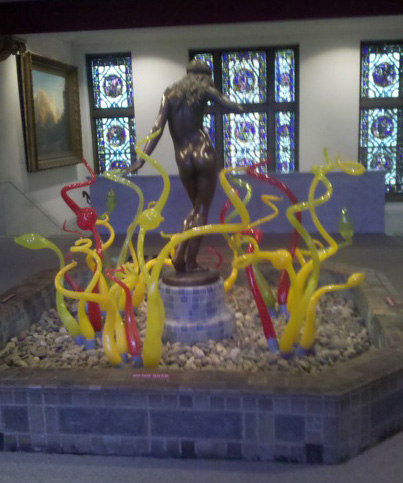
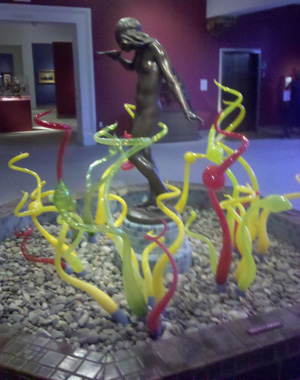
“While in Berks county, Liz, I and kids got to the Reading Museum and we were happy to see that the Drinking Girl fountain is back in her place on the third floor landing. They have our father’s description from The Centaur on display.

However, there is a slight twist to this situation in that from the water of the fountain emerges several Dale Chihuly red, green and yellow glass “reeds.” The girl is surrounded by them. It was a site-specific work that the museum commissioned, but I’m not convinced it is a successful marriage of contemporary glass and nineteenth century figurative work . . . although from the back the reeds rhythmically mimic her S-shaped posture.”

According to the Reading Public Museum, which hasn’t displayed Drinking Girl (by sculptor Edward McCartan) for three years prior to its current exhibition in conjunction with “Tiffany Lamps: Articles of Utility, Objects of Art,” the fountain that made a lasting impression on a young John Updike will remain on display for at least another six months. Museum hours are 11 a.m. to 5 p.m. Tuesday through Saturday, and noon to 5 p.m. on Sundays. They are closed on Mondays. Admission is $8.00.

Updike children honor their father at Plowville cemetery

Bruce Posten wrote a story for the Reading Eagle. This report was written by Society board member Jack De Bellis:

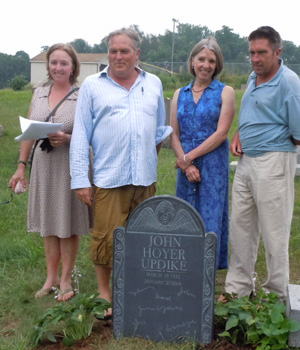
In Plowville Cemetery, where generations of John Updike’s relatives rest, John Updike’s children, Liz, David, Michael and Miranda gathered to show publicly their love for their father. The ceremony took the form of the placing of a headstone carved by Michael with affection and wit on Pennsylvania slate. The stone featured John Updike’s signature in its many representations, including “Johnny” as he was known by his parents. Linda and Wesley Updike rested only inches from the headstone. Atop the monument Michael had carved an angel in the New England style, a face with wings. He cleverly carved his father’s smiling face showing that though he feared death all his life, he had a faith which would enable him to ascend, happily, to heaven. On the reverse of the stone Michael had cut both stanzas from Updike’s poem “Telephone Poles”. There was little doubt he still communicated with those assembled.

The gathering included the spouses of Miranda and David, many of their children, and one, Trevor, who bears his grandfather’s features to a remarkable degree. John Updike’s blood flowed in many veins. Also honoring John were his former classmates and lifelong friends Jackie Hirneisen Kendall and Joan Venne Youngerman; David Silcox, who had kept Updike abreast of Shillington news; Jack De Bellis, Alvernia University’s John Updike Scholar in Residence; and Patricia De Bellis. Continue reading

More “More Just Looking”: Updike as Art

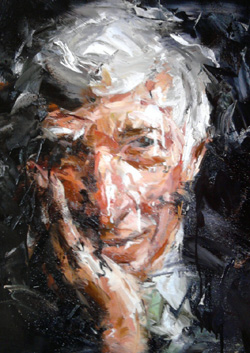
Member Andrew Moorhouse writes that for his 50th birthday he decided to treat himself and commissioned an artist friend to do a painting of John Updike.

Scholars and avid readers will recognize the image from a Frank Capri photo that adorned the cover of James O. Yerkes’ critical anthology on John Updike and Religion: The Sense of the Sacred and the Motions of Grace (1999). But, of course, the artist took the image into the realm of expressionism.

It’s the third such painting we know of, and seems somehow fitting and full-circle, given how Updike was inspired by art.

Persimmontree Magazine prints an Updike encounter

Persimmontree Magazine has a regular section called “short takes,” in which writers share small, lyric essays and reminiscences on a topic, and member Jack De Bellis drew our attention to the fact that Volume 16 (Winter 2010-11) features “My Night with John Updike,” by Lynne Davis.

She begins, “It’s not what you’re thinking. It’s not at all what you’re thinking.

“It started with a flyer in the mail room. On cream-colored paper, a man with a teacup. John Updike. He was coming to our rural Midwestern university.

“You could hear the whispers in the hall. ‘John Updike? The JohnUpdike? Why is he coming here?

“I fell in love with him when I was in college, when I read one of his stories in The New Yorker, ‘The Music School.’ His phrasing was lyrical, precise, so delicately balanced—like a Mozart piano concerto.”

To read more, follow this link to Persimmontree Magazine and scroll down for the rest of the story.

Poem: “Updike Redux”

This poem by Evelyn Lau was published in the The Malahat Review 171 (Summer 2010), which was released in September and reprinted here by permission of both the author and the review:

Updike Redux

Rain is grace; rain is the sky condescending to the earth.

—John Updike, “A Soft Spring Night in Shillington”

~

The sound of rain made you happy almost to tears.

Here, it’s November again. Lightning in the night,

the neighbor’s coughing through the drywall,

the tinny sounds of late night TV.

I try to remember gratitude, the wonder you felt

as a boy crouched under a wicker chair

on a porch in Shillington, storm showers falling

all around you like a benediction.

Is it possible we never met?

Perhaps your sleeve brushed mine, once,

in the desert where you spent the winter—

among the crowds on the baked streets

of Scottsdale, the avid tourists

and fake cowboys, you a tall man with a hawk nose,

skin red from psoriasis and sun.

Or perhaps we drove past your house

in the foothills of Tucson on our way back

from the Biosphere, microwave lines of heat

radiating above the road

as we crossed the dry riverbeds

toward the saguaro forest at sunset—

the talcum kiss of the parched air,

lurid watercolours in the sky. No,

this was April, you were in Beverly Farms,

it was the last spring of your life.

Here the soil sizzles, soaking up the downpour

after the Indian summer that lingered

like it would never end. Blue days of bluster

and blown leaves. The tree in the courtyard

a massed bruise, magenta and mauve,

the maples filtering blood through their spun keys.

If it was hard to be happy then, tell me how

to survive the winter. Tell me how

to get to Plow Cemetery, where soft fistfuls

of your ashes were scattered on stone.

Clouds of ashes, the colour of smoke and dust,

Lifting above the land

You loved so much, seeding with rain.