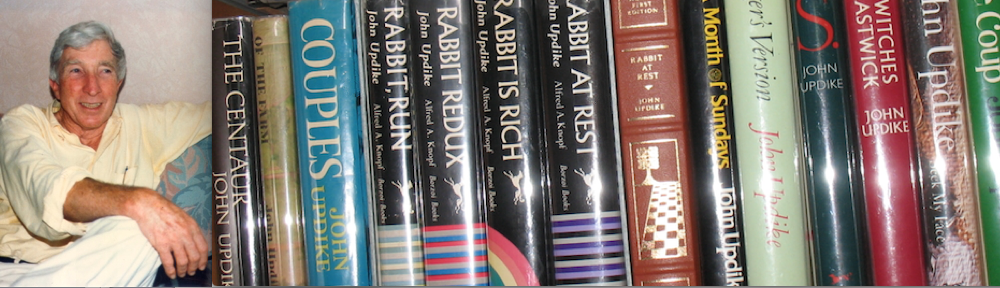
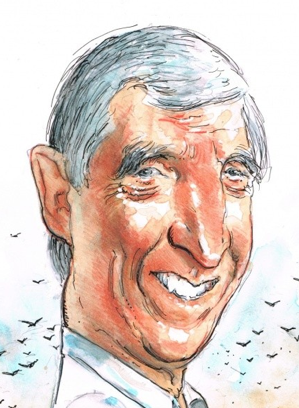
Conferences are fun reunions, but they also inspire people to attempt new projects. Shortly after the Third Biennial John Updike Society Conference in Reading, Pa. this past October, John McTavish thought it would be a great idea to do a round-up of members who would share their first exposures to Updike and important discoveries, as well as any recommendations they would have for would-be readers of Updike. Below are the fruits of his labor:
John Updike Readers Share Discoveries and Recommendations
“Only a very tiny list of writers comes to mind when you think of the finest American novelists,” Dick Cavett once noted, “and John Updike is certainly upon that very short list.” The British novelist Ian McEwan went even further recently claiming that “Updike at his best is… a great observer. He never ceases to surprise and delight me. I love the intelligence of the sentences with that odd little hard-to-define spring… an extra beat that quickens my pulse. Who else does that? Shakespeare, Milton and many, many other poets. Bellow does. Calvino. There’s no end of them, really. But never so copiously as Updike. One can read him at random and find some felicity on the page.”
This is high praise indeed from some pretty reputable sources. But the fact that Updike wrote over sixty books (compared with, let’s say, four for Salinger and nine for F. Scott Fitzgerald), makes it hard to say which is his best book or short story. Hence the variety of testimonies and recommendations here from a variety of readers all of whom have no hesitation in saying how much we appreciate that “odd little hard-to-define spring” in John Updike’s sentences.
First Exposures
We begin with DON GREINER, the dean of Updike criticism, who discovered the writings of John Updike while he was a student at the University of Virginia: “Because those were the days after the deaths of Hemingway and Faulkner, Frost and Eliot, etc. we used to gather in a pub after leaving the library around 10 pm to drink a few beers and to argue about which current American writer would take the place of the recently deceased American modernists. Bellow was mentioned a great deal, but most of us put our money on Salinger. We did not know, of course, that Salinger had vowed not to publish again, a vow that he kept. But one of our group of beer-drinking ‘intellectuals’ insisted that I read his copy of Pigeon Feathers and then decide. I have been reading Updike ever since.”
It was one of those stories collected in Pigeon Feathers that first turned JAMES PLATH onto Updike: “Like so many, my first exposure to Updike came in high school, when I encountered a short story vaguely reminiscent of J. D. Salinger’s that began, ‘In walks these three girls in nothing but bathing suits.’ With that first sentence, Updike grabbed the attention of every pubescent boy in every high school in America – even the back-row jocks who leaned in their chairs against the wall. ‘A & P’ appeared in the Points of View anthology, and it was easily one of the most accessible yet resonant stories we read in Honor’s English. ‘You know,’ the 19-year-old narrator says, ‘it’s one thing to have a girl in a bathing suit down on the beach, where what with the glare nobody can look at each other much anyway, and another thing in the cool of the A & P, under the fluorescent lights, against all those stacked packages, with her feet padding along naked over our checkerboard green-and-cream rubber-tile floor.’
“Apart from Salinger’s Catcher in the Rye, I couldn’t recall reading any literature with a capital ‘L’ where even a word like ‘naked’ or ‘bra’ appeared, much less a description of ‘the two smoothest scoops of vanilla’ inside it. Like the more graphic sexual descriptions which would follow in Couples, the Rabbit novels, and countless others, the metaphor seemed so startlingly right. But I also thought Updike perfectly captured the disconnect, the unrequited love between high school boys and girls that, at this stage in their lives, might as well have been Greek goddesses, for all their inaccessibility. Other Updike passages from other novels and short stories resonate, but you never forget the very first time that a writer speaks not just to you, but for you.”
JACK De BELLIS stumbled upon Updike in 1962 while teaching a freshman comp/lit course at UCLA and searching for a book that would show the world of Holden Caulfield as a grown-up, a person who couldn’t be saved from adulthood by the catcher in the rye: “I thought Rabbit, Run was perfect, and it was. Later I did a 45-minute radio review of the book; much later I published two articles: ‘Oedipal Angstrom’ and ‘Names in the Rabbit Trilogy,’ and of course went on to teach the book many times.”
BILJANA DOJCINOVIC was 15 or 16 years old when she went to the municipal library in Belgrade to borrow the recently translated novel everybody was talking about — Couples. But the librarian thought that she was too young for such a book, and refused to hand it to her, saying that Couples was a sociological study:
“Instead, she gave me Rabbit, Run…. The recognition of closeness came in the scene when Rabbit comes back home and finds Janice, pregnant and alcoholic in their messy apartment. Before he goes out again to fetch Nelson from his mother, Janice calls from the kitchen, ‘And honey, pick up a pack of cigarettes, could you?’ Her voice awakens in Harry a strange sensation: ‘Rabbit freezes, standing looking at his faint yellow shadow on the white door that leads to the hall, and senses he is in a trap. It seems certain. He goes out.’
“It was this image of the character in the trap, between the door leading back to the hall/hell and the one which was seemingly the exit, that made the deepest impression on me. Anti-hero Angstrom, obviously marked by existential Angst, facing the classic either/or of going with the family, problems and all, or moving outside and risking the loneliness and cold — spoke to my not-quite-conscious youthful dilemmas.”
“Seems to me, WILLIAM PRITCHARD recalls, “that one of the first, perhaps the first time I became really aware of Updike’s presence as a writer was at the end of ‘The Happiest I’ve Been,’ the final story in The Same Door. John Nordholm and his friend are driving to Chicago, and on the Pennsylvania Turnpike John’s friend Neil let him take the wheel while he sleeps. The following great sentence raised my consciousness:
There was the quality of the 10 a.m. sunshine as it existed in the air ahead of the windshield, filtered by the thin overcast, blessing irresponsibility – you felt you could slice forever through such a good pure element – and springing, by implying how high these hills had become, a widespread pride: Pennsylvania, your state – as if you had made your life.
“I found attractive earlier parts of the story, a post-high school gathering of John and his friends, but it was the ending that took off, and I felt as exhilarated as our hero.” Continue reading →