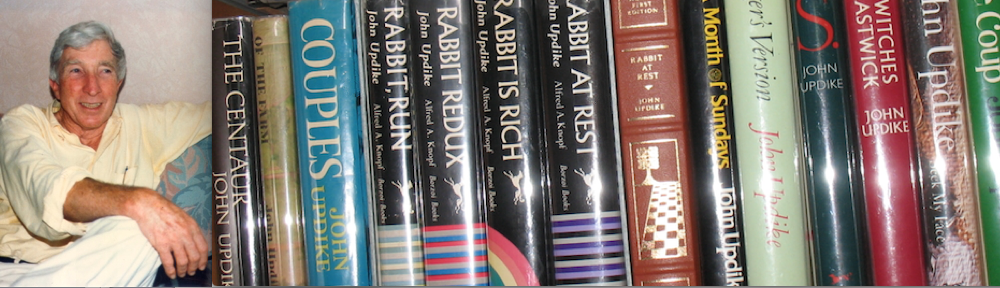
LitHub recently published a fascinating piece by Alex Vernon, “Bringing the War Home: How Tim O’Brien Approached the Art of Moral Consequence” (May 27, 2025), in which John Updike featured prominently.
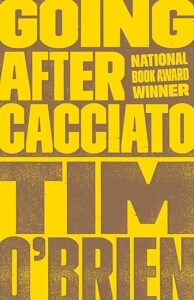 The issue was negative versus positive reviews. Christopher Lehmann-Haupt’s New York Times review was cited as an example of the former, with Lehmann-Haupt arguing that “by repeatedly invoking Catch-22 Mr. O’Brien reminds us that Mr. Heller caught the madness of war better, if only because the logic of Catch-22 is consistently surrealistic and doesn’t try to mix in fantasies that depend on their believability to sustain. I can even imagine it being said that Going After Cacciato is the Catch-22 of Vietnam. The trouble is, Catch-22 is the Catch-22 of Vietnam.”
Vernon wrote, “Not to worry, as The New York Times Book Review lauded the novel on its front page and didn’t cite Heller. It did bring in Hemingway, as did John Updike’s review in The New Yorker, which struck the opposite note as Lehmann-Haupt’s: ‘As a fictional portrait of this war, Going After Cacciato is hard to fault, and will be hard to better.’
“Cacciato enjoyed plenty of glowing reviews, yet Updike’s review had a huge impact on its success and helped convince the reading world to pay attention to the literature of O’Brien’s war. As O’Brien’s agent’s office wrote to Lawrence, “The John Updike review in The New Yorker seemed to be the word that tipped the scales against resistance to a Viet Nam novel, and now all the scouts are asking for it.”