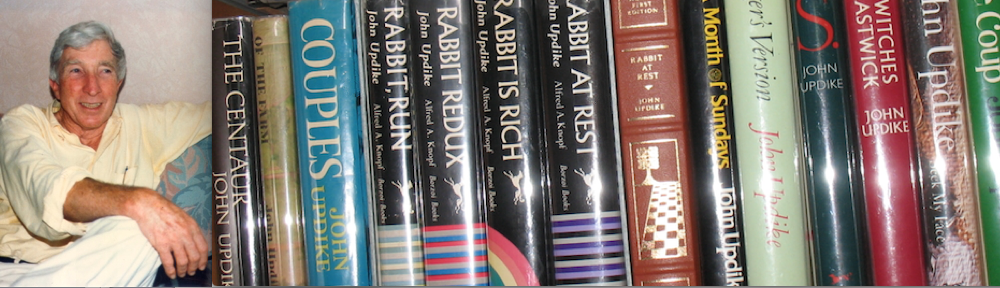
Bob Waite, whose father was Updike’s dentist back when the author lived and worked in Ipswich, has been a columnist for North Shore media for decades. Recently he wrote an opinion piece that was published by The Local News, “Lite Waite: Could John Updike, a Straight White Male, Find a Home in Today’s Literary Scene?”
It’s a fair question, but readers probably already know the answer. In fact, John Updike Society board member Sylvie Mathé was watching the new BBC miniseries Down Cemetery Road when she saw this allusion to Updike that perfectly captures the current situation (and provided these screenshots): 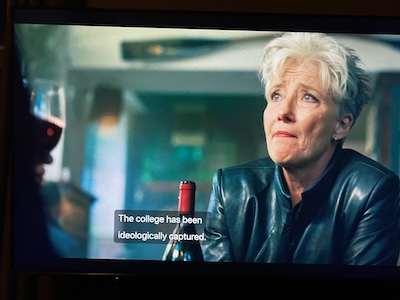
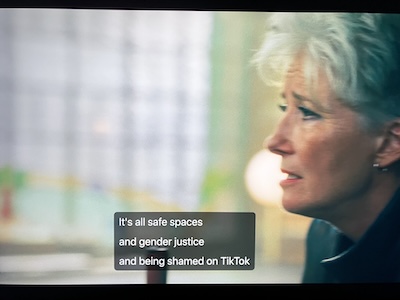

After Updike published his scandalous wife-swapping novel Couples in 1968, the attention the book brought elevated him to the role of spokesperson for America’s changing morality that deviated sharply from the staid 1950s. It’s no surprise then, that Updike would also become a lightning rod for criticism of male novelists during the era of “#Me Too.”
“There is no shortage of millennial white males who believe themselves shut out of a contemporary literary scene that seems curated by, and targeted at, women,” Waite wrote. “By implication, Updike would suffer a similar fate. To elaborate, Waite cites Ross Barkan (“From Misogyny to No Man’s Land”): “If men still sit at the top of publishing houses, it’s college-educated women writing, editing, and agenting most of the novels of note.” Barkan argues that straight white males have all but disappeared as authors and literary characters. Waite wrote, “He tells us that ‘between 2001 and 2011, six white men won the New York Public Library Young Lions prize for debut fiction. Since 2020, not a single white man has even been nominated (of 25 total nominations).'”
Waite asked New Yorker assistant fiction editor for her thoughts. “It’s complicated,” she told him. “Part of it has to do with the market. Today, many more women read books than do men. And of course there is an interest in providing readers with a greater diversity of voices.”
“She’s right,” Waite wrote. “Significantly more women today graduate from university. ‘They buy more books. They populate more book clubs. And they write. Plus, there are more individuals from diverse backgrounds—men and women of color; those from the LGBT community—getting published. . . . ‘We do have a short story in our upcoming issue written by a young male writer, Nathan Blum,’ Leyshon offered enthusiastically, as if describing a unicorn.
Probing further, Waite asked New Yorker editor David Remnick to comment, since The New Yorker basically gave Updike his start. “I’d like to think that John Updike, whose stories and Rabbit novels deserve a place on our eternal reading lists, will find their audience,” he said. “I am not deluded. Literary fashions change. Sometimes even the best writers are eclipsed for a while, and it might be true of late with Updike.'”
“The thing about eclipses is that they pass,” Waite wrote. “I side with Remnick that Upike will always find readers—and that men, with all their flaws, will eventually creep back into literary fashion.”