James Schiff’s long-awaited Selected Letters of John Updike will be released on Oct. 21, 2025, with a reading-booksigning-publication party scheduled that evening at the Salmagundi Club in New York City, where Schiff is in town to convene with other members of The John Updike Society for a joint Roth-Updike Conference with the Philip Roth Society.
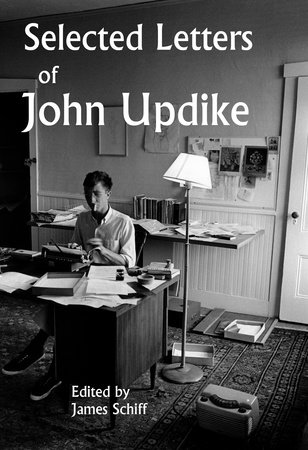 The volume of Updike’s selected letters, decades in the making and years in the gathering, runs a whopping 912 pages and is published by Alfred A. Knopf, Updike’s publisher.
Early reviews were positive . . . and insightful, while later reviews continue to positive to glowing.
Kirkus Reviews
“Missives from the mountain. Updike . . . wrote to everyone, from famous writers and politicians to librarians and family members. ‘I can’t believe that you’re cutting ‘Spider-Man,’ he wrote in a letter to the editor of the Boston Globe in 1994; after the letter, the Globe reinstated the comic strip. . . . In 1960, he wrote to publisher Alfred A. Knopf that his novels sought to present an image of an averagely physical young American.’ He resisted censorship, feeling that to cave to it would be ‘to funk my job.’ At times, though, he can be dead-on in his judgments: ‘I feel in general that literary history is too much modelled on biology when it is really more like geology. There is not much evolution; there is a great deal of accidental thrusts and upheavals and whatnot and when it’s all over a map is drawn.”
Read the entire review
WSJ – The Wall Street Journal, reviewed by Thomas Mallon
“In ‘Selected Letters of John Updike,’ a new and predictably enormous collection of Updike’s correspondence, we see all his lovers, spouses, neighbors and children as persons, and we experience Updike himself with even more candor than he displayed in his first-person essays. . . . The letters illuminate the consistency of Updike’s fiction aesthetic. Remarkably, at 19, he wrote of the need for ‘an author who can see America as clearly as Sinclair Lewis, but, unlike Lewis, is willing to take it to his bosom.’ He would maintain, decade after decade, that style ‘is nothing less than the writer’s habits of mind—it is not a kind of paint applied afterwards, but the very germ of the thing.”
Read the entire review (subscription required)
The New York Times, reviewed by Dwight Garner
“Schiff estimates Updike typed some 25,000 letters and postcards over the course of his life. . . . Some 700 of them have been resurfaced by the indefatigable Schiff, who teaches at the University of Cincinnati and is the founding editor of The John Updike Review. Despite Updike’s distance-creating geniality, what an enormous and beneficent bounty these letters are for anyone who cares about this country’s literature during the last half century.”
Read the entire review (subscription required)
Airmail, reviewed by Thomas Beller
“A fraction of the total, Schiff’s selection is still 822 pages long. At the outset, one feels a sense of fatigue and even dread about the climb ahead. By the middle, I was engrossed. And as I came to the last pages, I was surprised to feel a welling up of grief. . . . I felt a gratitude toward Updike at the end of this book that exceeded the feelings upon concluding one of his stories or novels. Maybe it was just nostalgia now that he is gone. Or maybe it’s that Updike’s industriousness, order, lyrical precision, and outbursts of libidinal energy now seem more attractive than they once did.”
Read the entire review
The American Conservative, reviewed by Peter Tonguette
“The superb, revelatory Selected Letters of John Updike gives an indication of the eagerness with which Updike wrote to friends, family members, both his wives, countless editors, and even the occasional critic. . . . Schiff presents Updike’s correspondence in chronological order, which gives the reader the pleasure of tracking the development of his intellect and the attainment of his aims, professional (in the form of contributions to the New Yorker) and personal (expressed most vividly in his marriage to his first wife, the former Mary Pennington, and the birthi of their four children). Some of the earliest correspondence gathered here reflects Updike’s youthful drive to become a cartoonist, though even in these examples, his gift with words shines through most clearly. . . . As Schiff promises, Updike’s letters commemorate and valorize everyday existence with as much vigor as his fiction.”
Read the entire review
Arkansas Democrat, reviewed by Philip Martin
“What emerges is not a corrective to Updike’s fiction but a parallel body of work–less burnished, more provisional, animated by the same faith that sentences matter and that daily life, properly attended to, yields meaning. . . . By the end, ‘Selected Letters’ reads like a long-running conversation with the world, sustained by curiosity, discipline and a refusal to retreat into abstraction. Updike believed, stubbornly, in making art from the given materials of his life. The letters show the cost of that belief as well as its rewards. They will not convert skeptics or silence critics. They offer instead a fuller sense of how a major American writer stayed productively engaged with his time, his peers and his own limitations, one envelope at a time.”
Read the entire review
The Atlantic, reviewed by Adrienne LaFrance
“Updike’s letters could constitute the outline for a never-published Updike novel. The writing is variously winking, earnest, desperate, oversexed, and ambitious. . . . And Updike is, as ever, captivating on the page. He experiments with format: Lists are often deployed for comic effect, as are the occasional doodle, self-portrait, or caricature. An otherwise mundane detail can be, in his hands, stop-and-read-it-twice beautiful.”
Read the entire review
Books (France), reviewed by Michel André
“Frequently funny, sometimes moving, occasionally embarrassing, his letters are often a pleasure to read and always of interest. Written to inform, amuse, seduce, or settle practical matters, they shed light on his daily activities, his work as a writer, and the vicissitudes of a chaotic love life. Brilliant as it is, his correspondence nevertheless only imperfectly reflects the extent of his talent and the qualities that constitute the merits of his work. The keen and astute observer of the American middle class of the 1950s and 1960s, the realistic painter of the manners and psychology of its members, is to be found in his novels and short stories. One will also search in vain in the 800 pages of this collection for more than a few traces of the immense culture, the vast curiosity, and the powers of exposition and analysis that made him the most brilliant and prolific English-language critic of his time. For those not yet familiar with his work, we would therefore recommend starting with one of his best novels (a volume from the Rabbit series), a collection of short stories or any collection of his essays and reviews – works whose richness and diversity led a famous New York Times critic to describe him as ‘a truly complete man of letters’.”
Read the entire review
The Guardian, reviewed by John Banville
“Updike’s approach to the depiction and discussion of sex in his novels is strikingly brisk and commonsensical. He did not write to shock, much less to assert his masculinity. He simply did not see why the intimate doings between men and women – as a writer he had no interest in homosexuality – should not be described as accurately and with as much intensity as any other human interactions. “At the heart of this volume we find the correspondence, from the first half of the 1970s, surrounding Updike’s separation and divorce from Mary, and his affair with and marriage to Martha – the biblical resonances of the names are almost too pat. These pages make for painful reading: Updike could be cruel – to Martha: ‘Mary’s body (her breasts!) would delight me still, if I could dissociate it from her pinched Unitarian soul …’ – but in the main they are either pained, with Mary, or passionate, with Martha. And simultaneously, of course, he was having it off with other loves, old and new.”
Read the entire review
The Hudson Review, reviewed by William H. Pritchard
“James Schiff’s editorial guidance, here and everywhere, is clarifying, always helpful and refusing to take sides when a situation like the one with Begley or Crews threatens. . . . Mine and another reader’s letters of dissent are similarly treated with place and date of publication. Both extensive in fullness and unfailingly perceptive in critical viewpoint, this edition is a model of what such an edition should be.”
Read the entire review (subscription required)
The Local News (Ipswich/North Shore, Mass.), reviewed by Trevor Meek
“Living in Ipswich in the 1960s and ’70s with John Updike as a neighbor meant playing a high-stakes game of literary roulette,” Meek wrote. “On any given day, you might crack open his newest novel or short story to discover you’ve been immortalized—or perhaps skewered—on a page destined to be read by millions around the world. That uneasy thrill returned for some folks late last year with the release of Selected Letters of John Updike. . . . And in Selected Letters, whatever thin curtain once separated the artist’s private life from the public is fully pulled aside.
Read the entire review/article
The New Statesman, reviewed by James Marcus
“By 14, he was already submitting poems and drawings to the New Yorker. To an adolescent living in a cramped Pennsylvania farmhouse, the magazine was a distant beacon of literary craft and urban élan. He would not appear in its pages for a decade. Yet the first letter here to capture Updike’s characteristic tone, written when he was 19, is a defence of that very publication, aimed at a local newspaper columnist who bragged that she had cancelled her subscription: ‘Eustace Tilley [the caricature on the magazine’s cover] is grey now about the temples, his walk is less buoyant, he pants slightly as he climbs the steep staircase to the humour he attained once without apparent straining. But he is not as ancient as you would have it; he is still wearing a contemplative sneer.'”
Read the entire review
The Telegraph (UK), reviewed by Lisa Halliday
“In addition to editors, parents, grandparents, wives, lovers, children, in-laws, and grandchildren, Updike corresponded with a formidable roster of literary luminaries, including Joyce Carol Oates, Kurt Vonnegut, Philip Roth, Erica Jong, John Cheever, Norman Mailer, Italo Calvino, Don DeLillo, Richard Ford, Margaret Atwood, Cynthia Ozick, Mary McCarthy, Muriel Spark, Lorrie Moore and Alice Munro. . . . Updike also wrote to cartoonists, the Pentagon, politicians, college presidents, a woman who’d invited him to judge the Miss Universe pageant (he declined), a boy with psoriasis (‘In Latin it is called morbus fortiorum–the disease of the strong’), and the ‘Gentlemen’ at Agri-Fab Inc.: ‘Whenever I go to use the garden cart manufacdtured by your company, the tires are flat or nearly so’. . . . Among Schiff’s many judicious interventions are an excellent introduction and the reproduction of some of Updike’s letters, postcards, telegrams and drawings, including a sketch Updike made of his first child the day after she was born. Letters have a singular facticity, an immediacy and fidelity to their moment that no biographer working retrospectively can match.”
Read the entire review
The Times (UK), reviewed by David Mills
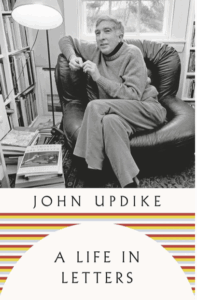 “After catching up with his old university friend Joanna Brown, in May 1966,John Updike sent her a thank-you. ‘It was lovely to see you, to hear you, to make love with you on Tuesday; I am sorry that I had that little asthmatic seizure.’ A few weeks later he is gratefully writing to his neighbour Joan Cudhea, enjoying that when he left her house, she, ‘still naked, hugged me and laughed and said, “Well, come around and f*** me again some time”‘. . . . It’s a pity that the English edition has been lumbered with the misleading title A Life in Letters. It isn’t that. It is, as the American edition has it, the Selected Letters of John Updike. Whatever, it is brilliant: riveting and essential for anyone remotely interested in Updike; shockingly salacious enough to enthral the remotely curious; and cleverly annotated for easy reading.”
Read the entire review
Times Literary Supplement (UK), reviewed by Nicola Shulman
“You must read closely to know what Updike thought about anything beyond the integrity of his texts, the pre-eminence of which comes through loud and clear. The letters show a man of uncommon tact, kind to his children, jocular and polite with almost everyone, principally interested in his literary career and prepared, with only a shade of embarrassment, to adapt his opinions to please whomever he thinks can promote it. His compliments and thank-yous to this end (“I treasured, too, the Bloomingdale’s box”) are splendid, and should really have a book of their own, for the use, like eighteenth-century letter writing manuals, of clueless correspondents who find themselves chewing their pens when faced with this task.”
Read the entire review
Voice Magazine (UK), reviewed by Kaitlin Jefferys
“Spanning six decades, this collection follows Updike from his beginnings as a bright, introspective Pennsylvania farm boy to the Pulitzer-winning literary force he became. In ‘real time’ we watch him negotiate his earliest book contracts, navigate the triumphs and anxieties of young fatherhood, and grapple with the meteoric rise that followed the success of Couples and the Rabbit novels. . . . As a whole, A Life in Letters is more than a literary artifact. It is an unfolding memoir told in the voice only Updike could write. For readers of his fiction, it enriches and reframes familiar themes; for newcomers, it provides an introduction to one of America’s most distinctive writers.”
Read the entire review