I eventually settled on using Value Holidays in Wisconsin for my May Term trips because, over time, they knew what I wanted and delivered great trips. Earlier efforts (e.g., Susie Davis here in Bloomington) were frustrating, because I knew more about the situation than the operators did. I recall one 4 am screaming match in Hong Kong since we had no flights to get us into mainland China.
Usually, I would outline my desires (e.g., hotel near downtown, tip money included, American breakfasts), such as this:
Summary
Round trip air fare from Chicago.
Prefer no less than three star hotels, with double occupancy, private bath.
Sufficient money provided for baggage handling & tips included.
All Porters, All Guides, Drivers, and all served meals, for servers and entertainers, as expected. Sufficient money for Visas.
Transfers to and from each hotel/airport/train station or whatever else is planned for the group.
Assistance with all connections.
Sightseeing tours of each city with local guides.
Entrance Fees as required
All departure taxes, including at intermediate cities.
Visa fees
Admission tickets where indicated.
Program fund of $100 per person for speakers, fees, etc., on top of taxes, etc.
$4000 ish or less.
Figure for two leaders for free, with single. Desire prices for 15, and 24.
and the following was one such return from the agent (which proves we did more than covered in this blog):
ILLINOIS WESLEYAN UNIVERSITY
CHINA & HONG KONG
THREE CHINAS THREE BUSINESS SYSTEMS
MAY TERM 2004
Day 1 – Thursday May 6, 2004
FLY CHICAGO TO BEIJING
United Airlines flight
Depart Chicago
Arrive Beijing , May 7
Day 2 – Friday May 7, 2004
TRANSFER: BEIJING AIRPORT TO HOTEL
You will be transferred from the Beijing Airport to your hotel in a private vehicle.
Accommodation: May 7-May 12
NEW OTANI HOTEL
Within the hotel you will find a complete range of facilities such as a health club and a shopping center, all to enhance the comfort of our guests throughout their stay. The attractive guest rooms enjoy an exceptional view of one of the world’s most historic cities. The hotel restaurant offers authentic Chinese dishes, guaranteed to be a most delicious memory. Visit Beijing and experience the unmistakable touch of New Otani hospitality and service.
Breakfast is included during your stay.
Day 3 – Saturday May 8, 2004 [B, L]
FORBIDDEN CITY AND TEMPLE OF HEAVEN
This morning depart your hotel for magnificent Tiananmen Square, the largest public square in the world, where Mao’s picture hangs over the rostrum at the entrance of the Imperial Forbidden City. Walk in the steps of ancient emperors today as you tour the powerful Forbidden City, hidden from public view for over 500 years. This is where Chinese emperors resided and ruled the country for 700 years until the year of 1911.
After a delicious lunch in a local restaurant you will also witness the masterpiece Temple of Heaven, the embodiment of grace and harmony. This is where Ming and Qing emperors prayed for good harvest and it is the largest temple complex remaining in China today. The pomp and grandeur of imperial China lives on in these historic landmarks so integral to the nation’s soul.
Day 4- Sunday May 9, 2004 [B,L,D]
FULL DAY GREAT WALL AND MING TOMBS
Snaking 3700 miles along the country’s vulnerable northeastern boundary, the 2000-year-old Great Wall was constructed as a barrier to protect China from invasion. It was built section by section between the fifth century BC and the 16th century AD. Walk along the Great Wall of China ranks high on the wish lists of many travelers, and your excursion today will confirm that this indeed is one of the world’s greatest travel experiences. Linger at the towers and broad promenades; contemplate on the spectacular scenery, and the lives lost in building this monumental construction that never truly fulfilled its purpose. There is ample time to stroll along its ancient stone promenade and photograph the wall as it winds across impossibly steep mountain areas.
After enjoying a Chinese lunch at a local restaurant you will be driven to the Ming Tombs along the Sacred Way, which features giant marble figures and animals guarding the tomb area for deceased emperors of the Ming Dynasty ( 1368-1644 ). On the way back to the city, you will also visit the Beijing Cloisonne Factory. Cloisonne is famous for traditional enamelware known as the “Blue of Jingtai” in China, with a history of over 500 years. It is one of the famous art and craft forms of Beijing. You will witness this elaborate and complicated process.
PEKING DUCK DINNER Tonight you will be transferred to a prestigious city location where you will enjoy a sumptuous Peking Duck dinner.
Day 5 – Monday May 10, 2004 [B]
BUSINESS VISITS IN BEIJING
Day 6 – Tuesday May 11, 2004 [B]
MORNING SUMMER PALACE TOUR AND AFTERNOON FREE
Day 7 – Wednesday May 12, 2004 [B, L]
HALF-DAY HUTONG TOUR
Today you will learn about the history of Beijing and about Chinese people’s life and feelings on this tour of the Hutongs and the Shiheyuans.
A hutong is an old city lane unique in Beijing. The Siheyuan is a building complex formed by four houses around a quadrangular courtyard. Siheyuans are arranged in rows and vary in size and design according to the social status of residents, and hutong is long and narrow path between each row, dividing the Siheyuans and at the same time connecting them to each other.
This morning your tour will start from the north entrance to Beihai Park on pedicab to the picturesque Shishahai lake area. You will then visit Gu Lou, the drum Tower, where you will enjoy a bird’s eye view of the old city. Then proceed to the neighborhood in the rear of the Shishahai Lake area and walk down the hutongs to drop in one or two courtyard-style homes. Lastly you will visit the mansion and garden of Prince Gong of Qing Dynasty, prior to returning to your hotel at around lunchtime.
Early Afternoon Transfer
BEIJING HOTEL – AIRPORT
Your guide will meet you in the lobby of your hotel. The guide will then transfer you from your hotel to the Beijing airport by private vehicle.
FLY BEIJING TO XIAN
Flight times to be advised – flying time is approximately 1 hour and 45 minutes.
Transfer: XIAN AIRPORT TO HOTEL
You will be transferred from the airport your Xian hotel by private vehicle.
Accommodation: May 12-May 14
ANA GRAND CASTLE
The Ana Grand Castle Xian is conveniently located just 40 minutes by car from the Xian International Airport. Facing the South Gate of the Ming Dynasty, the hotel, with its highly distinctive appearance designed after the model of the Big Goose Pagoda, creates a fabulous atmosphere in harmony with the surroundings. Featuring a spacious and bright atrium lounge, a variety of the newest amenities ensure personalized service with scrupulous care. The famous Bell Tower and the Forest Steel Museum are just a 15-minute stroll from the Ana Grand Castle Xian. The hotel locale gives visitors the opportunity to experience and share in the unique Chinese lifestyle of Xian.
Breakfast is included during your stay.
Day 8 – Thursday May 13, 2004 [B, L, D]
TERRA COTTA & PROVINCIAL MUSEUM
Today, your guide will be waiting for you in the lobby of your hotel for a morning departure. Please note that your local guide will inform you of the exact pick uptime upon arrival into each city.
Walk in the steps of ancient traders and travelers on today’s sightseeing of Xian, the head of the great caravan route once used for shipping silk and other prized Chinese goods to the West. Tour the archaeological site which so far has yielded some8000 terra cotta soldiers and horses, each a unique, finely detailed sculpture. Also tour the Provincial Museum, Big Wild Goose Pagoda, and City Gate. Lunch is included during today’s tour.
TANG DYNASTY WITH DUMPLING BANQUET
This evening, your guide will be waiting for you in the lobby of your hotel for your departure. Please note that your local guide will inform you of the exact pick uptime upon arrival into each city.
The performance at the Tang Dynasty Theatre Restaurant tonight will introduce you to Changan Music and Dance which originated over a thousand years ago in Changan, the capital of the Tang Dynasty, which is now known as Xian. It is during the time of the Tang Dynasty (618AD to 907AD), when China experienced tremendous achievements in culture, the Arts and technology.
Built in 1988,the Tang Dynasty Theater Restaurant is known as “the first Chinese style nightclub” and can hold up to 1,200 people. The entertainment tonight will be performed by the Tang Dynasty Song and Dance Troupe and will include pieces played on unique musical Chinese instruments and dances displaying dramatic masks and costumes.
Day 9 – Friday May 14, 2004 [B, L, D]
Morning: XIAN SIGHTSEEING
Transfer: XIAN HOTEL TO AIRPORT
Early afternoon, your guide will meet you in the lobby of your hotel. The guide will then transfer you from your hotel to the Xian airport by private vehicle.
FLY XIAN TO CHONGQING
Flight details to be advised – flying time is approximately 1 hour and 10 minutes.
CHONGQING AIRPORT TO HOTEL
You will be meet by a representative at the airport, and transferred to the hotel by private vehicle.
Accommodation: May 14-May 16
MARRIOTT or PLAZA HOTEL, CHONGQING
Day 10 – Saturday May 15, 2004 [B, L, D]
DAZU TOUR
Leave Chongqing, and travel through the green heart of Sichuan to Dazu, home of 50,000 stone Buddhist sculptures clustered in hillsides and caverns. Enjoy the scenery; view the colossal reclining Buddha and stirring scenes of village life.
Day 11 – Sunday May 16, 2004 [B, L, D]
CHONGQING SIGHTS
Your Chongqing city touring will include Chongqing Zoo to see the panda, Grand People’s Hall and E’ling Park. Stillwell Museum is currently under renovation and will be open after June. Tour will also include lunch.
Cruise: May 16-May 21 VICTORIA CRUISES – YANGTZE RIVER CRUISE
(CHONGQING TO YICHANG)
VICTORIA CRUISES – DAY 1
After dinner this evening you will be transferred to Victoria Cruises to board the ship.
Day 12 – Monday May 17, 2004 [B, L, D]
VICTORIA CRUISES – DAY 2
Today you will have an excursion to Wanxian or Fengdu
Day 13 – Tuesday May 18, 2004 [B,L,D]
VICTORIA CRUISES – DAY 3
Begin the passage with Qutang Gorge, the shortest & most dramatic of the three gorges. Pass poetic Wu Gorge before anchoring for an excursion on the Shennong Stream or Daning River. Enjoy on board activities tonight.
Day 14 – Wednesday May 19, 2004 [B,L,D]
VICTORIA CRUISES – DAY 4
Sail through the Three Gorge ship locks. Take a morning tour of the Three Gorges Dam Site. Arrive Yichang at noon.
Transfer to Wuhan via coach.
Accommodation : May 19-May 20
SHANGRI LA WUHAN
Day 15 – Thursday May 20, 2004 [B,L]
Morning business visit
FLY WUHAN TO SHANGHAI
Flight details to be advised – flying time is approximately 1 hour and 15 minutes.
TRANSFER: SHANGHAI AIRPORT TO HOTEL (Hotel not yet confirmed)
You will be transferred from the Shanghai Airport to your hotel.
Shanghai: May 20-May 23
Day 16 – Friday May 21, 2004 [B]
BUSINESS VISITS IN SHANGHAI
Day 17 – Saturday May 22, 2004 [B, L]
CITY AND SHANGHAI MUSEUM
Today, your guide will be waiting for you in the lobby of your hotel for a morning departure. Please note that your local guide will inform you of the exact pick up time upon arrival into each city.
Immerse yourself in the culture and sophistication of Shanghai on a full-day tour of the city’s premier attractions. View all manners of Chinese arts, beautifully displayed in the astounding galleries of the Shanghai Museum. Explore the paths and pavilions of Yuyuan Gardens; stroll the waterfront Bund; visit the endearing Children’s Palace. Lunch is included during today’s full day tour.
Day 18 – Sunday May 23, 2004 [B]
FLY SHANGHAI TO Hong Kong
Accommodation: May 23-May 27
NEW WORLD RENAISSANCE HOTEL
HONG KONG AIRPORT – HOTEL
New World Renaissance Hotel is a first class business and tourist hotel conveniently located in the heart of Kowloon’s Tsimshatsui business and shopping center. Within a5-minute walk from the Tsimshatsui MTR (subway) station, and an 8-minute walk from the Star Ferry Pier, New World Renaissance Hotel provides easy access to almost every part of Hong Kong. The 543 well-equipped guestrooms and suites as well as four Club Floors offer exclusive services to all guests.
With five restaurants and lounges, New World Renaissance Hotel offers a multitude of dining choices or even the most particular of guests. Guests can also relax by taking a dip in the hotel’s outdoor swimming pool, working out in the well-equipped fitness center, jogging or walking along the Tsimshatsui Promenade on the harbor-front, and shopping in the adjacent shopping centers and New World Department Store.
Day 19 – Monday May 24, 2004 [B]
HALF DAY CITY TOUR
Pick up from hotel to reach Victoria Peak for a breath-taking 360-degree view of the bustling harbor, Hong Kong Island and Kowloon as far as the eye can see. From Victoria Peak, the tour continues to Aberdeen village to see the many fishing junks and floating restaurants moored there passing by the scenic resort areas of Repulse Bay and Deep Water Bay. The tour will continue with a visit to Stanley Market – a popular open air markets for souvenirs to bring home!
Day 20 – Tuesday May 25, 2004 [B]
BUSINESS VISITS IN HONG KONG
Day 21 – Thursday May 26, 2004 [B]
DAY AT LEISURE IN HONG KONG
Day 22 – Friday May 27, 2004 [B]
Transfer: HONG KONG HOTEL – AIRPORT
You will be meet in the lobby of the hotel by a representative, and transferred to the airport by private vehicle.
FLY HONG KONG TO CHICAGO
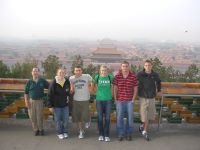
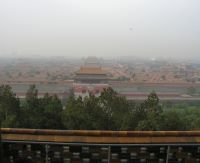 other day, which was really neat. We got up early (of course) and biked from our hotel to the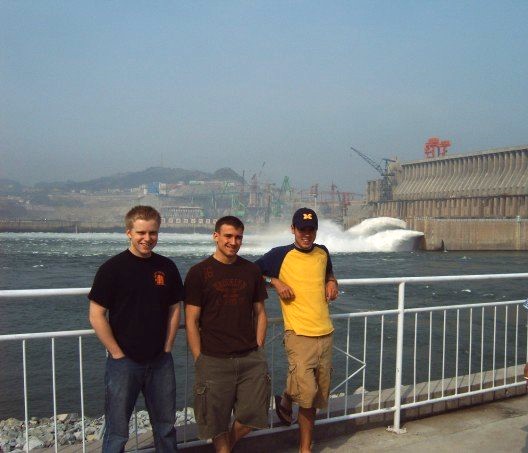
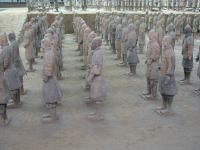 warriors, remains as it was the first time I saw it. It helps that I am sharing it with students who are seeing it for the first time.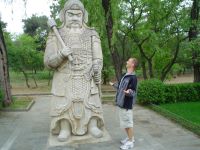
 H
H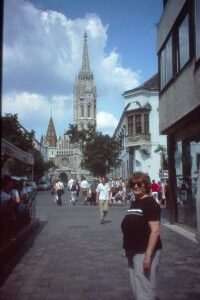
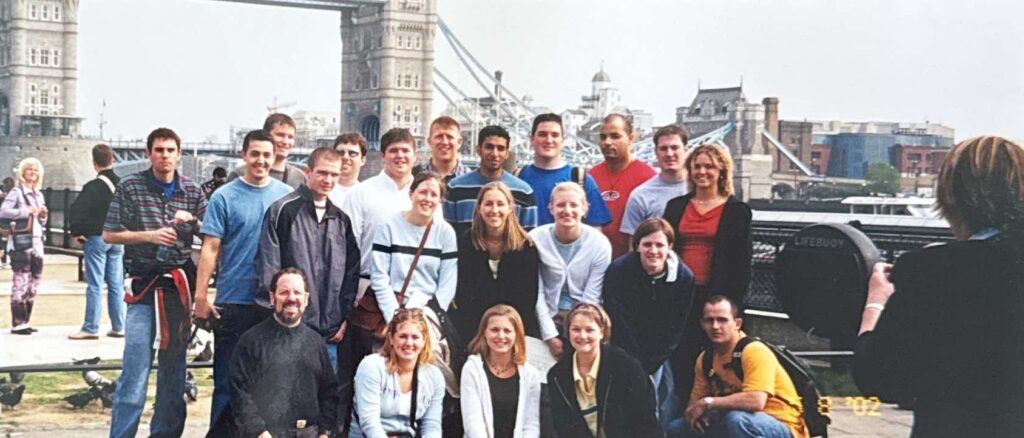
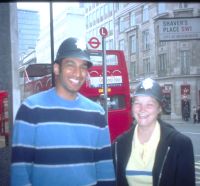 hotel very beautiful. The old-style phone booths were a hit!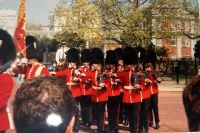

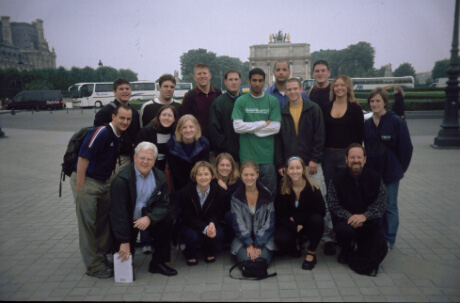
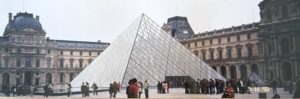
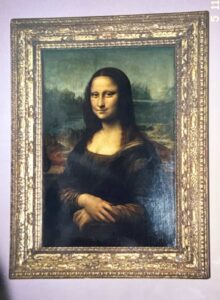 and beautiful paintings.

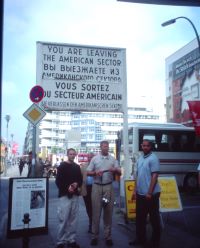 street that East Germany showed off, but the wall proved East Germans were really prisoners. A heady sight was the old airport, which had a monument to the airlift that saved Berlin during the cold war.
 drinking out of male bed pans. It was very cryptic in there, but oh what an experience! This is obviously Liz talking.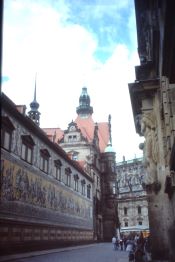
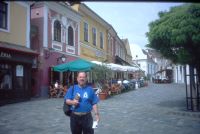 had never heard of Bratislava, because it historically was Pressburg, where the Hungarian monarchs were crowned. We stopped at a building that commemorated the victories Napoleon won at Austerlitz, certified in the Treaty of Pressburg.
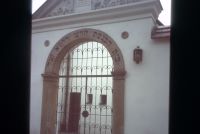
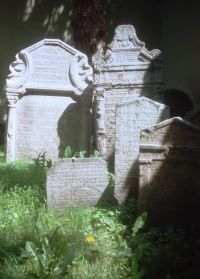
  And of course, Prague is memorable as an example of what Europe could have been like without World Wars, at least the buildings. Hitler spared the city as a museum, while he gassed its inhabitants. The old areas–the Charles Bridge, the palace, the former synagogues with the roll call of Holocaust victims…
 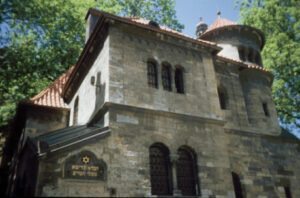 *I just remember it being such a beautiful city and wanted to return one day. We hiked up to Prague Castle and saw incredible views from the top, especially at night. There were many houses that “shorter” soldiers fit in, and I have a great picture of Professor Hoyt fitting right in the doorway. We saw the American Embassy in Prague and listened to retired, rich men that would play music in the square every day. Prague Castle Square was neat, and we learned a couple is buried inside the castle. We ate at a traditional Prague restaurant and performers danced while we ate! They even pulled a few of us up to dance with them.
  them to become Budapest! There was very stunning architecture around the whole city.
 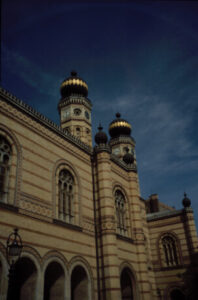 The Great Synagogue, built in the 1850s in the revival Moorish style was one of the birthplaces of Zionism. It’s the largest synagogue in Europe, and–before World War II, housed a major Jewish community. It included a number of early Zionists.
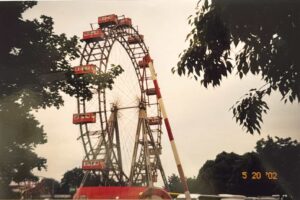 along with their many beautiful buildings.
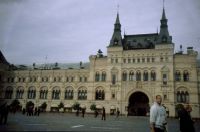 West won.” Even the Gum Department Store was carved into Western boutiques.
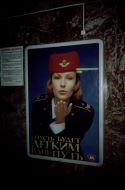 incredible art–socialist realism style.
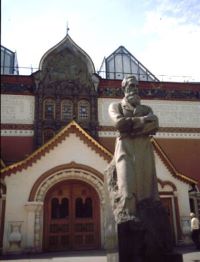 really impressed with the Tretyakov Museum near the Kremlin, where I discovered the Russian
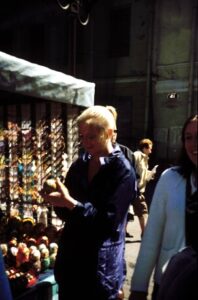 And the opportunity to buy matryoshka dolls and other souvenirs on Arbat Street.
 confiscated art. To think, the country produced so many wonderful musicians and artist. And, as
 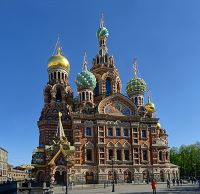 Leningrad, the city bore the brunt of a Nazi siege for almost three years.
  Moskva, Vodka, and waiving at locals on one of the white nights as we said good-bye to the trip.
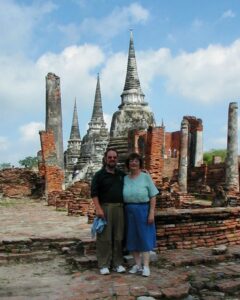 Our self-indulgence started in Bangkok at one of the premier hotels. I believe it was the Oriental, whose 150 years of celebrity attraction now included Fred and Carolyn Hoyt. Our trip included the highlights of Bangkok, especially (for me) Ayudhya and its splendid ruins.
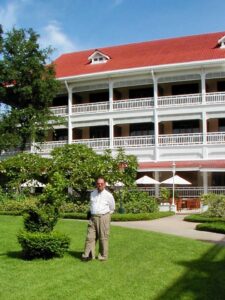 We boarded a train that took us down Thailand, to Hua Hin, where we spent a night at the “Railway Hotel,” another on the “must stops” on the tour of the peninsula.
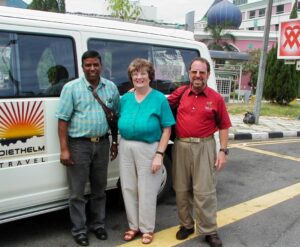 country whose mix of
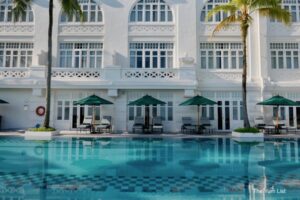 Not coincidentally, our arrival coincided with the reopening of the refurbished Sarkie Brothers Hotel, the Eastern and Oriental, on the Gulf of Thailand. I could sit there dreamily considering retiring to a bungalow facing the Gulf with my xiao lao po.
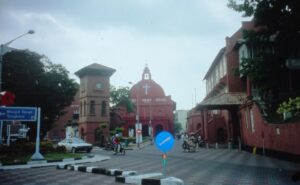 , a city whose charm (i.e., history and appearance) resembles George Town (Penang). Small shops, Chinese influence.
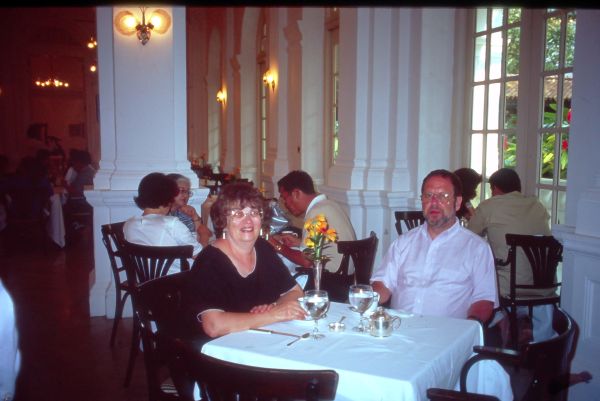 The crown jewel in this nostalgia trip to the past, of course, was an overnight or two at the Raffles Hotel in Singapore.
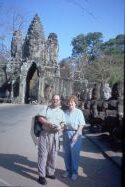
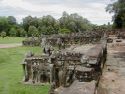
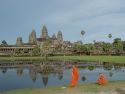
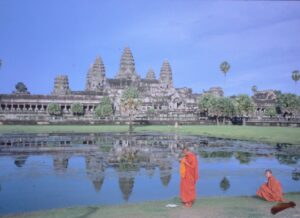
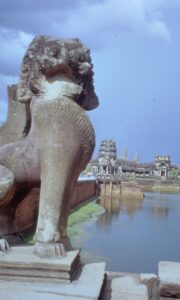 When “they” left (I paid their departure tax and made sure they left, along with my colleague Ruth Ann), I took a small plane to Siem Reap (which means Siam destroyed–that whole area, my son pointed out, is the Balkans of Asia. Whoever has power destroys those who don’t, until those who don’t, do, and they return the favor), for a visit to Angkor Wat.
 pronunciation!).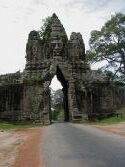
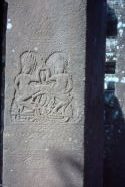
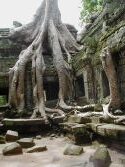
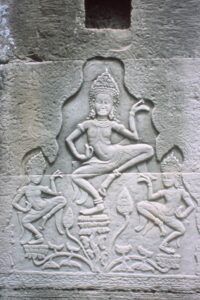 buildings, so only the Godlike places are left). The pictures don’t do it justice, and I was awed by the sculptures on the walls, which had the story of Good Versus Evil (Ramayana again) and the monkey king, and the history of the regime. The second is Bayon, built by Jayavarman VII (easy for me to say!), with the haunting four heads that are one of the most well-known pictures of Angkor. I finally found a sculpture (typical of Cambodia, I found it in a workshop for the homeless because of minefields!) that captured it (22 pounds; it cost 2x as much to ship as to purchase). Third was the one that they left jungle-like. The jungle always wins, given enough time! Finally, Banteay Srei, which has the most marvelous sculptures (or did!). We came to one place and my guide said, “There was a head on that statue last week.” One thing I would have done differently was to spend a day in Phnom Penh at the National museum. Some of the statues are there, replaced with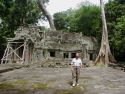
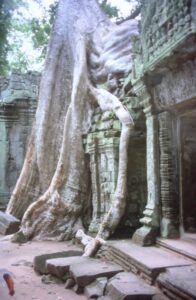 virtually similar reproductions.