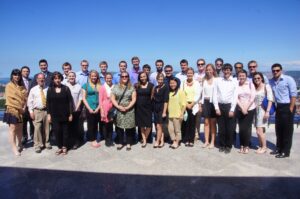
My 27 new best friends and I will be saying goodbye early this morning as they head back to the United States, leaving at 3:30 am for Munich and thence to Chicago. Perhaps it was appropriate that we spent half the day together, viewing still more of the attractions that bring 10-15 million visitors to Istanbul, then the other half of the day in a free for all, doing some of the other things that bring 10-15 million visitors to Istanbul.
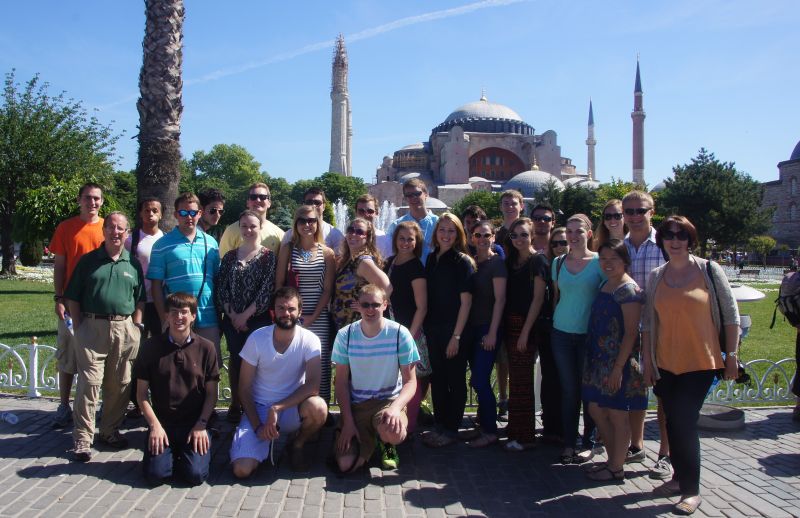
All three of the sites we visited reflected the past of the city. The visit to Aya Sophia represented the oldest site. The church, built on a previous church site, was constructed in the 6th century during the reign of Justinian, who was responsible for many of the great works (and great expenses) of the Byzantine Empire; during his reign, the boundaries were at their greatest, including the reconquest of the Western Empire, i.e., Rome. Justinian (and his consort, the one- time courtesan, Theodora) were, for example, builders of the wonderful chapels at Ravenna, Italy, with their likenesses. Justinian’s efforts in Istanbul, however, led to the creation of the 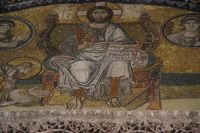 largest church in the world at the time. Emperors received their crowns in ceremonies in the Church, which was one of the last holdouts in 1453. Of course, after the conquest, Mehmet changed it to a mosque, plastered over the mosaics, and for the next 400 years, Aya Sophia remained a mosque.
 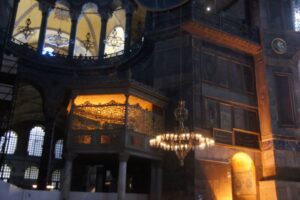 During the Republic, Ataturk turned it into a museum, partially Christian, partially Muslim. Some of the mosaics survived, but so did the mihrab and the camel skin panels praising Mohammed and Allah. It remains, for me, one of the most impressive sights in Istanbul, partly for what it has meant over time. When you come to see it, it may have more of its original features; about half the building now is being renovated.
Across from Aya Sophia, we visited a still-used mosque, from the 17th 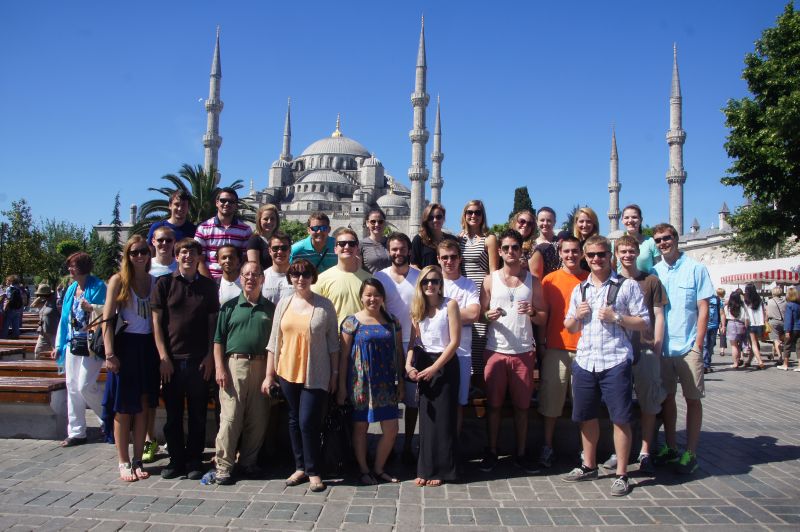 century. Western guidebooks usually call it the Blue Mosque because ofthe plethora of blue tiles in the stunning inside, but it’s really the mosque one of the sultans commissioned to be built (as our guide said most mosques were) in 7 years. Indeed, the sultan ordered the mosque to have 6 prayer towers (minarets), because, at the time, only the mosque in Mecca had 6 minarets; most have only four, but the sultan of Turkey, Defender of the Faith, was, I think, at the time the overlord of Saudi Arabia, and wanted to demonstrate his authority. Enraged conservatives added three minarets, and now the mosque in Mecca has nine, but the Blue Mosque is the only one with 6.
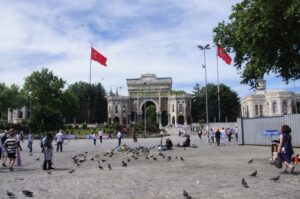 Not many noticed it, and our guide did not point it out, but connecting the two religious institutions was what had been the center of Byzantine social life, the Hippodrome. At one time, it could seat 100,000 people, and was THE place for the Reds, Greens, and Blues and Whites to cheer on their teams, much as soccer fans still do today. There’s not much left from the Byzantine days, save for a few obelisks (the Romans brought them to Rome, too).
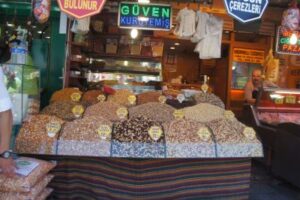 The other site was a visit to a 15th century business location, the so-called “Spice Market,” where merchants from Egypt and other exotic places brought their saffrons, teas, and other foodstuffs that makes Istanbul a far more interesting place for me to eat than, say, London. This was where I parted company with the group and began my own “free for all,” because there were a few places I thought I would hit because they were not on my after-trip itinerary.
Note: I did not realize it at the time, but this was to be my last trip with students. As you’ll see from the timeline, that enabled trips to places I would never have gone with students–Cuba, Latin America, and Africa. But what a wonderful way to close out almost twenty years of opening young minds to the world.
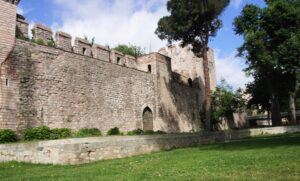
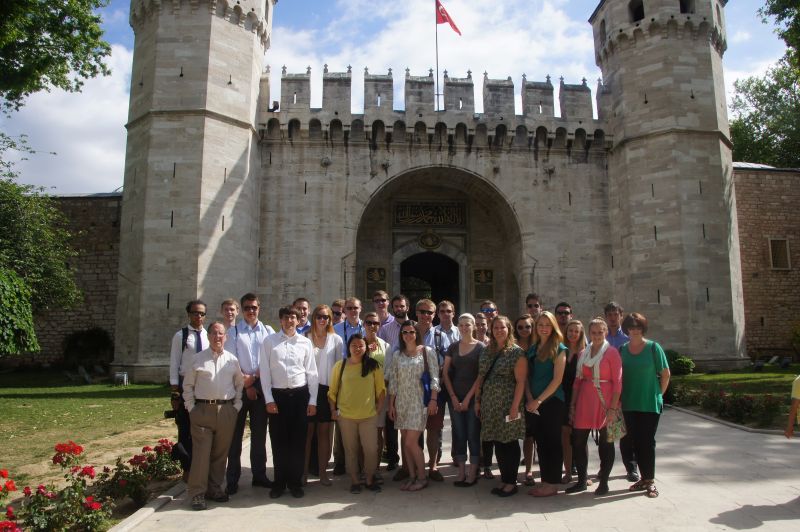 the 36 Sultans of the Ottoman Empire (1453-1923, though the family moved in the late 18th century to a more European palace in another part of the city). Having been to Windsor Castle, Versailles, and Potsdam, we’ve seen Western European castles and palaces. No one, however, except me, had seen the palaces in India (the Moghul forts at New Delhi and Agra) that are the closest equivalent of Topkapi—with the open pavilions, the gold and tile floral decorations—etc., that make me think of Scheherazade).
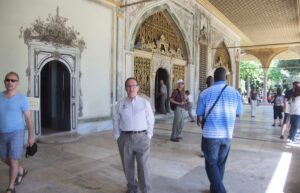 artefacts that are stunning—diamonds, jade, jewels—and the Peacock throne, which a Persian army looted from New Delhi, and the Ottomans took from Persia. The religious relics included the sword of David, the staff of Moses, an arm and jawbone of St. John the Baptist—and hair from the beard of Mohammed, his footsteps, his sword—all reminders that at one time, the Ottomans conquered the Holy Lands (Mecca and Jerusalem), and the Caliphate was in effect the “pope” of the Muslim world. I think one of the many titles of the sultan was Defender of the Faith. Expanded over the years, Topkapi became the second largest palace complex over the years—second to the Forbidden City. Ataturk turned it into a museum in the 1920s.
 2008—but now are not so sure. The company itself has numerous projects and holdings, few of them in Europe, and most of them trading regionally (Russia and the nation of Georgia) or Muslim countries, like the UAE, Algeria, and Malaysia.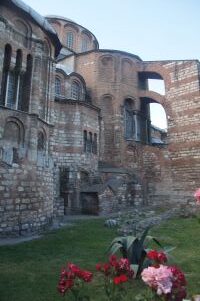
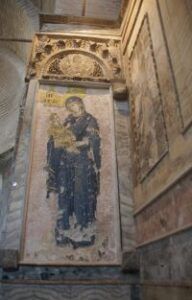
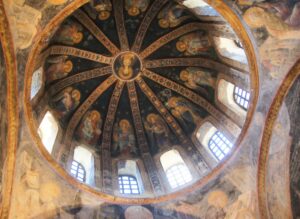 The ceilings are literally covered with the story of Jesus and Mary, the gift of a city official in the 14th century, which saw a renaissance (our guide used the word, and said that the “Renaissance” began in Byzantium before it spread to Western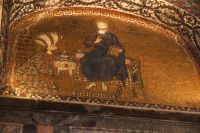
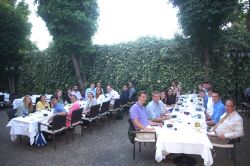
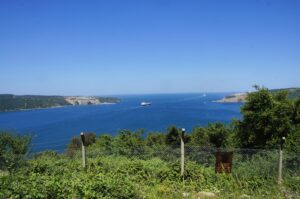
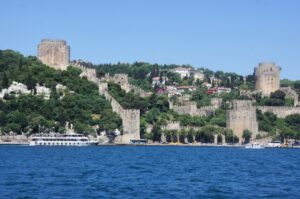 Spain, and the physicians to the Sultans were usually Jewish), it’s sometimes difficult to remember how rich the country was—though it is easily remembered how powerful it was. Suleyman’s defeat at the gates of Vienna marked the westward limits of Turkish conquests, but I’ve seen battlefields in Poland and Russia, and indications of the occupation of the Balkans, Greece, and Hungary that are neither forgotten nor forgiven. We will be seeing the Topkapi Palace tomorrow, which should give our students some insight into what being rich meant in the 16th and 17th centuries. It helped Professor Pana and I to understand it when we went to a “traditional restaurant” whose recipes were based on the cookbook of Mehmet II. As we sat in the shadow of Hagia Sophia, we ate like a king for a night. We’ve set up a “farewell dinner” in a similar restaurant tomorrow, near the Chora Church with its world famous mosaics.
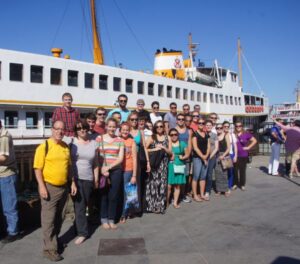 ride to the Black Sea.
 Acropolis, reflecting the civilization of the Mycenaean period, the other, a third century theater, paired with Greek medicine, that today has acoustics and seating for 14,000 that still draw entertainment from performances of Aeschylus to symphony orchestras, with acoustics at the top as clear as at the bottom—and no electronic magnification.
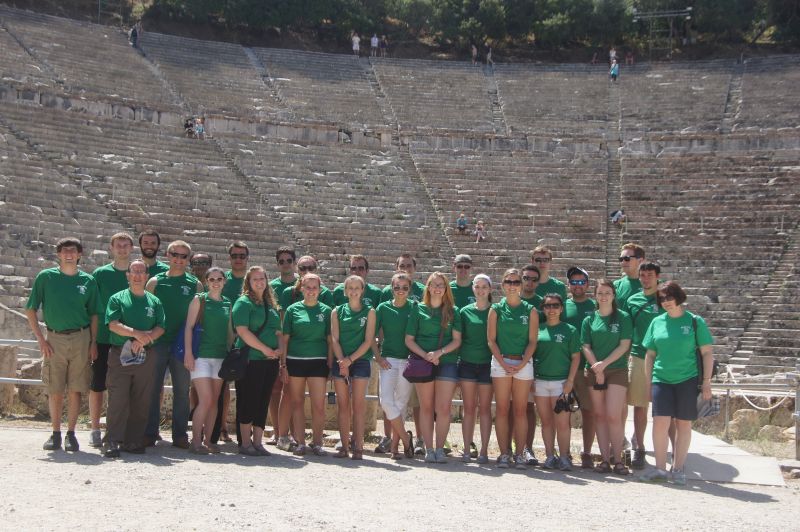 The theater is stunning, set in pines in the mountains, but its origins were to celebrate the god of healing, Asclepius. The Greeks had developed medicinal practices, ultimately ordered by Hippocrates (in the Hippocratic Oath that doctors still take today), that included therapies borrowed from Egypt, and home-grown therapies such as shock treatments (putting people in with snakes)! I’ve seen a similar complex in Pergamon, which apparently rivaled Epidavros, but today, what’s left at Epidavros is the theater.
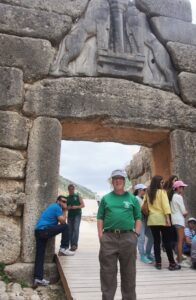 pure fiction, the current thinking is that Agamemnon was a real king, but the “mask of Agamemnon,” one of the most famous pieces in the National Archeological Museum (did I tell you they close all museums save the Acropolis museum at 3 pm to save money) is about 300 years off. We saw
  the citadel on the acropolis, distinguished by a double lion gate, and the beehive shaped tomb where Schliemann found the mask. We also saw ruins of many other citadels, proving that Greece had both civil wars (the Peloponnesian War marked the end of the ascendancy of Athens) and wars with the Persians, and later others, including the Turks, who conquered the country shortly after the fall of Constantinople, and the Venetians, among others.
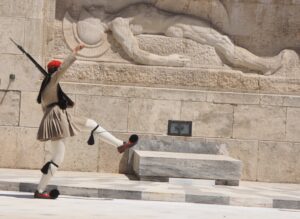 Berlin, via Warsaw on Lot Airlines—no doubt an event to be celebrated. We’re in the city with 5 million people, and it’s easy to talk about the birth of democracy. It happened here, and we’ve seen the love affair that Europe has had with Greece reflected in the museums in London, Paris, and Berlin. The independence of Greece from Turkey, in the 1820s, was partly Europe’s payback for that love affair.
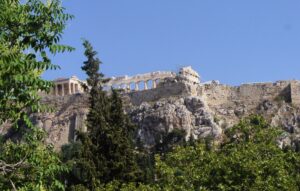 and his cohorts constructed on the Acropolis a literal “city on a hill” that has become the second most-desired site to see in the world (second to Angkor Wat). We visited the Acropolis this afternoon as part of our city-of-Athens tour, and really the major highlight of it. Perched atop the highest flat hill in Athens, the Greeks built temples to the main gods of the city, Athena (who supposedly gave the city olive trees), and Poseidon, who was the lord of the seas.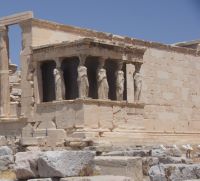
 Poseidon and Athena has the Caryatids that support the roof, rather like the Museum of Science and Industry in Chicago. There’s also a temple to Athena Nike (victory) and another smaller temple at the entrance. The Acropolis was used by the Greeks, the Romans, then converted to a Church when the empire went Christian, then converted to a Mosque when the Turks conquered Greece, then reconverted to the Acropolis. One of the features we noted in London was the “Elgin Marbles” (saved from pollution and depredation, says the British Museum; stolen illegally, say the Greeks), the friezes that make up the story of the procession of Athena on the frieze at the Parthenon.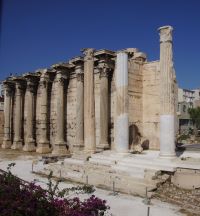
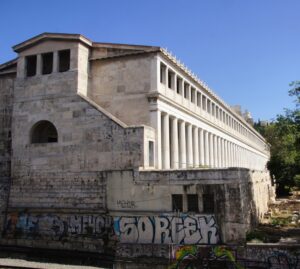 because I went to areas that I’d never been before, which are not really accessible by bus. The area is Monastiraki, an old monastery area at the base of the Acropolis, that is really the old town. One after another sights—the Roman baths, the library of Hadrian, the Tower of the Winds—all part of the ancient city artifacts, and all closed as of 3 pm. Can you believe that? Only one museum in the city is open after 3 pm….
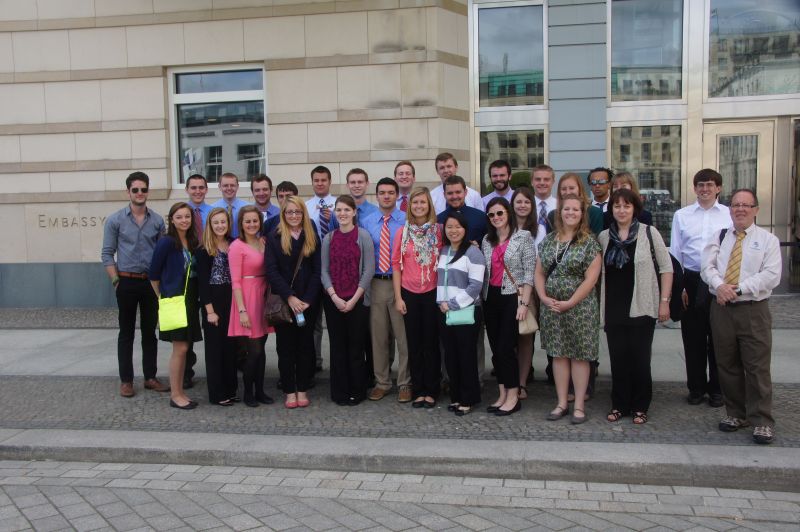 The political and economic officers, for example, mentioned that Germany has asserted leadership, both within the European Union and also on behalf of the European Union in world politics—it’s got a number of troops supporting US efforts in the Middle East, for example. German support for the government’s handling of the economy registers in the 70%, while Europe as a whole averages under 10. Even the support of Germans for the efforts to prop up the Euro are applauded—provided the mechanisms for responsibility and accountability are put in place. Germans do not generally accept debt as readily as Americans do—the German word for guilt is identical to the word for debt, he stated, and was one reason Germany did not get burned as badly as the US did in 2008; another is that the economy is still weighted toward industry, rather than services. He also pointed out that Germany has become a bigger economic trading partner with the Chinese, something I’ve seen on my trips to China. Germany has benefitted from both travel (2 million Germans get US visas; 1 million Americans reciprocate), and, with the lowest birth rate in Europe, from immigration; 20% of Germans are “first generation.”

 Germany for the Netherlands, and is buried there.

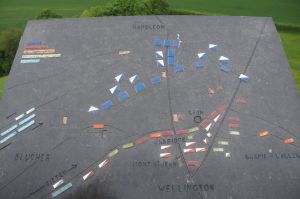 struck a quick blow. At Waterloo, he tried to keep the Prussian and Anglo-Dutch armies from uniting against him. Slowed by rain (imagine that!), in June 1815, his armies struck too late to prevent the Prussians from joining
 years, the United States had not yet sorted out many of the issues that “We the People” wrote a constitution to settle; I hoped it doesn’t take a civil war to resolve Europe’s issues.