July 24, 2012
I guess I’m fickle, since I found a new fancy today—an overnight sail to Ravenna and Bologna, and now I’m infatuated with those two Italian cities.
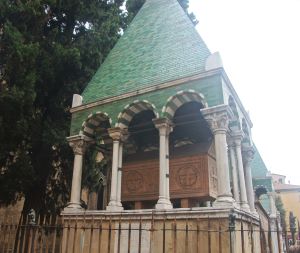
 Bologna claimed my allegiance because it is the home of the first university in Europe—1088 was the origin of a school of anatomy and law (religion, apparently, was too serious to be left to the universities). Today, it houses 90,000 students, which is staggering in a city of 500,000. Fortunately, the school was in recess, so the traffic rather resembles Bloomington Normal in July—rather light. We exited the bus at the tombs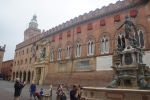
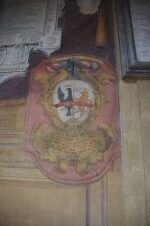
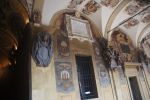 of the first three professors, which are impressive indeed, from the days when professors were esteemed. Furthermore, in the old library, faculty got to create and draw their own coat of arms, another European idea that would look pretty neat on the IWU campus—if we couldn’t build buildings that looked like they were from the 14th century!
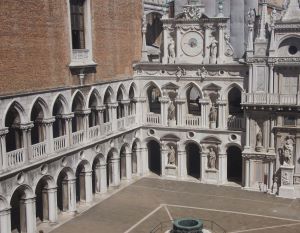
The most impressive building to me was an old castle, that after one of the many wars, became a palace with a new façade, constructed over two time periods, on one side. I never before realized the difference between Romanesque and Gothic (especially flaming Gothic) until I saw them side by side—rather plain, square, and ornate arches and circles over the windows.
One amusing and sort of frightening event. I was engrossed in the faulty 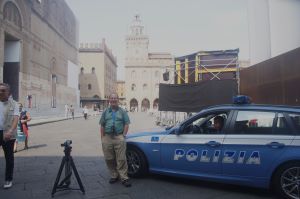 coat of arms, but saw that our tour director from the boat was equally absorbed. However, when we were ready to leave, we realized our guide had taken our group to the lunch stop. The Ukrainian tour director spoke no Italian, but we flagged down a police car. One of the officers had been born in New York (he said he was the only English speaker on the force). He called the boat, found out where our lunch was, and took us to the restaurant. Happily, I did not have to spend the rest of my life in Bologna.
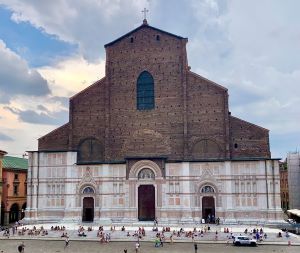
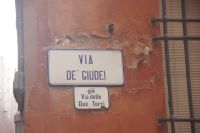 The other building worth going to Bologna to see is a massive cathedral, partially finished, in Gothic style, that the people of Bologna wanted to raise the money for themselves, and raised enough to start building the cathedral. They wanted it big, and it was so big that the Pope intervened and said that no church can be bigger than St. Peter. It was never finished, but the city’s residents have exhibited some liberal tendencies (it was a hub of the communist party after World War II, and there were some terrorist bombings in the 60s and 70s). The church is also renowned for a painting picturing Mohammed in hell, a picture which after 9/11 has the church under tight security (that along with the recent earthquake which closed a number of sites for repair).
Bologna is around 60 miles inland from Ravenna, the city where our boat 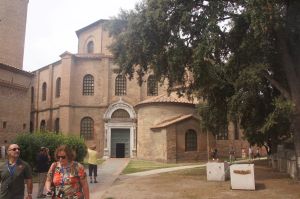
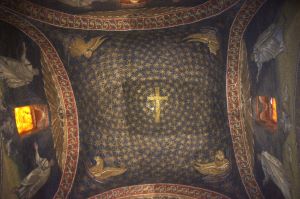 was docked (actually, the city was on the Adriatic in Roman times, but the ocean had filled in, and it now sits 6 miles or so from the port). I was interested in Ravenna for its historical importance: after the split of the Roman Empire between Constantinople and Rome, the Romans eventually moved the capital to Ravenna, which was far easier to defend against the northern tribes. It was, in fact, the last capital of the Roman Empire. Theodoric I, an Ostrogoth, conquered the city and added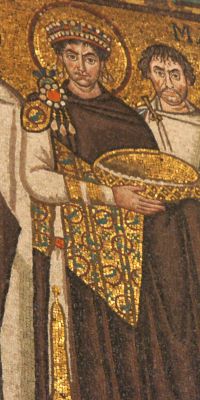
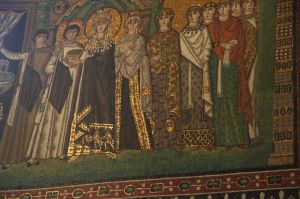 something different to it: a form of Christianity that held Jesus was not one of the trinity, but the son of God. That sort of doctrinal challenge to Catholicism, branded Arianism, was banished at the Council of Nicea in the 4th century, but some of the sites in Ravenna managed to escape the order to destroy all Arian churches and mosaics.
The two (of eight) UNESCO sites we visited were not Arian, but had what art historians argue is the best preserved Byzantine icons. One set was in a church, where it portrayed the Byzantine Emperor who restored (Eastern) Roman rule, Justinian, and his wife, Theodora, whose accession from dancer to Empress scandalized the Christian world (The Empire became Christian when Constantine converted early in the 4th century). The bits of colored glass put together to depict Christianity, so characteristic of Byzantium, are among the best preserved in the world, and almost 8 centuries earlier than those in Hagia Sophia in Istanbul.
How I wish I had spent more time in Ravenna than in Bologna, but at least I have seen both.
We’re at sea on our way to my next favorite—Dubrovnik.
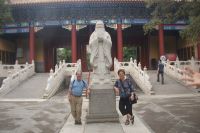
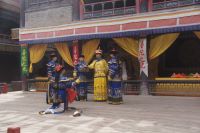
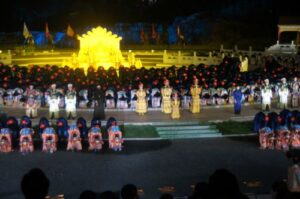
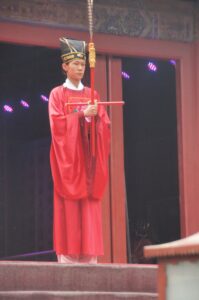 The emphasis on social stability was visible in at least two places where one might not have expected it. The first was in the Confucian temple in Beijing. We got there in time to see a dance performance based on the teachings of Confucius. Part of the message was about “social stability.” The Chinese phrase was, “Tian xia wei gong,” one of the teachings of Dr. Sun Yat-sen, roughly translated as “The Earth Belongs to the People.” You can find that on the gateway to almost every Chinatown in the United States (see Chicago’s, if you
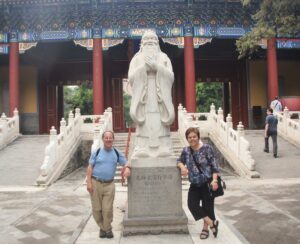 doubt me). That Confucius is revered today is a remarkable change from the Mao past, when the “New China” meant demolishing the old.
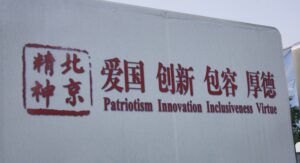 The second clue is the “Beijing Spirit” motto: “Patriotism, Innovation, Inclusiveness, and Virtue.” The last named is also part of the Confucian ethic.



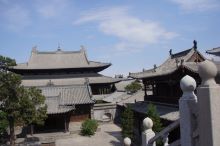
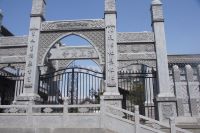

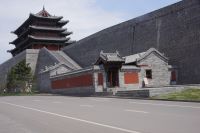

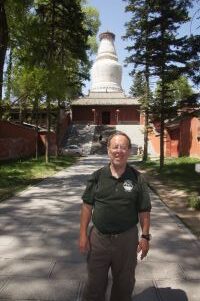


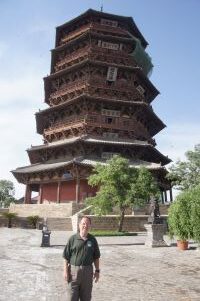
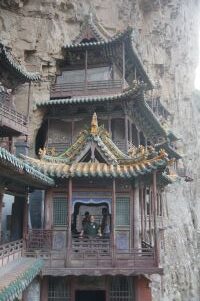 The last stop was the one Li Bing, a thousand years ago, called “magnificent “—the hanging temple on Hengshan, another sacred mountain, this one to Daoism. Begun in the Song dynasty (or earlier), the temple looks like it ought to have a frame around it, and be sold as a 3 D insert; it literally clings to the side of a mountain. It was built by monks who perched down from the top, put in beams, carved the caves, etc. It is a Daoist temple—but at least one room helps explain why it (and
 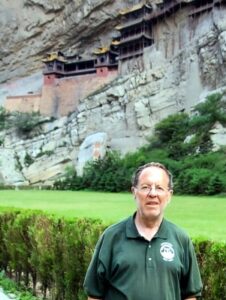 not much else on Hengshan) survived the Cultural (and other) Revolution. One multicultural (my word, not the guide’s) room has: the Buddha in the center, one of the Daoist immortals on one side, and Confucius himself on the other. Rumor has it that one tablet was added during the Cultural Revolution—“Long Live Chairman Mao.” And that may well be why the Hanging Temple (truly magnificent, and fortunately, we do have an exclamation point in English!) exists today. Period.





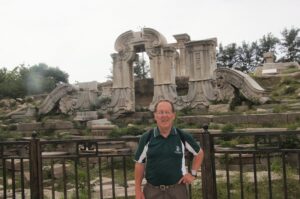


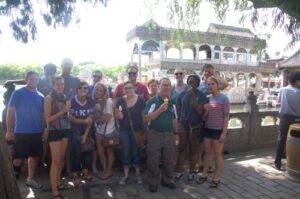
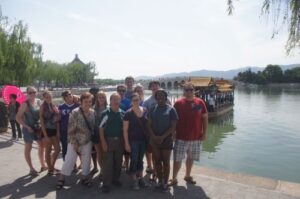 legacy. She constructed it northwest of Beijing (which has grown to absorb it) to replace the Yuan Ming Yuan, a summer palace reputedly one of the wonders of the world, which the allied armies, who torched Beijing in 1860, left in ruins. Those ruins today rest nearby, and if I have time on our return to Beijing, I hope to get out there. They are hauntingly part of the “road to rejuvenation,” the exhibit I saw this morning at the National Museum of China, a stupendous building that is so big it seems relatively empty of artefacts, although I suspect there were thousands. A separate exhibit that is difficult to find deals with the road to rejuvenation, the route the Communist Party traveled in undoing



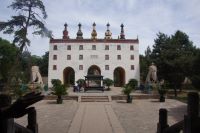

 and animation you would not believe. Having been here, though, I can believe it. One of the messages in it was that Kangxi recovered Taiwan, which held out against the Qing until the 1680. On the other hand, Qing fortune in the 1680s also brushed up against the aggressive Russian state, then moving into Asia. The Treaty of Nerchinsk, between the Qing and the Romanovs was one of the first modern treaties, an opening step that would eventually help make the Ming and Qing part of what the Chinese like to call their “feudal past.”


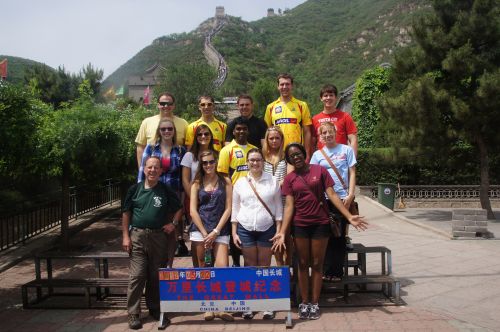 Yongle was not responsible for the Great Wall, but the Great Wall we have come to know was a product of the Ming dynasty, which, as I said, lived in fear of invasion from the north. The Ming resurrected a defense system that predated even Qin Shi-huang, the first emperor, who consolidated the wall his predecessors had built. The Ming wall ran over 4,000 miles, from Shanhaiguan, where it met the sea to Jiayuguan, where it extends into the desert. The stretch we climbed was within 30 miles of Beijing (if you think about the possibility of invasion from the north, bear in mind that’s the distance from Seoul to the 38th parallel in Korea), the product, I think of the post-Mao dynasty, which has been building tourist attractions like crazy.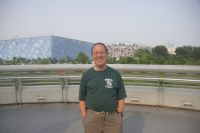
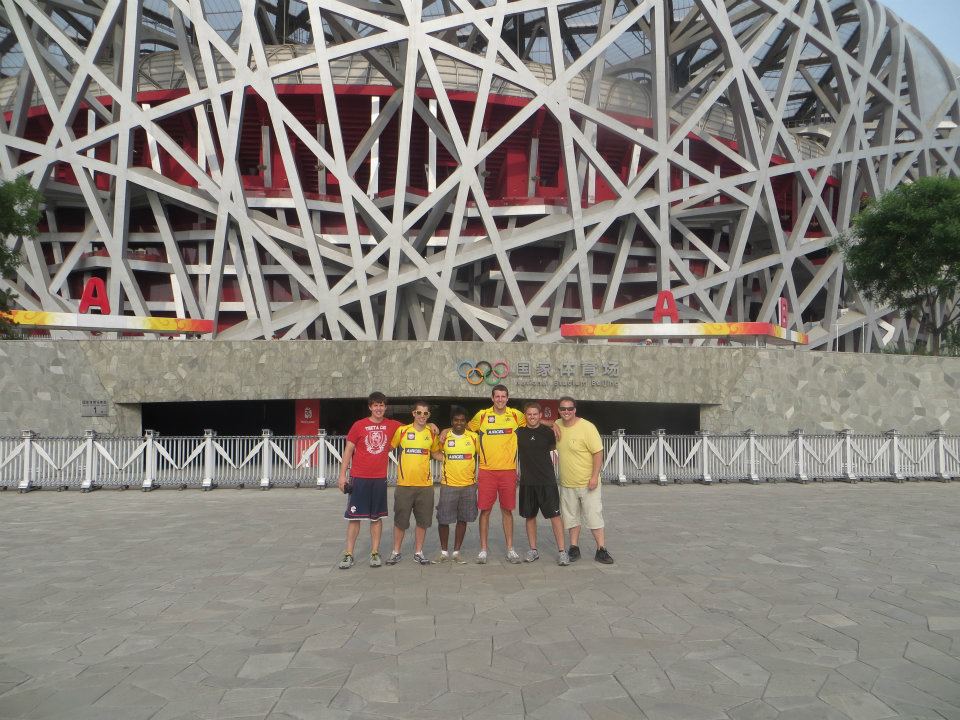

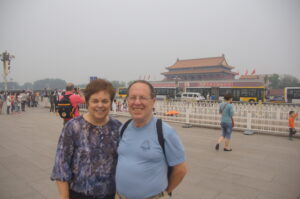
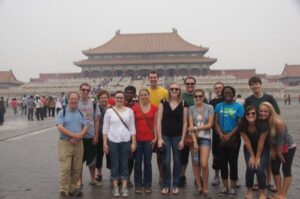 chronicled in The Last Emperor, winding up as a gardener in Beijing (after being puppet emperor of Manchukuo under the Japanese from 1932 until 1945) It has been a public museum since.