June 1, 2007
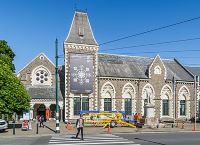
We crossed the ditch, as they call the Tasmanian Sea, to New Zealand, last Friday. We are in Christchurch, the largest city on the South Island (NZ has 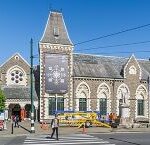 two islands–they jokingly call Australia their third), and the oldest in the country. I remember when I was here a decade ago; I told Carolyn I was not sure I ever wanted to go to London, because ch-ch as they call it, was built in 1850 to be the most English of cities. It looks like it, with the church dominating the square and Gothic revival architecture around the city. We are across from what used to be the University of Canterbury; it was designed in England to face south–which captures the sun in the northern hemisphere, but not here. We were told this is one of the warmest Mays on record, but it is around 4 Celsius in the morning and there is snow at the
  higher elevations (will get to that in a minute). The Avon River flows through town and you can get a punt ride if you wish, play lawn bowls, or sit in Victoria Square, honoring the 4 million people who live in NZ. The Aussies consider the Kiwis their Appalachian cousins, and after Sydney, we do seem to have stepped back a bit in time. At least it looks like fall here, because they transplanted lots of trees (we’re across from the botanic gardens) and the trees they brought in, unlike most of the native flora, are deciduous.
I sometimes think I am in the Rockies, too, since one of our trips was to the 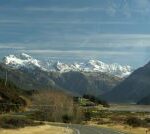 Alps (they think they are closer to England than they are) we had the foreign minister tell us (last time I was here) that NZ is Britain’s last, least and most loyal colony. They still talk of “going home”—second and third generation–for a visit to England. They are also leaving NZ to work in Australia, where salaries are higher and home costs are lower, at the rate of 600 a week.
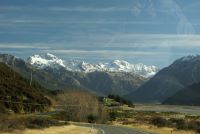
Back to the Alps. We took a trip to Arthur’s Pass, the major tramping center 
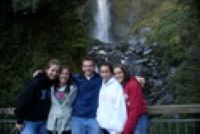
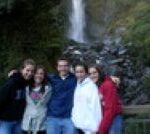 and the main route to the west coast. It is at about 3500-4000 feet, so was cool and spectacular. Along the way, we passed some of the 45 million sheep that are also one of the features of New Zealand, making it a good place to buy wool, and to eat lamb. Anyway, we tramped for about an hour and a half to a huge waterfall. On our free day, Ruth Ann and I wound up in a hot springs in the foothills, a reminder that NZ is part of the rim of fire around the Pacific–volcanoes.
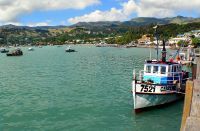
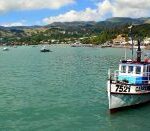 Yesterday, we were supposed to swim with dolphins in the Pacific Ocean, but rough seas reduced that to a more simple tour of the harbor, (created by volcanic explosions) of Akaroa, which was originally settled by the French, whose government decided too late to claim South Island (GB took it over in 1840). The town has some French names left, and supposedly some French people, too.
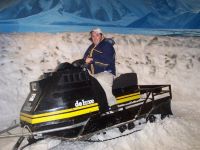
New Zealand is one of the gateways to the Arctic, and there’s a nice museum 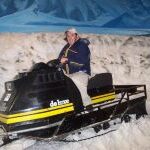
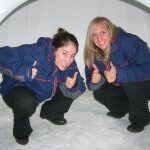 in Christchurch that we visited. That introduced us to the clothing and special equipment needed to live on the bottom continent.
Sometimes you find some rare treats when you travel. I did. On our way to the Alps, we stopped at Springfield, New Zealand, which advertised a Rewi Alley park. I recognized him from my Chinese history days. Edgar Snow introduced him to communism in China in the 30s. He then worked with the government cooperatives, and stayed in China after the “liberation.” The exhibit noted that he had sent artifacts back to the Canterbury museum, which is right across from the YMCA where we are staying. The museum was not on my must-see list–until i realized that Rewi Alley probably sent back lots of items that were available in the old days.
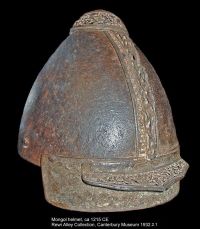
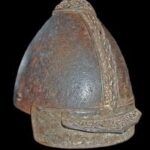 Indeed, he did. The museum had great exhibits, including a helmet from the armies of the Great Khan (Genghis), who overran most of the world, from Beijing to Budapest in the 14th century.
We are off to visit with the largest exporter of electronics goods here this morning, then have free time to explore this wonderful and beautiful city in a wonderful and beautiful country. New Zealand has stood for environmental purity (100% pure is the country’s tag line), which makes it a mecca for backpackers. Unlike our version of backpacking, backpackers here travel using backpacks instead of suitcases, and stop in hostels and other cheap lodging. They are all over Asia, mostly Empire kids who graduate college, then wander for a year. The government even gives training in bartending so its young people have a trade to ply as they travel.
Have a great barbie today [for Memorial Day]. We had two before we left Australia. One was at ICMS, a management college that purchased a seminary on a hillside overlooking Manly Beach. I took many pictures to show President Wilson what our campus might look like. The other was our farewell dinner in a building built in the late 18th century to house criminals. They are gone now. I hope.
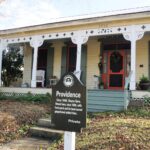
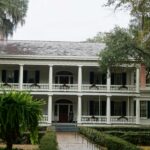 , which as a consequence has 140 houses on the national register. Carolyn and I went to one, Rosedown (restored in 1950), an antebellum mansion that an heiress fell in love with. She spent $10 m on it and around 90% is original furnishings. Once 3000 acres of cotton or sugar cane, with over 400 enslaved people, the original family lived there until the 1950s. After the war, the plantation devolved to share cropping, but the house was badly in need of repair ($10 million in 1950s dollars!)
 With its high ceilings and narrow staircases, I wondered how the elderly fared. The guide said they turned first floor parlors into bedrooms or built smaller homes nearby.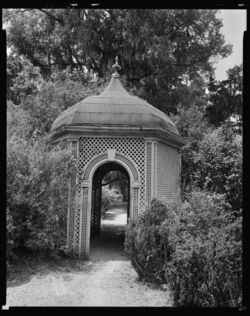
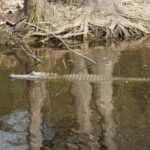 We woke up here in a thick fog, which lasted till we drove to Cajun Pride, operator of a swamp boat operation. We boarded a pontoon looking for wildlife. Alligators lurked looking for Captain Hook. Wild razorbacks rooted, scarfing corn thrown by our
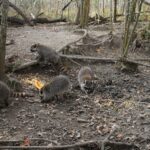 captain, from racoon families. Surprisingly, no mosquitoes sought our Yankee blood, despite 78-degree weather.
 home with a 38-acre garden decked out for Papa Noel, a Cajun version of St. Nick. Papa Noel arrives in a pirogue, drawn by alligators. Seems appropriate.