If you ever had a birthday in Xi’an…

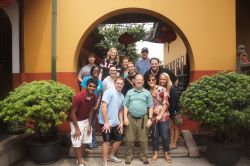
We had a student who had a birthday today, Michael Goldstein, and if you’d been here to celebrate with him, here’s what you might have done:
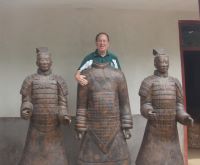
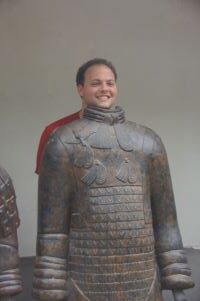
Trick photography. Hoyt towers over the warriors
Michael rules for the day

Most people come to Xi’an for the terra cotta warriors, and rightly so, but the first emperor who constructed them ruled China for only 15 years, and his dynasty lasted only 3 more years.  The pride of China (the Midnight in Paris as it were) were the Tang, generally conceded (by Chinese) to have presided over the most prosperous and imaginative period in Chinese history.  Certainly the Tang set standards for much of East Asia.  It was the Tang period (600-900 roughly) that influenced Japan and Korea.  In fact, if you go to Japan and look at the Buddhist temples, you’ll see the roofs that resemble Tang China more than its successors.

And, if you knew the importance of the Tang, you might have looked at the map, as I did, and found that one of the sites you’ve never visited (and you’ve been to Xi’an many times before) is the site of the Tang palace.  After all, the current city wall surrounds what was the Ming version of Xi’an.  We’re in the north side of the city, just outside the North Gate of that wall, and less than a mile from here is that Tang Palace park.  You might have figured out that I’m an insomniac, and while China doesn’t cure that for me, it makes me glad I am, because it extends the day.
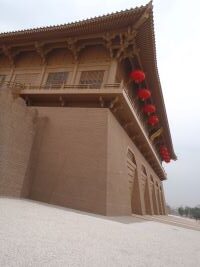
So at 6:30 am, I wandered off for an hour and a half through the city, focusing on visiting those ruins.  I saw the excavations and attempts to build up the three south gates to what was a huge palace, and if I get a chance to go back tomorrow, there’s a small museum with some of the artifacts from the palace.

You would have been more likely to join the rest of our team for the 9 am tour to the terracotta warriors—after all, no foreigners (other than me) were at the Tang DeMing Gong Yuan (the palace park), and none were spotted on my walk back through tree-lined (sycamores) side streets of Xi’an.
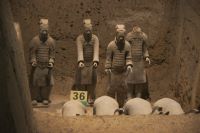
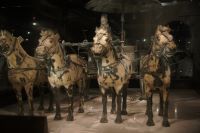
The emperor’s tomb complex is about 20 miles from the current city of Xi’an, located where there was favorable feng shui.  The emperor himself has enjoyed periods of fame and infamy (our guide stressed that even though the Zhou and Shang states predated the First Emperor, they don’t count because they were based on slavery!) partly because on the one hand he unified the country, reconstituted the great wall, standardized the currency and roads, and gave his name to the country (he was from the state of Qin); on the other hand he had a rapacious appetite for monuments to himself, which led in turn to forced labor (20,000 workers built the tomb complex, and he reputedly killed them all to preserve secrecy—can you believe that the tombs lay undiscovered after the immediate aftermath of his dynastic fall until 1974, when a head appeared in the retrieval of matter from a well being drilled on the site).  He also burned books that he did not like, and killed scholars who refused to tell him ways to live forever, and subsequent scholars have gotten their revenge.

If you’d joined Michael and his classmates today, you would have seen the four basic complexes that are now open—Pit Number 1, the best known, was opened in 1979, and houses the infantry.  Two more accommodate other armies designed to guard the emperor in the hereafter.  The main pit originally collapsed after the rebelling populace burned the tomb, smashing most of the 8,000 warriors.  There are now around 2000 reconstructed—and you might have thought jigsaw puzzles were difficult!  The other display is of some bronze chariots that are exquisite.
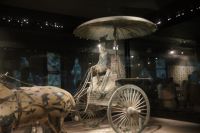
The big question mark is the emperor’s tomb itself, supposedly a recreation of the universe (with mercury serving as the sea) that remains unopened.  The consensus is that the Chinese await the technology to prevent oxygen from destroying silk, wood, and colors, as has happened with many other tombs, and even to parts of the terracotta army.
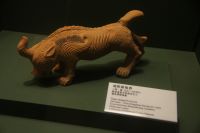
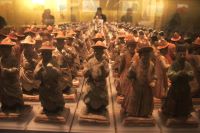
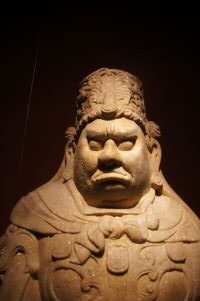
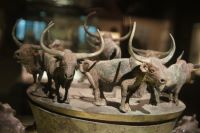
We spent a little time in the splendid provincial museum that demonstrates the importance of the province and the city in Chinese history, with artefacts especially from the Qin, Han, and Tang periods.

The interesting thing about the Tang period is the importance of two women.  One, the Empress Wu, took over for her husband and ruled China. She was the only female to claim the title, though Tzu-hsi, a concubine who rose to queen mother and poisoned a number of emperors was the power behind the throne until her death in 1908 (you might remember her from The Last Emperor),  and Madame Chiang and Madame Mao might have acted the role! She had, our guide kept emphasizing, a desire to be more powerful than the males, which she demonstrated by having male concubines (shucks, I told our guide, so did many empresses, including Catherine the Great, whose biography I read this year), and by constructing a lion standing up to guard a building, which is quite rare in China.  The other was a famous concubine, who was “plump,” and set the bar for beauty in Tang China.

If you were to celebrate your birthday with us, you might have asked the guide for an unusual dinner in Xi’an.  We had the famous Xi’an dumplings last night (some in the shape of a chicken, which were filled with chicken; my favorite was the walnut shaped dumpling, filled with walnuts).  She suggested Muslim food.  One of the consequences of Chang’an’s position as a world leader in trade (the Silk Road ended here) is that foreign traders came.  Unlike India, where the Muslim contact was, at times, military and political, Muslims settled in Xi’an, and have been here for centuries.
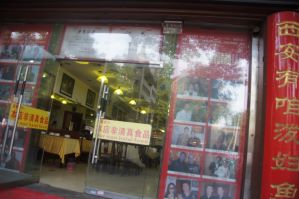
She suggested a special meal for Michael’s birthday that consisted of a lamb stew that was made famous by an emperor (who started a dynasty), who had started life as a beggar.  He begged for bread, which got hard, and then he put it into a soup, and lo and behold, when he became emperor, everyone agreed with him (which is why I want to be emperor) that it was one of the most tasty dishes they had ever eaten.  It was certainly a different way to spend your birthday.
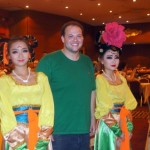
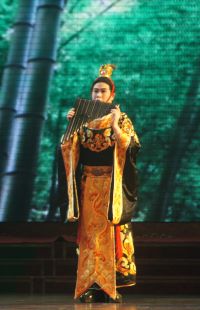
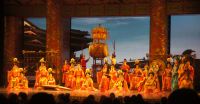
After the dinner, we went to one of the best shows in China, the Tang dynasty show.  Ruth Ann and I had seen it several times before, and knew it was spectacular.  What Michael did not know was that we’d arranged to have a birthday cake brought to him by two of the Tang performers, who gave him a dao (a halyard?) to cut it. The choreography was even better than I remembered, and some of the musical instruments the cast used were archaic.  One that is haunting sounds like an oriole—the emperor commanded a musician to write a piece for him that sounded like an oriole, which had sung for the emperor’s coronation (I can’t remember when I’ve seen anything other than an English sparrow in China, but the Tang dynasty was a long time ago).
So, if you have a birthday coming up, you may want to spend it in Xi’an, because I don’t think you can do the things I’ve described in Chicago.

Happy Birthday, Michael.
 

Xi’an, the road to Western Peace

We’re in Xi’an, a city of 8 million, but one, as I’m fond of writing, that was the capital of China for over 1000 years (thirteen dynasties, our guide reminds us; can you name more than 3? Qin, Han, and Tang?), but most recently 1000 years ago.  It’s a reminder that China was once THE place to come for fashion, political ideas, culture, and what passed for “electronics” in those days.  It was one terminus of the Silk Road that connected Europe and Asia, and brought the sophistication of the East to the backsliding West.

The journey here began with our last day in Shanghai, with a great site visit to a former student who is the General Manager of Cargill China. I hope that Confucius’ saying, “It is a great pleasure to welcome guests who come from afar” applies to him, because I was certainly glad to visit with him.  Omar Sadeque graduated IWU in 1992, got an MBA from Baylor, and went to work for Cargill.  Though I’ve followed his career, it’s been mostly from a distance.  The last time I visited him, it was May of 1997 or so, and he had just been sent to China, where, reasonably fresh from the MBA program, he’d been given around $30 million and told to “start a chicken feed plant.”  I remember being impressed by his responsibilities, and by his expat life style, which included car/driver/apartment/cook and maid.  He successfully established that plant, and has spent most of his career in the East—in Indonesia and Thailand, among other locations, helping grow the 12% of Cargill’s business that is in Asia.  I’ve heard good things about him from his coworkers in Malaysia, Viet Nam, and Singapore, where I have  visited Cargill operations courtesy of the University of Wisconsin Faculty Development Trips.

Omar Sadeque ’92

His current assignment is a major one—to build a chicken processing plant in Anhui province that will eventually employ 4500 people, and perhaps supply chicken, as Cargill does elsewhere, to McDonalds and KFC.  The company kind of flies under the radar; although it’s a $120 billion corporation, and would rank in the top 15 of the Fortune 500, it’s still family held, and in a business far less glamorous than Infosys, which has comparable revenues.  Its motto is nourishing people and nourishing ideas, and I’ve been impressed with what I know about its social responsibility.  When we were in Viet Nam, for example, the plant manager took us to a school that Cargill and its suppliers built and maintain for youth in an area where the government cannot afford to build schools.

Omar’s task was not only to do the right thing, as he put it, but to do it in the right way.  He helped the company negotiate the purchase of land rights (only the government owns land in China) from 1500 farmers, promising them not just a fair price, but an annuity, and moving them elsewhere.  A similar operation in India would probably cause (as it has) a farm protest, and indeed, similar displacements in China (the Yangtze Gorges project displaced over 1.5 million people) have provoked riots and unrest. But not many agreements contain the annuity.  It is an impressive company, and I’m certain that a number of students present will consider applying to the Minneapolis-based corporation.

Before our 21 hour train ride to Xi’an, we had an afternoon free to browse in Shanghai.  The bus took us to a market that houses mostly knockoff goods.  It used to be a big open air market for fake North Face, Rolex, etc., but the intellectual property negotiations have made the knockoff market become  less obvious in China.

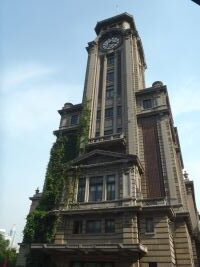
For me, the building was a short walk from People’s Park, and there were a few sites there that I would much rather have seen—and did. People’s Park occupied what had once been the racetrack in Shanghai, and I have postcards of it from the 1920s and 1930s.  The Chinese government  converted the clock tower and grandstand into a Museum of Modern Art, and it’s story, as well as the planned growth of Shanghai, were related in a nearby museum; on visiting it, I was able to check it off my bucket list.

The 21 hour train ride (I almost typed “strain ride”) was kind of a shock to the students.  On the Hong Kong-Shanghai train, being an international train, there was a baggage car; hence, the four-bed compartment (the so-called soft sleeper) was fairly comfortable with our day packs and us.  On the Xi’an train, we had to take our luggage into the compartment, and find a way to store it and us together.  I think our students understood why Chinese travel light.  After the visit to the knockoff market, several students had to buy additional suitcases!

Well, we are here in Xi’an which means Western Peace.  It was also called Chang an, which means long peace.  I’d hoped to write more, but I’ll save it for after our tour tomorrow (when we visit the terra cotta warriors) or Saturday, where we tour before another train ride.


The New and the Old in Shanghai

I had almost started by saying we were touring the “old,” which is the Jade Buddha temple—built in 1928—when I realized we’d visited the Yu Yuan (the Yu garden) which dates from the 16th century, and spent almost two hours in the Shanghai Museum, where I lingered in the bronzes, some of which go back to 2500 BC, and the beginnings of the Chinese state.

I’ll be perverse and stick with my first thought, because “old” tends to be no later than the early 20th century, especially in the area where we are located.  Our guide said there are 3 working Buddhist temples in Shanghai (population 23 million), and the Jade Buddha is the most visited.  One (and this is so PRC) was moved to make way for a metro station and reconstructed. The third one is quite a distance from the Bund, but was featured in a lot of postcards from a hundred years ago.  We passed it once, but our guide pointed out that it was a prison camp area under Japanese occupation, and thus is not on most tour agendas.

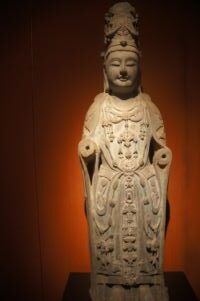
Our guide did one of the best jobs in explaining Buddhism that I’ve had in a long time, and especially the differences between the Buddha, Bodhisattvas, and Arhats.  She compared it to Phds, Masters, and College graduates, an analogy I finally understand.  The main Bodhisattva (serious disciple who has learned and stayed behind to help people) is the Guan Yin, whose transformation, documented in the Shanghai Museum, and I hope over time at the Buddhist caves I will be seeing in Datong after the students leave.  The Guan Yin started as an Indian man (all the Buddhas are male), but I think it was the Empress Wu, the only woman to rule China, who made him into a her.  The museum exhibit also (bear in mind that it is a little Sinified) noted that in becoming Chinese (which happens if you’re here long enough, as our students will see in the mosque in Xi’an), it became more compassionate.  The Guan Yin is popular especially among women because they pray to her for children.

She was also excellent in explaining the layout of the Buddhist temple—with its halls, drum tower,and bell tower, etc.  Our students will get other opportunities in Xi’an to see another temple (an OLD one), and I hope to compare and contrast it with the Tibetan temple in either Beijing or Chengde.

The secular version was the Yu garden, once the centerpiece of the third Shanghai city of the old days—in addition to the French Concession and the International Settlement, there was a Chinese city.  The wall around it has long since been torn down, and the rest of the area rebuilt as a “China town,” but there is no mistaking the wealth of the Pan family which built the garden originally, or the authenticity it represents in furniture, layout, gardening, and especially the juxtaposition of rocks (many with interesting shapes, some piled together to make hills) and ponds—together the characters for mountains and water equal scenery.  As one of the students noted, facing a man-made pond filled with huge goldfish and a hill that at one time was the highest in flat Shanghai (it is on the Yangtze River delta), “I could really study for finals here.”  It’s one of my favorite places in Shanghai, partly because no matter how crowded it is, the use of space gives you the illusion of solitude—in a city of 23 million people.

The surrounding “Chinatown” offers a wealth of shopping, eating, and other experiences, such as the Temple of God, which is a Taoist (an indigenous religion that has somewhat amalgamated with Buddhism) temple; I’ve bought reproductions of the International Settlement coins there over time, as well as xiao lung bao, a Shanghai dim sum, tea, chopsticks, and lots of whatnot.  Every time I think the boundary of gauche has been reached, I go back to the Yu garden area and discover how inventive is the mind of man.  Today, the touts were trying to sell us a roller skate that goes on your heel, and has only two wheels.  We managed to escape, at least the wheel man, with pocket books intact.

That Shanghai has a museum is in itself a change from the first time I came here—or rather that it’s open is a change.  I first saw materials from the Shanghai museum in Chicago when a traveling exhibit came to the Field Museum (I believe) in the lovefest that followed ping-pong diplomacy.  But it was always closed when I started coming to Shanghai.  In the 1990s, the Shanghai government (remember, I mentioned it was this period when Zhang Ze-min, who had been mayor of Shanghai, replaced Deng Xiao-ping as China’s leader) built a number of new edifices in People’s Park (which had been the race track in the International

Settlement).   One was the art museum,  in the old clock tower; another was the museum, where our guide supplied us with an audio guide.  Although I’d been to the museum before, I’d never bothered with the guide.  It was very useful in the two exhibits I spent my time in—sculptures and bronzes.   In addition, the gift shop is first rate, especially in books.  I was a little surprised to see some books for sale which I know in the pre-1990s period would have been banned.

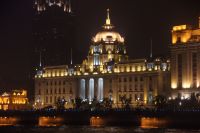
What really showed me the contrast between the old new China and the new new China was a boat trip we took tonight on the Yangtze River.  I’ve done the trip, but not recently, and never in the evening.  It was unnecessary because there were few lights at night in China, a country notoriously power poor. And poor as well.  The old Bund was lit up now—and there were enough new skyscrapers to confuse Shanghai with Hong Kong, although Hong Kong’s setting is unmistakable.  Shanghai doesn’t have the Peak, but it certainly has the location as the financial center and main entry and exit point for the trade from central China along the Yangtze River.

Speaking of the old and the new, the bus took the old back to the hotel, and the new to Xintiandi, a trendy area, to continue their exploration of Shanghai.

Shanghai: The other capitalist city in China

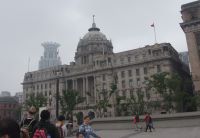
Shanghai Municipal Council building

From Hong Kong (a capitalist enclave in the People’s Republic of China) we took a 21 hour train ride to Shanghai, which has been reclaiming its pre- revolutionary title as the center of capitalism (and finance) in China. I think of it, not always positively, as New York.

One of the original treaty ports opened to foreign settlement in 1842, it gradually became an enclave with its own self government—in fact, two governments. One, that controlled the area we’re in now, was once the famed “International Settlement,” formed by the union of the British and American concessions in the 1860s. Administered by foreigners, it was really a quasi-independent city, with its own officials (elected by a minority, which did not include Chinese until the 1920s), its own police (supplemented when needed by forces from the foreign navies here), its own stamps (at least until 1896; the stamps featured the dragon, an otherwise imperial symbol), and courts which administered foreign laws. There was a US Court for China, for example.

Because of extraterritoriality, the right to be in this protected Settlement (the French, as was their wont, refused to join, and had the French Concession, which was more known for gambling and gangs; it was right next to us, along the Whangpu, the area known as the Bund), safe from the vicissitudes of civil war (the disintegration of the Chinese empire lasted almost 100 years, and included a 19th century quasi-Christian uprising called the Taiping rebellion that lasted nearly 20 years, and left millions dead, and swelled the population of Shanghai with refugees).

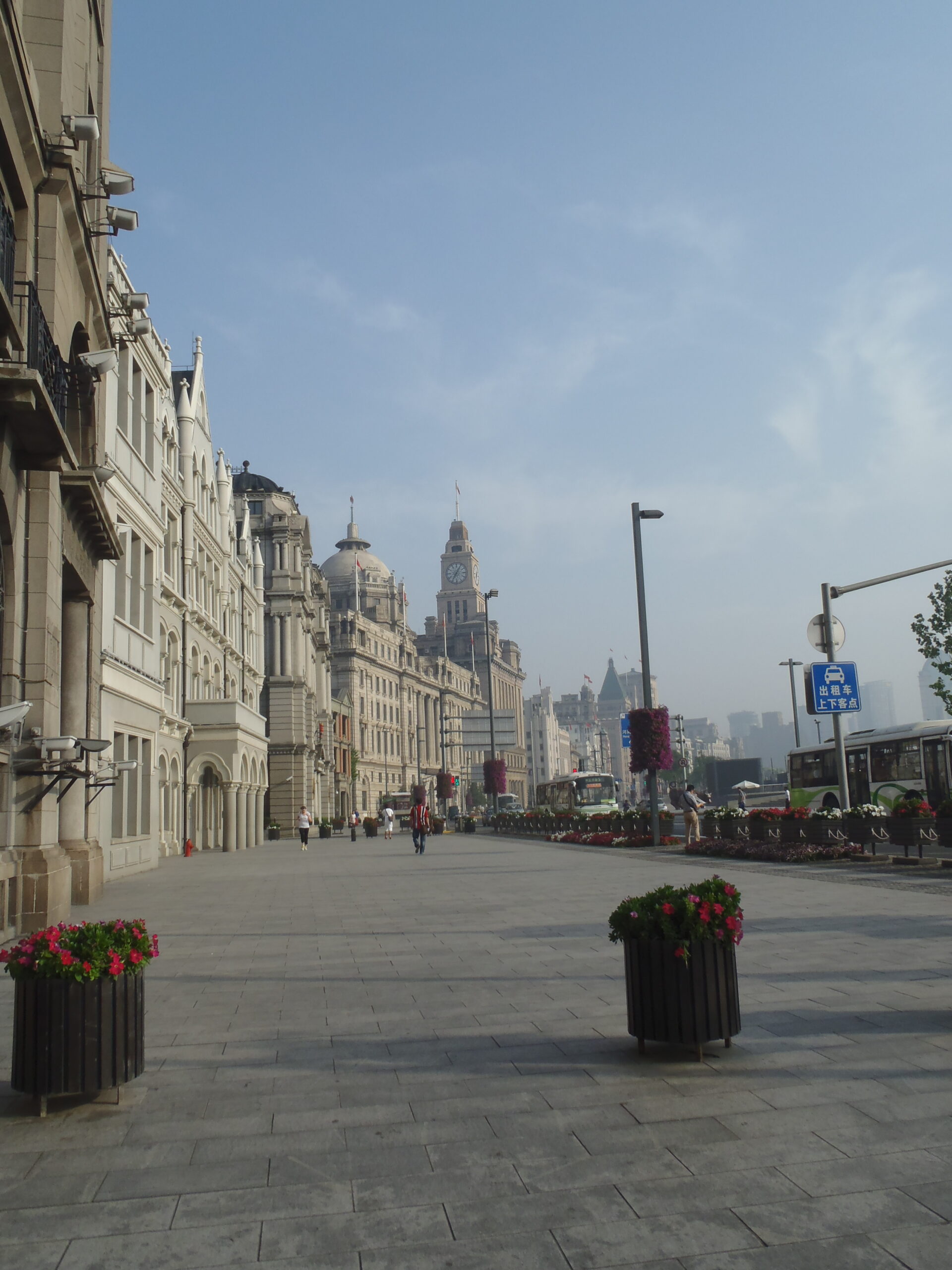
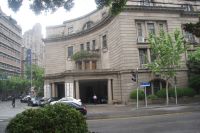
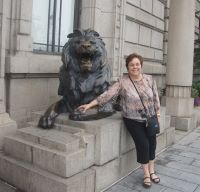
In the early 20th century, Shanghai became the hub of especially British, and later Japanese, enterprises in central China, as the port connecting the Yangtze interior to the rest of the world. Hence, along the Bund were located the major banks and hotels and clubs that recreated the lifestyle of countries thousands of miles away. We’re just behind the Bund, that wonderful façade of 1920s and 1930s buildings that you might have seen in Empire of the Sun. The former Hong Kong and Shanghai Bank, just down the street from us, dominates the Bund—its British lions restored in front guard the entrance to an interior that I remarked to Ruth Ann, “I’ve seen churches that aren’t this nice,” with marbled floors and columns, and murals recently uncovered on the ceiling depicting stylized cities of the Western world.

Because of its association with capitalism under the Nationalists, Shanghai suffered for a long time after 1949. Many of its industrialists fled, either to Taiwan or Hong Kong, to help jump start those “tigers,” but Shanghai languished until the early 1990s, when former political officials from Shanghai—Zhu Rong-ji and others—moved into high offices in Beijing, and the city more than came alive economically. Always populous, it now has 23 million inhabitants. Always crowded, it has (since my first visit here in 1990, and with a great assist from the Shanghai Expo) found ways to move crowds (infrastructure is one of the major contrasts between China and India; on our over 800 mile ride from Hong Kong to Shanghai, we were paralleled by new highways) such as subways, expressways (some of which destroyed the old colonial homes; I’ve met Tess Johnston, who has compiled “Lost Shanghai,” and other books detailing the colonial architecture. She and her photographer were taking pictures of the buildings as the bulldozers were tearing them down), and double decking. One of the most crowded streets was the Bund, which had 11 lanes of traffic and needed 20. That was torn up and an underground tunnel put in. Amazing changes.

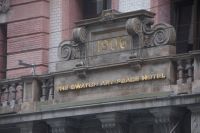
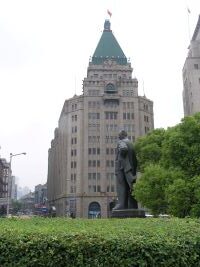
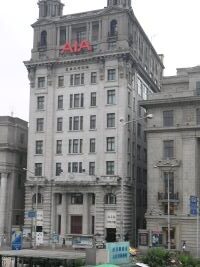
I love the old colonial architecture of the Bund (so called Puxi, the west side of the Whangpu river), and the Chinese have made serious efforts to preserve the “heritage” of the colonial past. The buildings in this area are signed with the period, former use, and architectural style. Many are art deco, dating from the late 20s, or early 30s, such as the Sassoon House, lavishly redone (3 years of renovation) by the Fairmont, and its 1906 partner, the former Palace Hotel, now the Swatch Art Palace Hotel (naming rights?). At least one has been restored to its former use, as the headquarters of AIA. Cornelius V. Starr, the founder of the insurance company, had a building on the Bund, and maintained good relations with the Chinese government after 1949, and returned here in the late 1990s. Not many people know (but I do) that the “AIA” building was owned by the North China Daily News, a British newspaper devoted to preserving the colonial way of life, but as I’ve said, I love irony (the most ironic location, perhaps, was when I came in 1990. There were few places where foreigners could buy things, the so- called “Friendship Stores,” which used special money—foreign exchange certificates; the biggest was in Shanghai, on the grounds of the former British Consulate).

If you’re a foreigner walking along the Bund, you’re likely to take pictures of yourself facing the Shanghai that people in the 30s, who had spent months at sea, witnessed on their arrival.

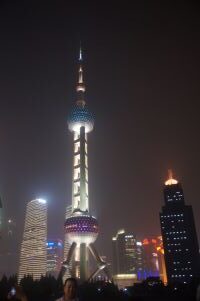
If you’re Chinese (or young Americans, like IWU students) you’re likely to be drawn to Pudong, the East side of the Whangpu River, which is the symbol of the new, new, newest China. The Pearl TV tower dominates this new town, which I visited when it was a gleam in a developer’s eye (in 1994 or so). It was rice fields and construction gear, and we went to a construction hut where there was a plan for the financial capital of China, with 3 million people, a major new airport connected to the city by a maglev train, the tallest buildings in the world; I thought, “Fat chance.” If you’ve seen the toilets, you’ll wonder what chance the Chinese had of creating this model city. 12 years later, on the way to Pudong airport, driving past this city of 3 million people to the major new airport watching the maglev train speed by the tallest buildings in the world (including one shaped like a bottle opener), I ate crow before that group of students, warning them not to doubt China’s ability to do whatever China sets out to do.

We got in around noon and had the day free, and, as you can tell, I enjoyed wandering aimlessly in and out of the 1920s and 1930s (the students think that was my youth), occasionally stopping for 2012. We do our tour tomorrow.

Hot, Flat and Crowded in Macau

Macau May 12, 2012

I’m sure Thomas Friedman did not have Macao (as the Portuguese would spell it) in mind when he wrote Hot, Flat and Crowded, but that was certainly an apt description of that Special Economic Region today. Once a sleepy backwater (probably since the Opium War catapulted Hong Kong ahead of it as an entrepot for the China trade, with the possible exception of World War II, when Macao was neutral, thus a magnet for refugees and a haven for spies), the handover in 1999 has given THE gambling spot in East Asia a sharp boost.  The city of 300,000 or so in 1999 now houses over 550,000, with a floating population of 80,000 laborers, 300,000 visitors from the mainland on a weekend (it is THE gambling magnet for a population that loves to gamble), not to mention the ferry boats from Hong Kong that brought us and other throngs to the peninsula. It’s only an hour away, and you get a passport stamp!  Plus, for me and Ruth Ann, there’s a seniors line that is at least fifteen minutes shorter through customs.

 A former Portuguese possession, Macao’s separation from China was by “accident.”  Portuguese sailors (and it’s hard to imagine, standing in Lisbon and looking out at the great unknown ocean) pushed the known (European) world boundaries around the Cape of Good Hope and into Asia, abetted by the Pope’s division of the colonial world between the Spanish and the Portuguese (which made Brazil a Portuguese colony as well).  They landed in Macao in 1517 or so, but a half century later claimed they were “shipwrecked” and eventually got a  foothold that became the base for European trade and missionary expansion.  The great Jesuits passed through Macao in their efforts to penetrate China (we’re likely to see the observatory and the astronomical gifts that won Father Ricci a place in China, having honed his skills in Macao, which had the first Western-style university in Asia). The Portuguese fought off the Dutch in the 17th century, and provided the base for other European traders in the 18th.

The first US ship appeared off Macanese waters in 1786, the beginning of a long history of Sino-American trade.  It was also in Macao that Caleb Cushing, an American diplomat, signed the treaty of Wanghsia in 1844, giving Americans the same rights that the British had won in the Opium War, the so-called unequal treaties that ushered in what the Chinese call “The century of humiliation.”  It was, in fact, in Macao that Chinese commissioner Lin Teh-hsiu  burned the opium stored in the colony, triggering the Opium War. The foreigners had, up till then, been permitted to trade only in Canton, living there temporarily during the trading season, then packing up and returning to Macao—until Hong Kong displaced it.

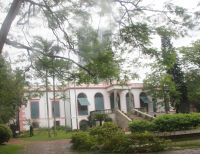
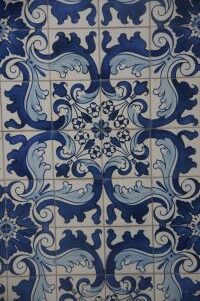
 Macao definitely has a Mediterranean feel, and for those who have followed my blogs, you know that because of my fascination for this pastel-colored community, I had to go to Portugal (well, I wanted to). I found that the pastels were Portuguese: the governor’s office is a coral pink, as is the King’s Palace in Lisbon, for example. The egg tart, one of the prime desserts in Portugal, has its counterpart in Macao (and there are some other foods that you find only in Portuguese possessions; many years ago when I stayed in Macao with students, we dined at the former officers’ club—also pink—which had a rather long list of port wines, certainly one of Portugal’s main products).  And I got into Leal Senado, the library cum legislative headquarters, with its blue and white tile garden that could have been in Lisbon or Porto or….

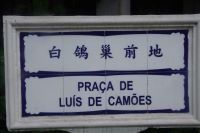
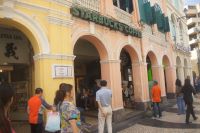
 Although there were few Portuguese in Macao, the Portuguese left other legacies.  Portuguese is one of three official languages in what is now a Special Administrative Region.  As Portugal honors its former colonies in Lisbon (when you’re there, visit the Museum of the Far East), Macao has not turned its back on the Portuguese background.  It plays up the tourist dimension of the historic center, focused on a kilometer- long area from Leal Senado (the main public square with pastel-colored colonial buildings, one of which hosts one of the most interesting McDonalds, another doing the same for Starbucks) to the shell of a 17th century church/fort which was devastated in a fire.  The façade is left, and is one of the most famous non-buildings, I would think, in the world.

The former Church of the Mother of God, it has become known as St. Paul’s ruins, including the remains of that Jesuit college that pioneered higher education in Asia, and trained generations of missionaries. In looking at it, I realized why the Jesuits got banned in 1762.  On the top of the building are Chinese dragons.  The Jesuits got caught in several controversies—including the so-called “Rites,” where they accepted into Catholic theology the notion that local practices were not antithetical to Christianity.  Heresy in 1762. In any case, there is a building heritage of churches .  I think our guide noted there were 27 churches and 28 casinos, the latter with far more devotees.  (There’s a lesson in those numbers!).  One nice addition to the Jesuit-built fort (which withstood a Dutch invasion on St. John the Baptist day, making him the patron saint of the city) is the development of a museum that combines history and business and culture.

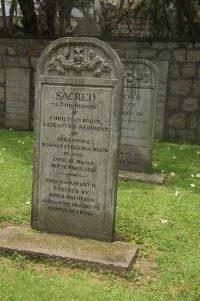
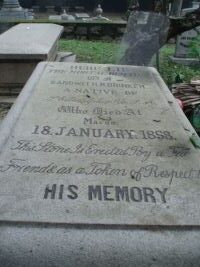
 One place I got us taken to is the Protestant cemetery, which I learned was maintained by the East India Company, one of those links that tie China and India together historically.  The Honourable Company (see John Keay’s book) brought opium from India to China in exchange for teas, silks, pottery, etc.   The cost was sometimes high, as the cemetery gravestones makes clear; death aboard ships in war and peace, in childbirth, from dysentery and plague, storming the heights of the Boca Tigris forts at Canton, etc.

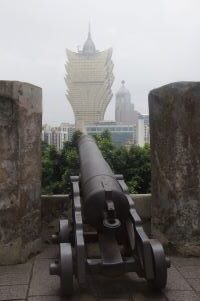
 The main business of Macao, however, is tourism, and as I’ve said, it’s THE gambling spot in a region that loves to gamble.  Until 2002, Macao gambling was the monopoly of Stanley Ho, whose four wives occasionally make the news in their squabbling to divide his wealth (he’s in his 80s).  The “opening” of the gambling trade (that’s supposed to be a pun on the opening of the China trade and the open door policy that it helps to be a Ph.D. to recognize) brought a number of US companies into the picture—Wynn and the Sands, for example–and today the revenues from the casinos in Macao are much higher than those in Las Vegas.  In any case, Mr. Ho built a “Grand Lisboa,” a bigger and better version of the “Lisboa” to welcome his new rivals, and we spent about 45 minutes ogling the décor—chandeliers and 4 foot long carved ivory tusks, gold boats, etc.  40% of the revenue is taxed, making Macao one of the most prosperous provinces of China.  The casino was mobbed, but not hot; the streets were hot, flat, and definitely crowded.

I think it’s been Hot, Flat, and Crowded for a long time; I’m convinced that humidity can be more than 100%, but for me, it was also fun!

Eating, shopping, and touring: HK

Our Peak Experience

Everybody loves Hong Kong—and with good reason.  One is the setting, unlike almost any city in the world, with its center on Victoria Harbor which separates Hong Kong Island from Kowloon on the mainland.  This is the tourist hub, and the bright lights and shopping meccas that are a second reason that Hong Kong is a popular destination.  That has been so since the 1840s, when, as a result of the Opium War—when the Chinese attempted to interdict (look that word up) the opium trade (from India, which is one connection for the course theme), the British sent in troops.  In 1842, the Treaty of Nanking, ending the Opium War, started what the Chinese call the century of humiliation.

Out of that treaty, the Chinese ceded Hong Kong Island in perpetuity to the British; two decades later, another war, and another Chinese defeat ceded the Kowloon peninsula to the British.  At the turn of the century, the foreign quest for spheres of influence led to the addition of the New Territories on a 99 year lease as part of the colony of Hong Kong.  It was the end of that lease that prompted Sino-British negotiations that led in 1997 to the return of all of Hong Kong to the Chinese.

We arrived in Hong Kong Thursday around noon, and had much of the afternoon to explore or shop (shopping and eating are the favorite pastimes of most tourists here, and most Hong Kongers, now that I think of it). Some of the students, though, reacted to being up for 36 hours by exploring the sleeping arrangements at our hotel.  For me and Ruth Ann, it was a visit to a tailor we’ve used for years, and it’s always fun to visit him (and come away with some apparel that fits!).
In the evening, my friend Eleanor—whom I met years ago in Viet Nam, and who has been a good friend to me and to IWU students over time—took us to a restaurant for a meal she had ordered.  I told the students we’d probably be taken to a building, go up an elevator, and be in a restaurant where everyone would turn to look at us (because we’d be the only foreigners), and none of the help would speak English (or, because this is Hong Kong, a special administrative region of China, under British common law—not the mainland—not Mandarin, either; they speak Cantonese, a tongue in which I know 2 words—bok choi, a green vegetable, and joe tsang, which is good morning).  What I did not reckon with was that this year, she took us to a wedding hall, where, for a while, we were the only people present.  The meal was as different as could be from Indian, but every bit as sumptuous as our farewell dinner in Bangalore.  We sat around a huge table with a lazy susan, with dish after dish passing in review. Professor Eleanor Cheaung (a management professor at  the City University) knows of my fondness for Peking Duck, so that was included, but it was one of about 10 different dishes she had ordered.  I have good memories 24 hours later—though some were off put by the chicken head that was on the plate with the chicken—as I said, that’s how you know it is what it is, and is genuine.  At least they did not bring it live, like they do when you order snake!  Food, as I’m reminded, is incredibly cultural.  I think I was the only one of  our group who had dim sum (egg rolls and dumplings) and congee for breakfast, but our hotel also offered omelets, waffles, cereal, fruit—and, since it was a British colony, roast tomatoes and baked beans.
This morning we took a tour of the city, which meant crossing from Kowloon to Hong Kong side, where we circled past Ocean Park (a pre-Disney rival to Disney), viewing some of the mansions  (90% of the population at least live in high rises, about half of them in public housing); land is very expensive in Hong Kong.  Our guide told us that free education is provided only through second year of high school, which is kind of surprising given that Hong Kong has a highly-educated population.

On the perimeter of the island, we saw beaches, a few spectacular mansions (if you’re the right age—mine—you may remember “Soldier of Fortune”, a very bad Clark Gable movie, whose saving grace is a mansion we passed and Susan Hayward as Mrs. Hoyt),and Wan Chai, home of the world of Suzy Wong (Hong Kong was pretty sleepy until the “fall of China,” which brought it many Chinese refugees, including Li Ka-shing, who is frequently listed as the world’s richest man, and then the Korean War, which brought a lot of US sailors and foreign aid). It was also China’s trading port to the world, a distinction it is losing for central China to Shanghai, and to an extent for the South to Guangzhou.

I remember when I first came here 20 some years ago, there were still factories in Hong Kong, but today they’ve moved to South China, though many managers still live here.  Ironically, with the handover and the ease of cross-border movement, some managers of Hong Kong companies now live on the mainland and commute the hour to Hong Kong because the cost of living is so much less.  We wound up at the Stanley Market, which like Hong Kong has transformed from a ramshackle collection of interesting shops, many dealing in Western brands to more of a mall, as Hong Kong has transformed from manufacturing to services (much like Bloomington-Normal, though that took close to a century).

There’s a palpable energy here that is quite distinctive, and a cosmopolitan lifestyle that involves, as I said, shopping and eating for tourists and locals, and hard work, mostly in services, for the 7 million locals.  There is a lot to do here, 24/7. Tonight, for example, Ruth Ann and I had a Korean meal (I love bibimbap), and then I went to the Hong Kong Philharmonic where the centerpiece was a Max Bruch  concerto. I came back via the Star Ferry (which is free to senior citizens) and the metro (half price to those of us older and wiser), a rather nice evening for me. Our students were sampling the nightlife in Hong Kong—sipping it, I should hope, since we have an early morning ferry ride to Macau, which was the last European possession in Asia.

Palaces and Gurus

Palaces and Gurus May 9-11
Today’s long day (8o miles in 4 hours—each way!) helped us understand a little bit more about South India. We’re 1070 miles from New Delhi, near 12 degrees latitude, which demonstrates in part that India is a country with size and variety.
We’re in the state of Karnataka, one of 28 states in India. I’ve been told that the state divisions were based on languages (roughly)—which should give you an idea of how many languages there are in India! 14 or so are “official”, and where they are, Hindi is taught as a second language. Certainly, most educated people (and people in the tourist trade) speak English.  Kanada is spoken and written here, eh? I can’t read it, but the script looks different than Hindi (which I also can’t read).
Here, the crops are rice, coconuts, and silkworms. The state runs wholesale centers for cocoons (we’ll probably see them somewhere in our trip in China) and coconuts, which we passed on the journey from Bangalore to Mysore. We also passed a number of textile factories, with workers, mostly women, wearing the clothing that they may be making walking to the factories—as typical in India, colorful.
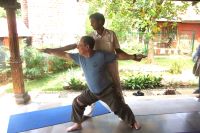
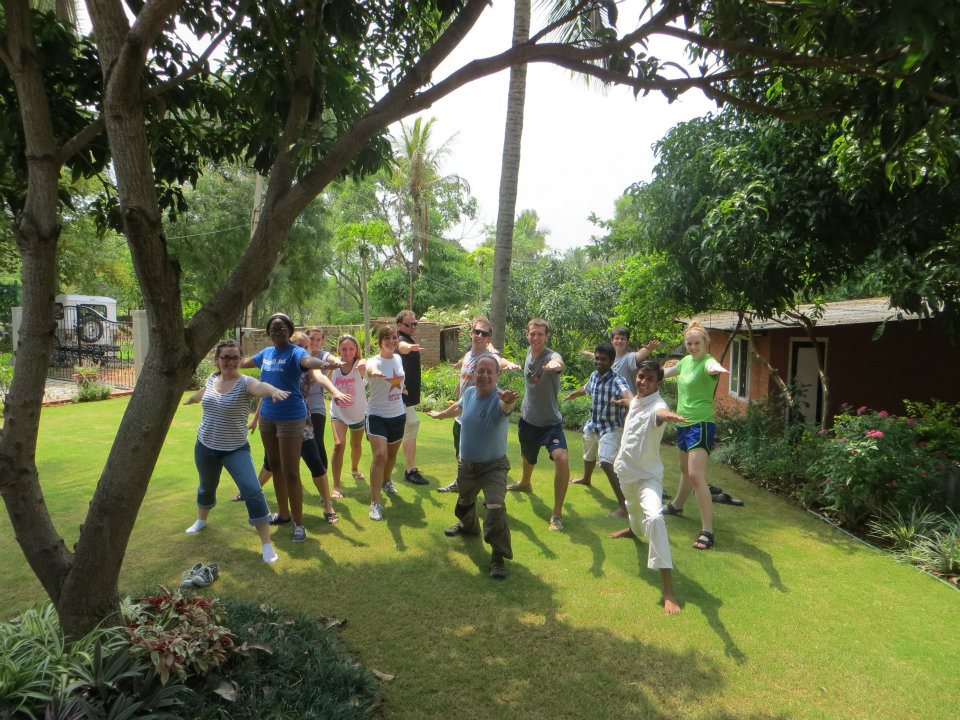
The highlight for me was probably taking students into my world—the world of yoga. I talked with our guide about the possibility of doing yoga in Mysore, because I knew (partly from my trip in January) that the area was a hotbed of yoga instruction, and my instructors back home all knew someone who had become a guru by spending time in Ashtanga Ashrams in Mysore. Fortunately, she was able to tie a yoga class with a lunch visit to a farm run by members one of the smaller communities in India. The yoga master appeared on the porch with mats for each of us, and gave about a 45 minute introduction to yoga moves, breathing, and meditation. Who knows, some students may take it up when they return to IWU. The meal was appropriate to the particular community, which numbers 19,000, has its own dialect and clothing, and lives in the mountains farming—including coffee.
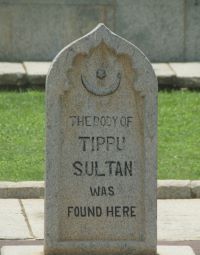
There is substantial tourism in Bangalore/Mysore, mostly domestic, and we encountered it because the schools are out and this is vacation time; much of it centers on 18th century heroes, the Muslim leaders Hyder Ali and Tipu Sultan. Hyder was a soldier in the armies of the Maharajah of Mysore, who overthrew the Maharajah and made himself Sultan. The result was a protracted and bitter series of wars in which Hyder, and later Tipu, enlisted French mercenaries, while the deposed Maharajah brought in British forces from the East India Company (British India proper began in 1857, after the British suppressed the Sepoy mutiny and abolished the Honourable Company), while local nabobs like the Nizam of Hyderabad switched sides as it suited them (or to whichever paid best). Hyder and Tipu won the first two wars, and became the great hope to block the growing spread of British rule. As I’ve suggested, this was part of the great world wars between France and Britain that culminated at Waterloo (and included our versions, the French and Indian War and the American Revolution). Tipu in particular hated the British so much he composed a diary in Persian in which he dreamed of a victory over the British. When one of his nemeses died in battle, Tipu had a toy built—it was a mechanical tiger that devoured a British soldier. When Tipu died in 1799, betrayed when one of his officials, bribed by the British, opened a passageway and let British troops in, the British supposedly drank on the corpse, toasting, “Death to India.” The tiger-toy now reposes in the Victoria and Albert Museum, while millions of Indians toast Tipu. Ironically, he was defeated by troops led by Lord Cornwallis, fresh from his role at Yorktown.
We saw two of Tipu’s summer palaces, one near Mysore which was occupied by Arthur Wellesley, better known as the Duke of Wellington, who cut his teeth in India before chomping Napoleon; the other was in Bangalore. Both were fine examples of Islamic art, with the arches, open air sections, with some explanations about Tipu and his wars with the British.
The other major attraction of Mysore is the palace, built by the Wodeyar family, the rulers of Mysore whom Hyder Ali had shoved aside. Restored to the throne by the British (whose resident built an equally magnificent colonial building) , the Maharajah has an Indo-Saracen palace which is open to the public. The family lost most of their privileges in 1947, when the new Indian government stripped the princely states of political power, though leaving them with some privileges, which were further reduced in the 1970s. The Maharajah and his family still live in the palace, but as I said, have opened up large areas to the public, including what used to be the public assembly hall, which in size and decoration rivals palaces in Europe. It is said that the Maharajah burned down its predecessor in 1897 because he wanted the opportunity to rebuild. It has lots of carved teak features, inlaid gold and silver doors, chandeliers imported from Europe, and a display of possessions that includes an 80 kg gold howda for riding the royal elephant and a 200 kg gold throne.
One of the businesses that has sprung up offers the opportunity to ride elephants around the grounds. Of course, it was something we had to do. I could only imagine going into battle on one of these beasts as we swung and swayed—rather like riding the bus on the 80 mile ride from Mysore to Bangalore. One of the reasons it took 4+ hours was the construction in Bangalore of a metro system. The other was the fact that the highway goes through every town, and to make people slow down, has speed bumps and a series of barriers that you have to dodge around.
We toured Bangalore today after an interesting talk from a real estate agent from Jones Lang, and LaSalle, an American firm based in Chicago that manages corporate headquarters (among other businesses) for companies like Dell. He pointed out that India’s conservative financial system spared it the Western meltdown. Our observations tend to concur. Spending an hour or so on “Commercial Street,” fostered the belief that consumerism is alive and well. So did our dinner at a mall that housed the high-end brands.
I’m writing this at 2 am, awaiting our flight to Hong Kong with some regret at leaving India. I’ll miss my dosa breakfasts, but am leaving with both good memories and a belief I did not have years ago of progress. One quick vignette: on the road to the airport, indeed, within the airport, the road had speed bumps and a series of screens to slow down traffic. We could not have had a greater contrast when we arrived early the next day (it’s a 3000 mile trip to Hong Kong from Bangalore) at the Hong Kong airport. Once we got on the bus and zoomed to our hotel in Kowloon, the infrastructure contrast between Hong Kong and India could not have been more apparent.
They say business (if not life) is about relationships, and for the India part of our trip, I’m glad Sambit went to IWU and had me for class, and that I went to India in January. Anup Nair at that time not only became a good friend, but a trusted travel agent, who made for an outstanding visit in India, which is, happily, more than infrastructure!

Business Lore from Bangalore

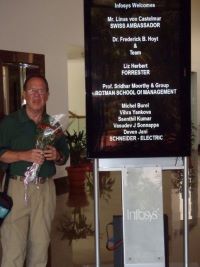
I think we got a pretty good feel today of what it’s like to conduct business internationally.  Our wake up call was at 4 am, so that we could be on the bus by 5 am to be at the airport at 6 am to take the 2 ½ hour flight to Bangalore to take a 1+ hour bus ride to Infosys for a tour of the facility and a presentation on the nature of the IT industry in the heartland of the IT industry in India….just like real business people do.

The Infosys campus is one of those “islands of excellence in a sea of chaos” that one reads about in India.  Going through security, one enters a campus that now contains 50 buildings, with 25,000 young people (the average age is 26, and the standard deviation appears to be +/- 2).  The company hires  around 25,000 well-educated employees a year, and offers training for 13,000 at a time on the 100 acre Mysore campus)

Although there are 140,000 employees in 64 countries, the bulk of the top-end work, I believe, is done in Mysore.  Though Infosys started in Business Process Outsourcing (it used to be call center), it has, like many of the Indian backroom companies, moved up the value chain. The man who spoke to us is part of a project team working with Boeing to develop lighter and fuel-efficient airplanes.

The campus is one of the most pleasant places in the work world; as they explained, the facilities are geared toward a younger generation, but the buildings and setting are definitely world class.  The company started with 7 men and a total of $250 in Pune (a city north of here), and gravitated to Bangalore because of its reputation as a center of scientific research, partly because in the Raj days it was one of the major air force encampments.  That led to aerospace research,  (a favorable state government helped), and as a result, most major multinationals, including the Indian ones, have some presence in Bangalore, usually in a gated community, many in the Electronic City (as is Infosys).

When I asked about Corporate Social Responsibility, I got an interesting answer: the company has attempted to make itself sustainable (the recycled river through it is the only place in India I’ve seen where I’d consider canoeing—or even touching!), with green buildings.  It has also turned that focus into a for-profit unit, advising other countries on how they might handle the challenges of limited resources on a frail planet.

Perhaps the most impressive feature was not just the rich culture we saw, but the confidence Infosys employees have in the future of India and their company.  The company pioneered the Global Delivery Model, which was based on taking work to the location where it could be done best—most cheaply and most efficiently, and has become a 10$ b company. One of the founders of the company, Nandan Nilekani, you may recall from Friedman, “The World is Flat.”  It was in Nilekani’s office that Friedman developed the idea that the world could be flat.  It’s also a measure of the “India Way” that Nilekani, retired from the company, is heading up India’s efforts to create a unique identification system.

Although it was nice to have the rigor of doing international business (flying somewhere and getting off the plane and doing business), it was nice when we got the hotel around 5 p.m. and were able to have the night off. As I tell my students, they ought to admire people who do this regularly.  Now they know why.

Don’t you wish you could have a day like this one for YOUR birthday?

Don’t you wish You could have a 21st Birthday like this?
May 6 in Delhi
I had always wondered why I seemed to know more about Muslim or British India than Hindu India, and today provided a good answer based on my trips to India, two of which had been exclusively to New Delhi; the answer was provided by the Qutub Minar, a major symbol of the city. This 180+ foot stone tower was built in 1193, by the Mamaluk King who put an end to Hindu rule, celebrating his victory. That battle essentially marked the end of Hindu domination in the Delhi area, and began the 600 or so year rule by Muslims. It seemed ironic to me that the tower was chosen as a symbol of a predominantly (now) Hindu-dominated country, when the complex, which was the palace and tomb of the Muslim conqueror not only celebrates his victory, but does so using stones extracted from a previous Hindu temple on the site. It also includes the so-called Iron Pillar, which commemorates a previous Hindu chieftain’s victory, centuries earlier.
To answer my own question, I can only point to the fact that Delhi, in particular, and much of India in general, especially northern India, has not been Hindu-ruled for the past millennium—until, that is, the emergence of an independent India in 1947. Ironically (and I do love irony), I read somewhere that the British created a Muslim-dominant Pakistan (which then was East and West) surrounding India in the belief that the Muslims would be helpful in minimizing Hindu nationalism and keep the Hindus in check, culminating a very typical British imperial policy of divide and rule that allowed a handful of Englishmen to rule the country for most of 200 plus years.
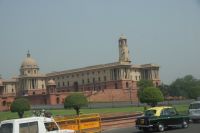
Most of the memorable tourist spots, as a consequence, are either British or Muslim, and we saw several of them today. The British laid out New Delhi, which may account for the broad, tree-lined streets, roundabouts, and bungalows that once housed colonial officials, and today house government agencies.
Two British architects designed the parliament buildings (one was a House of Lords in the old days; today it contains a number of very famous Indians, not necessarily politicians).  They also built the India Gate to commemorate the move of the capital to New Delhi from Calcutta in 1931, though today it is a memorial to the 90,000 Indian soldiers who died defending the Empire (the Japanese did recruit an Indian National Army to fight for independence from Britain, but that’s a story left to a wonderful book on Churchill and Gandhi), and so on.
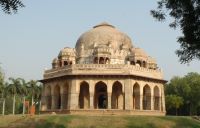
The other major stamp of the city, is from the Mamaluk through the Moghuls, a series of Muslim rulers from 1193 until the last Mughal in 1857, when Britain finally became, especially for foreign policy, the ruler of India. I had a real treat this morning when I woke up early. I had heard that Lodi Garden, about half a mile from here, was worth a visit, but I had no idea why. Turns out, it was the tomb (and I suspect the palace also) of the Lodi dynasty, which ruled the area briefly in the 15th century. In addition to Sikandar Lodi’s mausoleum, there were two or three other magnificent buildings, including mosques, and, as promised, a garden. Not just a garden with parakeets—a butterfly garden, a herbal garden, and, best of all, real people doing real things—in other words, it was tourist free.

That was not true of Old Delhi, started by Shah Jahan, he of the Taj fame, who moved the capital from Agra to Delhi, and built two landmarks. One

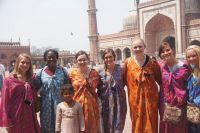
Appropriate attire was necessary in the Masjid

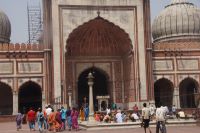
was the Red Fort, a twin more or less to the Red Fort in Agra. The other was the Jama Masjid, the Friday Mosque that is one of the largest in India. Built in the familiar red sandstone characteristic of the period and the place, it still encompasses the bazaar between it and the Red Fort that was a characteristic of the Moghul city. It was mobbed with people shopping for clothing and shoes, which we were able to observe from a safe distance in our cyclos, a bicycle-driven rickshaw that I am sure we will see again (in Beijing for sure). I think during the week it may be a more general market. I remember when I was there a section of Tibetan refugees, selling the goods more appropriate to Tibet (or as the British called it in the last century, Thibet). The one thing I learned this time (and it surprised me), is that the British closed the mosque in 1857, following a rather brutal suppression of the Sepoys; it reopened after Independence.

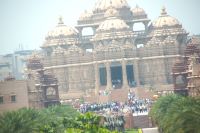
We also visited a Hindu temple, the largest mandir in the world (I think that means temple). It opened in the last few years, the project of one of the sects of Hinduism. It is certainly an impressive building and one of our students said that it attracts a million guests on Sunday. It seemed like they were all there this Sunday, since it took us ½ hour to clear security. I was reminiscing with our students about my trip to the Vatican last summer, where the lines were as long, and the movement as slow. When we finally got into the temple, it seemed the analogy was even better; it was as big and as decorated as St. Peter’s. It was white marble, and enough gold to qualify (in my mind anyway), as baroque.
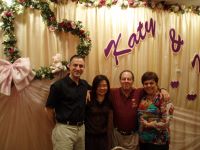
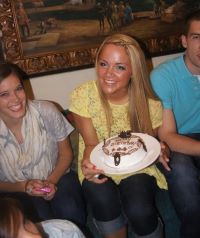
I just got back from a memorable birthday party for one of our students, Katie Bauer. It is her 21st, and I’m certain she’ll remember it! Don’t you wish you could have a day like this one for YOUR birthday?

The Taj Mahal

The Taj Mahal May 5, 2012
I think digital cameras were made for days like today, days when you would never have had enough rolls of film to capture the great sites of the world—and we saw three today, all associated with the Moghul dynasty, seven rulers that brought much of India, especially northern India, under the rule of this Persian-based Islamic group that brought India to the height of fame and wealth, only to become shadow rulers under the British.  Great Britain abolished the dynasty following what the British call the “Sepoy Rebellion” and the Indians call the first war for Indian Independence in 1857. The seventh and last Mughal emperor (see the book by William Dalrymple—any of his on India, in fact), more a poet than a ruler, died, exiled to the then-Indian province of Burma, his offspring murdered to prevent a successor.
The heyday of monuments were the product of three who ruled in the 16th and 17th centuries—Akbar (the Great; Akbar means the Great. It’s part of Muslim prayers), Jahangir, and Shah Jahan, who built the Taj.
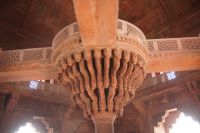
Akbar moved the capital to Agra, and built the Red Fort that has housed successive armies, culminating in the Indian army barracks that are there today. He has probably the best reputation because, among other things, he tried to resolve the multi-religion problem that still troubles India today. He synthesized the main religions and created his own, attempting to facilitate discussion among his subjects—including his three wives. One Muslim, one Hindu, and one Christian—and our astounded guide said, “He did not make them change their names or their religion.” The Red Fort was his palace, and remained at least one of them during the Moghul Empire, but Akbar also built a new capital, Fatehpur Sikri, about 20 miles away. Sparing no expense, he moved everyone to the new city, which had massive water problems, but was abandoned largely because of pressures on the Moghul state from the Northeast (read Persia/Afghanistan). The Persians would eventually sack the Red Fort in Delhi, and take the famed Peacock throne away. The stone buildings of Fatehpur Sikri remain, architecturally wondrous, and a visual treat.
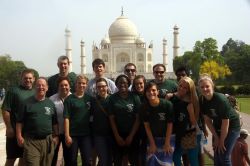
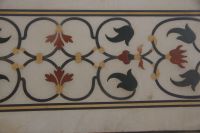
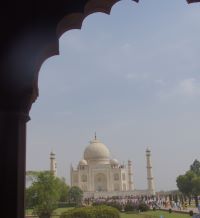
The Jewel in the Crown, though, is the Taj Mahal. It’s the fourth time I’ve seen it, and I feel truly blessed to have seen it at least once. Marketers usually overhype something, but as magnificent as the prose for it is, it’s even better in person. The scale (about 300 feet high) and the setting (stressing symmetry) and the marble work, the paired mosque-like buildings that surround it, its prominence on the river bank—are impossible to capture even if you have a 16 gigabyte card, but at least with a digital camera you can keep taking pictures!
Shah Jahan, you may know, built the Taj in memory of his favorite wife, who died giving birth to their 14th child at the age of 39. The ruler himself spent 22 years and used 20,000 artisans to construct the tomb. Ironically, he pondered building a black marble tomb for himself, and actually started to raise taxes to start the construction, but the taxes were so onerous that his son, Aurangzeb, overthrew his dad, and imprisoned him in the Red Fort in a room with a beautiful view of the Taj.
Agra is only about 120 miles from New Delhi, but getting there and back demonstrates one of the major challenges of India— our guide mentioned– distribution. The 615 am Shabadti express was smooth, on time, complete with a free newspaper and a (mediocre) meal, and took two hours. It’s no wonder that India Railways employs 1% of the workforce.
Coming home, by bus,  however, was a different story. It took us about 5 hours, which included a dinner, and a 20 minute breakdown in Delhi, which ended with cars taking us back to the hotel around 10 o’clock, on a spectacular day that began at 5 a.m.
The point of the 3 edifices might well be a reminder that, “What was, isn’t, and what is, might not be.” Isn’t that a nice yoga-like note to end this long day on!