Dec 28, 2025
Home from New Orleans
Tourism is New Orleans second biggest industry, and I would almost bet the Christmas New Year period is the largest “occupation” of the city. It certainly seemed that way on our one day visiting. I was glad we had been there several times in the French Quarter (the Spanish claim it should be the Spanish quarter, reflecting who owned the land when it was rebuilt after serious fires in the 1790s; the French Quarter is about the only part of the city above the flood plain, and is one of the most distinctive of all American cities). We’ve been to conventions there, so it was useful that we got to see other areas of the city this time.
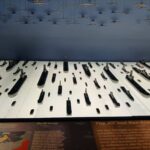 I think the National World War II Museum might not have been there when we were last in NOLA. That was high on my agenda (as a museum freak and World War II follower). It grew out of a cocktail hour with Steven Ambrose, a UNO historian, and Andrew Higgins, whose company built most of the LSTs that made D-Day possible. Originally conceived to celebrate D-Day, it now encompasses displays ranging from the 30s through the end of the War, with a strength on that “Second Front.” The movie, “Beyond the Borders,” features explosions that rumble the auditorium, highlighting battles, logistics, atom bombs, and the home front. Two hours barely scratched the surface.
The afternoon featured a bus tour of the city that skirted the all-too-crowded French Quarter (Jackson Square was shoulder to shoulder), but went to some other areas of the city. Loved the ironwork, which replaced wooden railings that were subject to spreading fires. One in 1788 did for New Orleans what 1871 did to Peshtigo (or Chicago the same day)
We made two stops. One was at one of the Catholic cemeteries, (Louisiana is 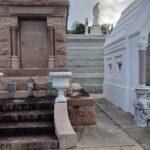 44% Catholic) which had mausoleums that we were told hosted only two coffins, holding the remains of the most recently-deceased member of the family. When a new death occurred, the old body was placed in a bag and returned to the tomb. All were above ground, since, our guide said, the water table is high and space is at a premium. (She noted the famous streetcars cannot turn around, but have two “fronts.” The driver goes to the other end at the end of the line. One track saves space).
Our second stop was at the New Orleans Museum of Art, built by a local to house his mother’s collection. Our guide pointed out mom’s art has slowly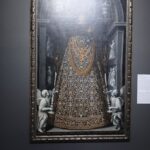 been replaced by Monet, Manet, and other prominent artists. Of course, I had to visit the small Asian collection, and discovered some wonderful conquistador art, Our Lady of Loretto, a Peruvian nod to the Virgin Mary.
The guide kept referring to pre- and post- Katrina features of the city, but as we toured, it was obvious that parts other than the Quarter were worth seeing. Rich planters and slave traders and others built wonderful mansions in the Garden District, too.
Our trip home was, happily, uneventful. Carolyn got bumped to First Class on the Dallas to Peoria flight. I knew she was “first class.” Now for the unpacking and recovery from sensory and culinary overload!