August 5, 2013
The Womb of the World
If you are in the port of Itea, Greece, I can confidently say two things about you: first, you’re on a smaller cruise ship, because it’s a small port; and second, you’re likely to be there to visit the “womb of the world,” the Temple of Apollo at Delphi. The famous oracle is located only about 12 miles (and up almost 2000 feet) from the ocean there, but nearly 120 miles and 3 hours from Athens.
For nearly 900 years, Delphi was the center of the Greek world, alternately called the womb, or the navel of the world. Part of the reason for its prominence is that the oracle at Delphi correctly predicted one of the Persian king’s defeat—ironically, in a cryptic response to the Persian king. He sent a delegation to ask what would happen if he invaded Greece. He was told a great empire would be defeated; he did not realize it would be his, but then, he didn’t ask the right question. The serpentine column that one of the grateful city
states erected in Delphi in honor of that victory (the site became a kind of “bragging place” where the disunited Greek city-states—the inconclusive 30 year Peloponnesian war between the various city states resulted in an exhausted stalemate– could in peace construct things to boast about their wealth) now graces Istanbul, because Constantine
brought it there in 330 as part of the decoration for his city. What better to display the might of the New Rome than a victory column celebrating the Greek victory over its greatest rival—Persia.
The Athenians were the richest city-state, and consequently, had the most ostentatious buildings, including one that touted the victory at Marathon (which doesn’t mention any contributions of the other city states).
As it turned out, the location generates energy because it lies on a fault line, and has suffered from a number of serious earthquakes . The 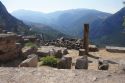 temple of Apollo, one of the most solemn places in ancient Greece, is also located over an area that generates a number of gases, one of which produces clear thinking if inhaled, and scientist believe it was this gas, rationed out to the women who did the predictions, which helped the reputation of the oracles.
Delphi’s prominence lasted until the Byzantine Emperor Theodosius ordere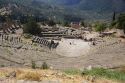 d the destruction of pagan
places, though for a time, there were Christian symbols in the area. Never a “city,” Delphi nonetheless had an arena that seated about 5,000, and a track that accommodated 20,000 people, both in reasonably good repair today. There’s also a wonderful museum, piecing together what they have found, including one of the 38 bronze statues believed to have been at Delphi, and a horde of gold bracelets and jewelry and ivory that was damaged in a fire, but could not be thrown away because it represented Greek gods, and thus was buried, only to be rediscovered in 1939.
We stayed in Itea for about 6 hours, and I think there were three things to do today: one was to shop in Itea, where the banks closed about 2:00, and there were few stores other than cafes open (the interesting
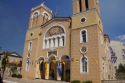 Orthodox Church closed its doors at 2 also); second, swimming in the Ionian sea, which was fun because it’s very saline, and floating took no effort at all; and third, today we watched air planes attempting to put out a forest fire in the area. There were five them that skimmed the sea to pick up water and return to fight the fire. I don’t think you can count on that happening every day, however.
We’re on our way to Athens, where this part of our journey will end. We 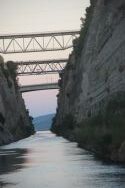 sailed through the Corinth Canal on the way, a 4 mile cut through solid rock that had been a dream since the 7th century BC, and was actually started by Nero. It was only in the 1890s, however, that the project was seriously begun and completed. In May, when I went with my students to the Peloponnese, we crossed over it from above. At places, the top is almost 300 feet high, and it is a small passageway, but it saves going all the way around Greece to get from the Adriatic to Athens.
I think the oracle said we would be in Athens by midnight tonight! I hope she’s right.