 stone tower was built in 1193, by the Mamaluk King who put an end to Hindu rule, celebrating his victory. That battle essentially marked the end of Hindu domination in the Delhi area, and began the 600 or so year rule by Muslims. It seemed ironic to me that the tower was chosen as a symbol of a predominantly (now) Hindu-dominated country, when the complex, which was the palace and tomb of the Muslim conqueror not only celebrates his victory, but does so using stones extracted from a previous Hindu temple on the site. It also includes the so-called Iron Pillar, which commemorates a previous Hindu chieftain’s victory, centuries earlier.
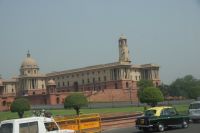 of Lords in the old days; today it contains a number of very famous Indians, not necessarily politicians). They also built the India Gate to commemorate the move of the capital to New Delhi from Calcutta in 1931, though today it is a memorial to the 90,000 Indian soldiers who died defending the Empire (the Japanese did recruit an Indian National Army to fight for independence from Britain, but that’s a story left to a wonderful book on Churchill and Gandhi), and so on.
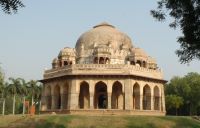 I had a real treat this morning when I woke up early. I had heard that Lodi Garden, about half a mile from here, was worth a visit, but I had no idea why. Turns out, it was the tomb (and I suspect the palace also) of the Lodi dynasty, which ruled the area briefly in the 15th century. In addition to Sikandar Lodi’s mausoleum, there were two or three other magnificent buildings, including mosques, and, as promised, a garden. Not just a garden with parakeets—a butterfly garden, a herbal garden, and, best of all, real people doing real things—in other words, it was tourist free.
That was not true of Old Delhi, started by Shah Jahan, he of the Taj fame, who moved the capital from Agra to Delhi, and built two landmarks. One
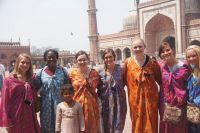
was the Red Fort, a twin more or less to the Red Fort in Agra. The other was the Jama Masjid, the Friday Mosque that is one of the largest in India. Built in the familiar red sandstone characteristic of the period and the place, it still encompasses the bazaar between it and the Red Fort that was a characteristic of the Moghul city. It was mobbed with people shopping for clothing and shoes, which we were able to observe from a safe distance in our cyclos, a bicycle-driven rickshaw that I am sure we will see again (in Beijing for sure). I think during the week it may be a more general 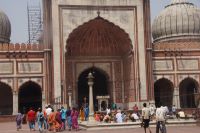 market. I remember when I was there a section of Tibetan refugees, selling the goods more appropriate to Tibet (or as the British called it in the last century, Thibet). The one thing I learned this time (and it surprised me), is that the British closed the mosque in 1857, following a rather brutal suppression of the Sepoys; it reopened after Independence.
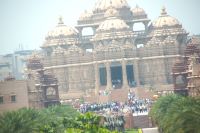 reminiscing with our students about my trip to the Vatican last summer, where the lines were as long, and the movement as slow. When we finally got into the temple, it seemed the analogy was even better; it was as big and as decorated as St. Peter’s. It was white marble, and enough gold to qualify (in my mind anyway), as baroque.
 I just got back from a memorable birthday party for one of our students, Katie Bauer. It is her 21st, and I’m certain she’ll remember it! Don’t you wish you could have a day like this one for YOUR birthday?