June 2009

You are currently browsing the monthly archive for June 2009.

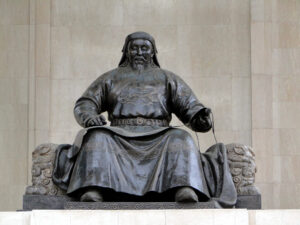
We left Ulanbataar with a better feeling for it than our original impressions as a combination of Eastern Europe and the kind of city you see from the train as you travel out west. It does have features that resemble both, but it’s only 20 years removed from being a Soviet satellite, and is slowly growing more comfortable with its past (the Soviets wiped out others’ history, and think of the Tartar years (the Mongol occupation) as the low point in Russian history. The airport, for example, is Ghengis Khan International, and a $10 million statue of the Great Khan and his offspring decorates the main square of the city.
As I said, it’s a country of 2.7 million people or so, 4 times the size of France, with the Gobi desert in the south, and lots of grassland (and a few mountains) in the north. Its economy rests on its produce—especially the export of meat, wool, and hides to its larger and more prosperous Chinese neighbor, which accounts for about 20% of GDP. The country imports much of its food, especially fruit, but my diet Coke came from Hong Kong (though there is a Coke factory in UB), and our dessert came from Korea. Tourism is also around 20%, with raw materials (gold and copper mines) a growing part of the trade: and the country is attractive for trekking, horseback riding (but after my experience, which was only two hours, I’m saddle-sore, and know why the Mongols were attracted to their richer neighbors, and feisty when they got inside the Great Wall, or into Europe). Camels were much slower, but, to my mind, provided a better experience!

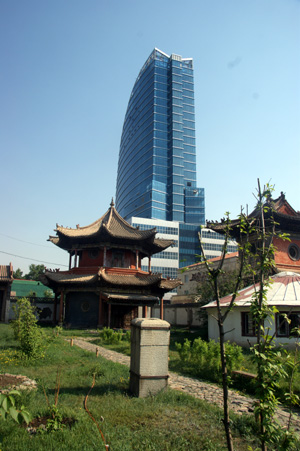
We toured what was left of the past in Ulanbataar before we left—apparently, the Mongolians converted to Buddhism in the 17th century, accounting for the relative lack of world conquest since then, and the few monasteries rebuilt since 1990 or preserved by the Soviet-oriented governments as museums. The Mongolians converted to Yellow Hat Buddhism, the Tibetan variety, and the Lama temple in UB, built at the turn of the last century, houses what the Lonely Planet accurately describes as a cultural gem. The Winter Palace of the Bogd Khan, the political/spiritual ruler of the Mongolian state that broke away from China in 1911, also remains. The Chinese government helped restore it, and, like the Thai palace, it contains European-style buildings—albeit on the Russian style, and artifacts from the Bogd Khan’s years. When he died in 1924, the revolutionaries who had seized power in 1921, dissolved the Khannate and established the communist government that lasted until the Empire fell.

In line with our desire to eat “Mongolian,” we insisted on a boodog, which is an animal (the best is a marmot, but this is the wrong season) cooked from within and without. The Lonely Planet described it as a “balloon with paws,” cooked with a blowtorch, but our mutton cooked with heated rocks in its skin was one of the tastier memories of the trip.

We watched the news in UB before we left; the hotel had a surprising number of stations, including CNN, when we realized that the date was June 4—the 20 year anniversary of the Tiananmen Square suppression. The coverage of the topic was pretty extensive, but I knew we’d not see it in China, and there’d probably be little in the press, and a lot of undercover police on the square, if it were not entirely closed to the people.

My first trip to China, in 1990, was in early June, and our visit to the Square was to coincide with the first anniversary—no one was allowed that day, and very few were there on June 5, when we got there, unfurled our “Long live the friendship of the U.S. and China” banner; the few were armed People’s Liberation Army soldiers, who told us to take our pictures, furl that banner, and get out of there as quickly as possible. We did!

CNN went blank in our TV in Beijing, and I knew what that meant. The government can still censor press, news, and video. The headline 5 June in Global Times, an English language paper in Beijing, was a “news” article about peace and prosperity on Chang’an (the street where Tiananmen Square is located. The article pointed out that in the last 20 years the government has developed a successful model of growth and stability that will provide a model for other developing nations. Again, the article highlights the importance of the intertwining of political stability (party rule) and economic growth.

I bade farewell to JR early in the morning—he had an earlier flight than I did and I sure enjoy traveling with him—and I set out to do some things I’d not done before in Beijing. My goal was to find what was left of Khanbalik, the capital that Kublai Khan built as the capital of the Yuan dynasty. Not much is left, but the trip through Beihai park, which was one of the imperial gardens from the 12th century until the fall of the dynasty in 1911, was a reminder that in the parks, as the song goes, “Every day’s the fourth of July,” or in the Chinese case, probably October 1 (the founding of the PRC) or October 10 (the revolution of 1911) or the New Years. There were no tour groups there, very few foreigners. And lots of folks, doing what Chinese do in the mornings—taiqi, calligraphy, dancing (ever heard the “Red River Valley” in Chinese?) playing cards, singing, exercising. Major buildings, many of them built by the great Qing emperors, Kangxi or Qianlong, reminds one of the wealth of China before its century of humiliation, and how much of it was concentrated in the hands of the royal family, and the Confucian elite. I got to two houses in Houhai, another artificial lake that has become a bar center at night; one of the hutongs had been the home of a famous writer, and shows that even under communism, favored people live better than others, though the wealth of Beijingers, and Chinese in the big cities today, raises questions about whether you’re in a Third World country or not. Beijing certainly has the trappings of a major world capital—with great restaurants (we had a wonderful farewell dinner of Beijing duck—go to Nanxingcang when you’re there!) and a growing consumer base that could lessen China’s dependence on exports. The other was a palace of Prince Gong, a sprawling home/garden that lends credence to Deng Xiaoping’s comment, “To be rich is glorious.”

The plane was miraculously not full, and I had two seats, which helped me think about (albeit very briefly) why I could leave at 4:10 and arrive at O’Hare at 4:30. Too bad it felt like 12 hours!

As always, Chairman Mao’s statement (during the Vietnam War) is a reminder that “Americans are not Asians, and sooner or later they must go home.” I’m glad it was later rather than sooner.
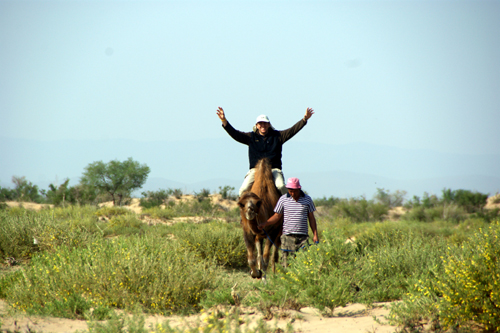
"J.R. Glenn of the Gobi"

I will see you soon.

A Few Days at Camp

JR often says, “This is just like Scout camp.” He’s usually right, but this time, he’s more right because Mongolia does resemble Scout camp in many ways. The Lonely Planet, for example, describes it as “The world’s largest campground,” and while there are a lot of places I wouldn’t want to pitch a tent, there are many that I could. With one million people in Ulan Bataar, and 500,000 in the second largest city, Mongolia has one of the lowest population densities in the world.

We discovered the “big sky” country on our 350 km trip from UB to Karakorum, one of the few ancient cities in a country dominated by nomads; even today, about 25 per cent of the population lives a nomadic existence, and about half, we’re told, live in the ger tent (a yurt is a more well-known name for the circular felt tent that is characteristic of Asian nomads. The road in places is no better than the road in Scout camp, and it, like most roads between cities here, is a toll road. Parts of it were under construction (ongoing, said our guide, for the past four years, and expected to be completed in four years). The “detours” are paths suitable (barely) for four-wheel drive vehicles, and we hung on dearly as our driver navigated one of several choices until we got back on the standard two-lane “toll road” to the northwest.

Like Mongolia, where 50% of the population live in the gers, we’re spending two nights in gers and two nights in hotels. Yesterday, after leaving UB, we drove most of the day, making two stops. One was at a sand dune that resembles the Great Sand Dunes national monument, without the backdrop of 14,000-foot mountains of Colorado, but with some mountains in the background, and about a 60-mile swath that is a haven for wild life. One of the main tourist attractions is in fact the outdoors—the Gobi in the South, the mountains in the North, and the wildlife in both places. The big sky panoramas are sweeping and spectacular—miles of space, with few gers, fewer towns (none that really merit the name until Karakorum), and herds—of sheep, goats, cows, and horses, driven by cowboys (yes! Some wear the traditional Mongolian dress of the del, a long robe with a sash; others look like something out of a cowboy movie). It was great fun to watch the drovers herd the sheep, aided by the dogs, as we did in our ger last night (and noted some on cycles and scooters doing the same). No wonder tourism accounts for 18% of the income of this country.

The other was at a monastery that gave some indication of the religion here that’s been restored since the fall of communism: a tantric Buddhism that owes its inspiration to Tibetan Buddhism, and in fact the first two Dalai Lamas, the religious leader of Tibetan Buddhism, were Mongolian. Between the nomadic nature of the populace, who built little of lasting value until the 17th century, the Chinese, who destroyed much of the historical evidence before that, and the Russians, who destroyed much in the 20th century, especially “superstitious” sites in 1937, there’s not much history left. The remnants of the one we saw yesterday being mostly rebuilt, with some ruins and a building or two leftover.

In the ger, a kind of motel arrangement for tourists—there was a shower in our compound—our guide taught us a few games that JR thinks I should bring back for camp; they’re played with sheep’s ankle bones. Each facing has an animal name, and one game consists of playing a kind of pool—dropping a handful of bones and flicking similar ones until you miss; then the next person plays, etc., until none are left. Then, the game restarts with the loser (usually me) getting the number he has from each player and beginning again.

Today, though, we got to Karakorum, and the trip was really worthwhile. There is a temple—again destroyed, mostly, in 1937 and the monks killed, but partially rebuilt—that was really spectacular. The guide took us through the extant buildings, which were a la Tibet—the animistic tantric Lamaism that has followers of the Buddha that resemble the protectors of the shaman religions of Mongolia and Tibet—blue demonic protectors of horses, the thousand-armed, thousand-eyed goddess of mercy (who got transformed in China by an Empress, who was annoyed that the Buddha god-figures were male, into a female, and as the Guan Yin, the goddess of mercy, is one of the most popular Chinese buddhas; and with the statues resembling Mary, one of the most popular purchases for Western Christians. The smell of yak butter reminded me of Tibet, where JR and I had gone five years ago. The temple also had an active congregation of monks, and when our guide said they would chant sutras in ten minutes, we went in for the services, which were in Tibetan, the language of Mongolian Buddhism. There was also a flea market in the compound, and I found a few things that I hadn’t in any of our night markets from Bangkok to Beijing (though most of the items were made in China; one of the vendors tried to sell me a genuine statue of Ghengis Khan that I had to remind him was the Guang Gong, one of my Chinese heroes. When we bargained, our guide was a little embarrassed, because, she said, Mongolians don’t haggle, and American tourists never bargain, they just pay the asked price. Well, surprise to her—we’ve been to China (and, in fact, I bargained in Chinese, which took the Mongolian lady by surprise, but she thought my Chinese was very good, and gave me the price I wanted). We’ve educated our guide, too—our food can’t be spaghetti and/or French fries. We rejected a boxed lunch of fried chicken in favor of a Mongolian dumpling soup that was much, much tastier.

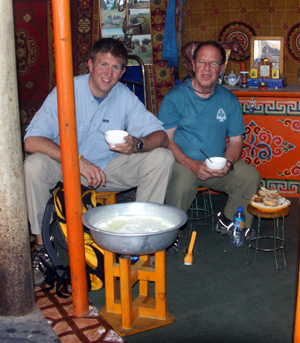
Our afternoon was more like Scout camp, and perhaps it was fitting that I had my Philmont shirt on; we went to a local family ger for an hour and a half horseback ride through the mountain transition zone that is where we’re at, and a visit to a real ger, one with a family who lived there. Our SUV took a mountain road, crossed a river that flows into Lake Baikal (I was tempted to say we forded the river, but we’re driving a Toyota Land Cruiser), and landed at the winter camp of a herdsman. Out came the local food for guests—yoghurt made from cow’s, goat’s, and sheep’s milk (happily and necessarily served with sugar), served from the pot in which it was made, hardened curd, and curdled cream from the yoghurt served on bread (I told JR we should be careful what we asked for).

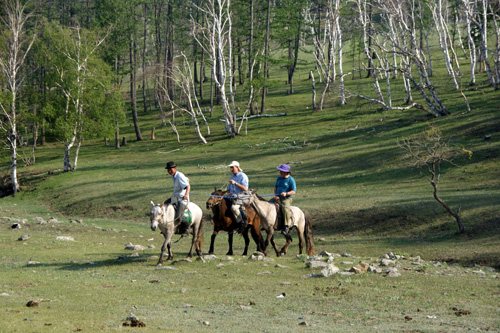
The food was preparation for a ride in the valley, where we got a sense of what it was like to have been one of the Mongol warriors, who spent 20-some years on the road carving out the empire that stretched to the gates of Budapest. The ride, on a Mongolian saddle made of wood and smaller than the English leather saddles (ouch!), took us through a small forest (the trees were suspiciously growing in straight lines, and look liked they’d been cut to make the outbuildings and corrals that keep the herd separate (the goats stay in the pen for milking purposes). We also passed a party that we later learned was celebrating, partly with vodka, the first mare’s milk of the season; when we went through they were using a pole with a lariat to lasso horses and rope them down, as well as one of the children. Twenty years in the saddle, even with time out for looting and pillaging, seems excessive, but two hours was fine. Still, my bottom was glad to be rescued by our guide and driver!

Dinner wasn’t like Scout camp, although we did have local food. We ate a sheep intestine dumpling that was much better than it sounds, and pasteurized yoghurt for dessert.

Believe it or not, we’re sitting around a campfire—the stove in our ger is lit—and I’m re-teaching JR Scout Vespers. Softly falls the light of day, as the song goes, and we’re fading away. Tomorrow we leave early for our return to Ulan Bataar, and on the way, we may get to ride a Bactrician camel. Try that at your Scout camp!

Riding in Mongolian saddles gave a sense of the Mongol warriors' lives.

The 1904 Lama Temple in Ulan Bataar juxtaposed with a 2009 office building.

Sugar helped improve the taste of this three milk (goat, cow, horse) fresh yoghurt, served in a ger.