Was it less than 48 hours ago that we said goodbye to the students and to Carrie?
It seems longer, but when I tell you all that we have been doing (we being me and JR), I think you’ll understand my disorientation.
On Friday, we got up early (at least some of us did) and went to Liulichang, one of the few “traditional” streets left in Beijing. The students had a choice, and a number of them decided to sleep in, but I had a favorite tea shop there and offered the students one last opportunity to see Beijing…We took the subway, which always makes me feel grown up, and got to the street around 9:30.
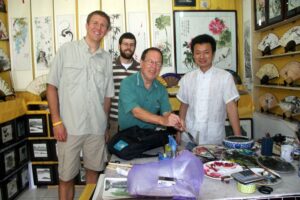 Two of the students decided they wanted to wander, but the others (there were three) joined me and JR as we wandered down the street. Pretty soon we were in an art shop, and had a new “best friend” who was the owner; before we left, he’d sold us a few paintings, took pictures with us, and introduced me to his 2-year-old daughter, with the knowledge that I had a 2-year-old grandson who speaks Chinese.
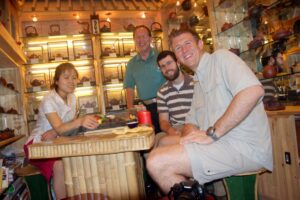 When we left his shop, a young lady came up to me with a picture she’d taken in her shop a few years ago, and said, “’lao peng you’ (old friend) I thought I recognized you. I’ve moved my tea shop. Come have a look.” For the next hour, we had a personal discussion/demonstration of eight different teas, a discussion of the world and what we’d done since we saw her last (she recognized JR—but everyone remembers him here), and, joined by the other two students who wandered by, left with teapots, tea bricks, and a better understanding of the tea business—and less Chinese money to change into dollars at the airport.
We met the rest of the students at the “Silk Street” store, which is one of 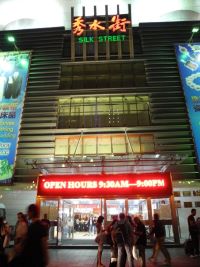 the most touristy places in Beijing. It used to be an outdoor street mall that got enclosed into six floors of everything you saw in China but hadn’t bought yet (if you’re a tourist) including extra luggage, “North Face” items (says so on the label), and a variety of T-shirts, souvenirs, etc. It said a lot to me that, when I went to find lunch, all I could find there was pizza. Our guide remarked that the young Chinese don’t shop there because they’re embarrassed to be seen with fakes…..Intellectual property has come a long way in China, but it’s not entirely where many foreign companies think it needs to be.
We escorted the class to the airport, and on the way got a lesson from our guide (she’s one of the best I ever had) on why China is a “democracy,” even if it’s not like ours; “China,” she told us, “is efficient.” It may be true, but that doesn’t make it a democracy, we chided, but Ms. Love Country Love Beijing person (my Chinese name for her) would have none of it, reinforcing (albeit with a small sample size—1) what I’d heard about young Chinese being nationalistic and defensive about their country, especially to foreigners.
When we came back to the city, Carrie, JR, and I spent some time wandering around the outskirts of the Forbidden City. As I’ve mentioned, it’s much bigger than the parts that tourists usually see; parts are closed off—the new emperors live there—but the streets around it offer interesting shops and hutongs. We wound up in a temple that’s not on any guidebook list, but was once an ancestral hall where the emperors prayed—fairly typical of the kinds of things you can stumble into when you have time and a sense of adventure in Beijing.
Since our train was leaving at 7:40 the next morning, we got back and packed up for what I’d like to think of as my “reward” for the previous three weeks of shepherding students around Asia. I don’t think of it as work, but life becomes a lot easier when you have only two people to worry about.
The Trans Mongolian Express will be the last train ride for me this trip. Fittingly, it was the longest—30 some hours to go the nearly 1,000 miles from Beijing to Ulaanbaatar, the capital of what was once called Outer Mongolia, but is now simply Mongolia. The trip took us through the countryside—about 19 hours of it was on the Chinese side, increasingly high (we were over 5,400 feet at one point) and increasingly dry. One reason the trip was so long was that we spent 3 hours at Erlian, at the border, where the train was whisked away somewhere and the wheel carriages changed for the narrow gauge necessary for Mongolia and Russia (the Trans Mongolian express links up with the Trans Siberian Railroad at the Mongolian/Russian border, near Lake Baikal). By the time we crossed over into Mongolia (an hour stop at customs, naturally around 1 a.m.), we were in the Gobi dessert, which covers the southern half of Mongolia. It doesn’t look like the Indiana Dunes, but there was some sand—and a lot of grass (surprisingly) that fed a lot of horses and cows and sheep.
Mongolia is a big, but thinly settled country. I think our guide said it was 4 or 5 times the size of France, but the population is around 2.5 million, nearly 40% here in the capital city, Ulaanbaatar (meaning, “Red Hero”; it was Urga before the communists occupied the country in 1921). Europe has had several skirmishes with people from this part of Asia, and come out on the short end of it every time. The Huns swept from here to ravage Europe; so did the Turks; and finally, so did the armies of Genghis Khan. The latter has gotten a particularly bad rap from Europeans, who are not good losers, but in the 13th century the Mongol armies swept from Beijing to Budapest, and established a global village that brought religious tolerance to a world (or at least regions) that killed thousands for making the cross with two fingers instead of three, and a pax Mongolica that lasted until the black death destroyed much of the European population, and the successors of 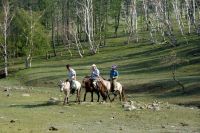 the Great Khan proved much less able than Genghis himself. The dynasty (Yuan) his grandson, Kublai, established in China barely outlasted Kublai himself, and in 1368, the Mings replaced Yuan (who took the seals and moved to Mongolia and tried to maintain the pretense of being the Northern Yuan dynasty). The Mongols pop up elsewhere later—Akbar, who united much of Northern India into the Moghul Empire, was a descendant of Ghengis Khan, and the Manchus brought the Mongols into the Qing Empire as another important non-Han member; Mongol was an official language of the Empire, along with Manchu, Tibetan, and Chinese. By 1911, the ties to the Chinese were snapping, and Mongolia eventually (after a crazy Baltic German, the Mad Baron, took over the country and proclaimed himself the successor of Genghis Khan—that’s the book I read on my Kindle on the way here) became a communist country to become independent of China (but not of Russia). It was heavily Stalin influenced; the Russian dictator, whose statue is in a restaurant in Ulaanbaatar (UB), something I’ve not seen elsewhere, found a henchman to bring the purges in 1937 that nearly destroyed the Russian Army to Mongolia; 100,000 monks were killed, and hundreds of monasteries demolished. Not until 1991, when the communists were overthrown (The politics here are interesting. The leader of the democracy movement was assassinated in 1998; the murder is unsolved. The communist party, heavily backed in the more conservative countryside, won the last election. Urban democrats burned the communist party headquarters) was Buddhism restored to favor. It’s a Buddhism that’s a close cousin to the Tibetan version, and the Dalai Lama (whose title came from a Mongolian Buddhist) is revered here; our Chinese guide called him a “traitor.”
The Soviet period influence is obvious. The large square in honor of a revolutionary hero looks sort of like Red Square in Moscow, but the buildings are colorful (the national theater is pink, as is the stock exchange; the Post Office is covered with a two-story high poster for Coca-Cola) and have statues of Genghis Khan and his sons and assorted warriors. If you’ve ever been to Budapest, UB’s square is sort of like the 1897 square commemorating the 1000th anniversary of the arrival of the Magyars (probably from this area too) into Hungary. There’s also a Lenin statue, a statue to a Mongolian general who helped the Russians defeat the Japanese along the Manchurian-Mongolian border in 1939, a battle which the national museum here said convinced Japan to go south and attack the United States, rather than fight an enemy that cost them 70,000 lives in this Asian prelude to Pearl Harbor. We saw a lot of ger coming in, the yurts that we’re going to spend the next few nights in.
I said the train ride was our last. I may remember it fondly. The next two days will be on the road—to Karakorum, or what’s left of it. The Mongols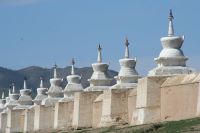 , as nomads, didn’t build cities until after their conquest years. Karakorum was the first. The Chinese armies, however, responding to Kublai’s successors fleeing Beijing and calling themselves the Northern Yuan, leveled the city. Mongolia has been rebuilding it, but when we were there, only the 17th century Buddhist stupas were there. We’re spending two nights in gers, and I may miss the train’s charcoal heated samovar (for hot water) and warm beds. And, given the roads, maybe the relatively smooth railroad beds.
Tomorrow is children’s day in much of the world, including here. Celebrate it for me in the United States.

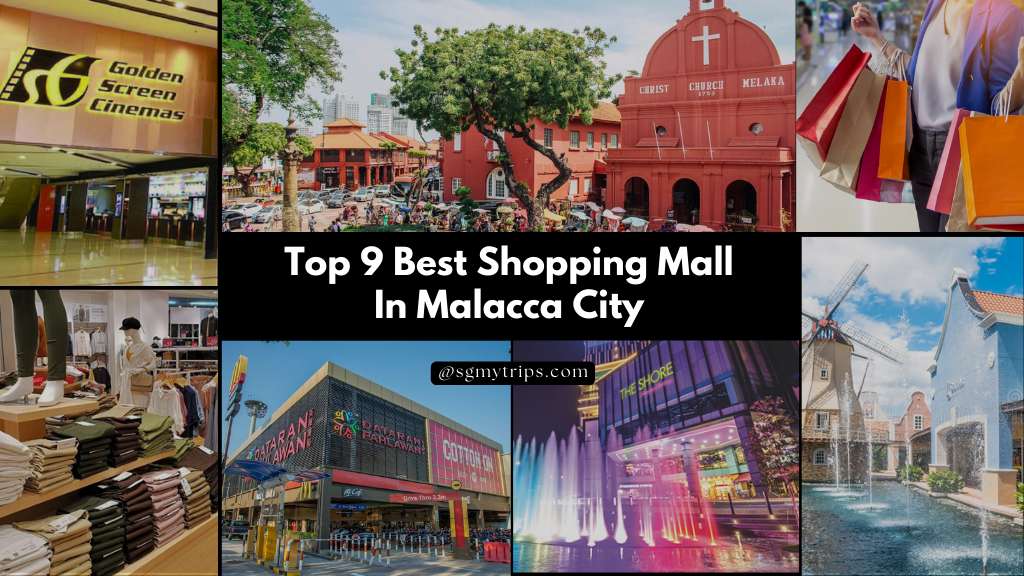 An old city at the southern entrance to the Straits of Malacca, through which pass over half of the shipping of the world, Malacca traces its history back to the 13th century or so, when an Indonesia prince (the connections between Indonesia and Malaysia are pretty strong even today; Bahasa is spoken in both countries, both are Muslim, and Sumatra, one of the over 2,000 islands that constitutes Indonesia, is 1-½ hours away by ferry on the other side of the straits) came here and had his dogs outfoxed (that sounds wrong) by a mouse deer, a small and now endangered species, under a Malacca tree. The sultan built a dynasty that lasted until 1513, when the Portuguese wrested away control of the city, beginning several centuries of Portuguese rule. The famous Cheng Ho, featured occasionally on the History Channel, visited here, and has a small corner in the history museum. There’s a rebuilt Istana (palace) of the sultan, which I can see from the window in my hotel, but Malacca is one of the four states in Malaysia now with no sultan.
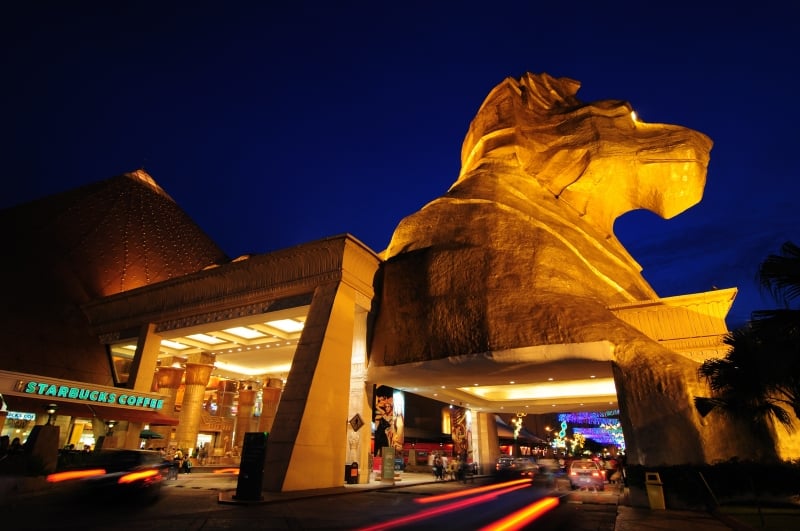 But the complex was more than just an over-the-top mall. It included an elegant hotel (pictured elsewhere), two theme parks (one water based, one with roller coasters and other non-liquid treats)—AND a university. Now that’s buzz.