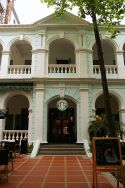
One of my favorite stores in Hong Kong is across from the Star Ferry. It’s the China Arts and Crafts store, which was once the “official” China Friendship Store, offering the mainland’s finest wares for sale. I once promised myself that if I won the lottery, I would buy that store and ship it home, take what I wanted, and send back what might be left. It occurred to me I haven’t visited that store for a long time, and the reason is simple: China has become more like Hong Kong.
When I first started coming here, too, friends worried about the “handover,” and what it might do to Hong Kong’s vibrant economy. The current absence of that fear, too, has a reasonably simple explanation: China has become more like Hong Kong, and in the process, has helped lift its own economy as well as Hong Kong’s.
I said politically China is not Hong Kong. The protest I mentioned yesterday could not happen on the mainland. But the economic wealth of this tiny (7.5 million) city-state has been important in funding the mainland’s economic growth. One of the reasons for Deng Xiaoping’s opening of South China is that three of the four ports were within an hour of Hong Kong. The financial and managerial expertise that Hong Kong brought to the transformation, and the example it set, have turned China more into Hong Kong than Hong Kong into China.
Some of those transitions are as much British as American. Hong Kong remains viable because of its heritage of rule of law, the close British cooperation with business, its free port status, its role as a facilitator of mainland activity (along with Taiwan), and the pride its return has meant to the mainland. I still remember the countdowns in Tiananmen Square to July 1, 1997, when it was “Goodbye Great Britain, Hello China.”
What we saw in business confirms the vitality of the local government and its ability to keep Hong Kong focused — and to provide a model for the rest of China.
The four businesses we visited all had a visible Hong Kong government hand. In general, Hong Kong government facilitates the business activities, without favoring a specific company. The first visit was to an office whose job it is to attract businesses to locate in Hong Kong. As the Director General (a Scotsman) pointed out to us, Hong Kong is the site of the majority of foreign regional offices, partly because of its entree to China, partly because of its entree to Southeast Asia. A businessman who spoke to us noted how easy it was to fly to Beijing for a day or two — or anywhere in the region. HK also has 60,000 American passport holders, and over 200 regional headquarters for American companies. Unlike the mainland, its money is fully convertible. One can incorporate a company in HK for $1 and have no directors living here. I was almost persuaded to open one!
The second visit was to what might be called an “industrial park‚” but it is one in the service economy; Hong Kong’s service businesses contribute 90% of the region’s income. The government saw the handwriting on the wall for manufacturing, and has helped move the Special Administrative Region downstream. About ten years ago, it decided to move the economy downstream, into services. It apparently gave Li Ka-shing, the world’s richest Chinese (he started manufacturing plastic flowers, and now owns much of the world) property in Hong Kong to build a “cyberport,” a high-tech work environment whose representative stressed the “community” of small businesses (and large ones) it brings together to promote digital communication and digital businesses. The facility maintains editing and movie capabilities that reminded me of how 20th century I am. Make that maybe early 20th century!
The final visits involved education. The government is building a new campus for HKU, and apparently the other universities in the SAR. We spoke with people from the business school, which has about 25-30% of the students. The Executive MBA has offices and classes in the technologically-advanced cyberport, and charges $1 million — that’s in Hong Kong dollars (divide by 7). At least as impressive was the government-sponsored Culinary Training Institute, which prepares young people for restaurant businesses. It offers one year of training (we saw four different kitchens — northern, southern, western cuisines — I didn’t realize the cooking arrangements were different), and one year of running a restaurant-club, where we ate lunch. Amazing how attentive the students were, how attractive the cuisine, etc. The school also certifies “master chefs” who have to have 8 years of training, then take a one-year course with a 10.5-hour oral examination, etc. The SAR also has a similar school for hotel services.
Yesterday was part lecture, part free time. We had an interesting lecture from a professor at the Chinese University of Hong Kong who compared and contrasted China and the United States. One of the secrets of both economies, to him, was that we both had low-cost assets — Mao confiscated all the land, which still belongs to the state; while the U.S. either purchased or appropriated land from its previous owners as well. In addition, he pointed out that without shareholders, the state owned enterprises in China can pour money back into research and development, salaries, or low prices, which enables Chinese workers to live better for less money than most other workers. I hadn’t thought about it, but one no longer sees the phrase “bankrupt State Owned Enterprises” or “bailout” — in the Chinese press. We also had a nice case (right word!) study of Coors in Asia from the only American in the Asia office. Coors has decided to become a nice beer, selectively distributed in 50 cities; the company has gone slowly and carefully, but with little profit — as yet — after 9 years!
In the afternoon, my roommate and I toured Macau with my HK friend, Eleanor. China may rightly boast one country, three systems, because Macau has a Portuguese history (from the mid-16th century until its return to China in 1999), and the distinction of being the most profitable gambling area in the world. Since its return, the mainland has opened the gambling (which used to be one man’s monopoly) to global gaming businesses. Part of the harbor has been filled in to create more space for new casinos, but the old parts of town retain a distinctive Mediterranean flavor. It’s unlike anyplace else in the Far East. Its success is in part attributable to the decision of the Chinese mainland government to allow its own citizens to travel rather freely into the Macao Special Economic Region.
Hong Kong, by contrast, is more difficult to enter, but the rise in the number of Chinese visitors has been quite impressive; it’s over 16 million, which is about 4 million more than other foreign visitors. One of our speakers suggested that Shanghai and Beijing has the upscale brand-name shops as a tease for the bigger stores in Hong Kong. The Louis Vuitton store in Hong Kong is apparently the largest one in the world. Typical of how I started this blog with mainland China/Hong Kong comparisons.
I’ve begun the long journey home; I started writing this at 7 a.m. in the Hong Kong airport, and am sending it at 1 p.m. from Tokyo. I have another 21 hours before finally getting to Bloomington-Normal. As I tell students when we come back from the East, it’s one of the longest days of their life.
See you soon.