
Calls for Papers

You are currently browsing the archive for the Calls for Papers category.

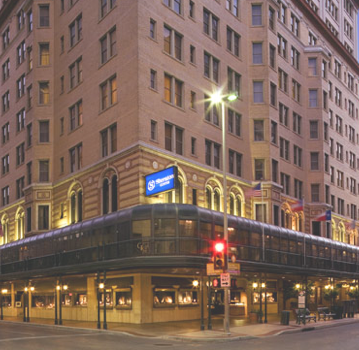
The John Updike Society needs presenters and moderators to fill two panels at the 2013 American Literature Association Conference in Boston, Mass. The conference runs from May 23-26 and will be held once again at the Westin Copley Place, right across from the library and within an easy walk of the Commons.

Proposals for papers and expressions of interest in moderating should be sent to:  James Plath (jplath@iwu.edu) by the end of December.

We hope that the JUS can be a presence at ALA. If you live within a short drive of Boston or are planning on attending ALA anyway, please consider helping our organization by participating on one of two panels.

Graduate students and independent scholars working on Updike need not currently be a member of The John Updike Society in order to submit a proposal.

In response to members who said they were swamped this time of the year, program director Bernard F. Rodgers, Jr. has extended the deadline for abstracts/proposals for the Second Biennial John Updike Society Conference. The conference, which will be held June 12-16 at Suffolk University in Boston, opens with a keynote address by Joyce Carol Oates on the evening of the 12th and features tours to Updike sites in Ipswich and Boston (including the Lampoon, pictured) and Hawthorne sites in Salem.

Here is the original Call for Papers, which are now due on January 16.


Society member Richard Androne (Albright College) has announced the panel topics for the Society’s offerings at the American Literature Association, May 26-29, 2011, at the Westin Copley Place in Boston.

Updike in Massachusetts. Topics might include, but are not limited to, Updike and Harvard, Updike and Boston, Updike and any aspect of the Ipswich/Beverly/Essex County/North Shore/Salem contexts, Updike and Hawthorne, Updike and the fine arts in Massachusetts.

The Other John Updike. This panel will explore Updike’s work in areas other than prose fiction:  poetry, drama, children’s literature, criticism, reviews, essays, public commentary, and texts in which he assumes the role of man of letters.

If you’re going to be at ALA and wish to submit a proposal, send your abstract directly to Dick via email (randrone@alb.edu) or regular mail (Dept. of English, Albright College, P.O. Box 15234, Reading, PA 19612-5234).

For more information about conference and hotel, click on the left-menu link for the American Literature Association.

Photo: Westin Copley Place (tallest building) and Boston Public Library (right).

Society board member James Schiff has been working hard to get The John Updike Review up and running, and he announced today that as editor he is ready to begin accepting submissions. This scholarly journal, published by The John Updike Society and the University of Cincinnati, will specialize in scholarship on the writings, life, and literary and cultural significance of John Updike.

The Review welcomes all critical approaches and publishes full-length articles as well as shorter notes, book reviews, bibliographical updates, professional postings about conferences, calls for papers, scholarships, and other items of interest pertaining to Updike.

Submissions will be reviewed by an editorial board comprised of Updike scholars and others knowledgeable on Updike and his writings. Work considered for publication is subjected to blind peer review by at least two outside readers and the editor.

Subscription information and submission guidelines are available at the quick-click left menu on the Society website.

The board of The John Updike Society has decided to propose two panels for the 21st American Literature Association Conference in San Francisco, May 27-30 2010. “Updike Abroad” was suggested by two members separately, and the board also approved their paper proposals. But one more Updike scholar is still needed to present on this panel, and another to moderate. A second panel on “John Updike and American Pop Culture” is completely open, with three panel spots and a moderator to be filled. And of course the second business meeting of The John Updike Society will be held at ALA. There will be much to talk about, as the board has been moving forward on a proposal to hold the Society’s first conference in October 2010. And Jim Schiff is moving forward with The John Updike Review, so there will be plenty of opportunities for members and other Updike scholars to share their work. The conference will beheld at the Hyatt Regency in Embarcadero Center, San Francisco, which is near waterfront walking/jogging paths, the ferry to Alcatraz, and a cable car stop. It’s also a short walk through Chinatown to Fisherman’s Wharf from the hotel.

Those wishing to propose a paper should send a brief abstract to James Plath (jplath@iwu.edu), who will disseminate it to the board for review. Those wishing to moderate should also contact Plath.

UPDATE: The “Updike Abroad” panel has been filled, and we look forward to presentations by members Kevin Frazier (Finland), Judie Newman (England), and Sylvie Mathé (France). We still have three panelist seats open for the “John Updike and American Pop Culture” session, which will be moderated by Sally L. LeVan of Gannon University.

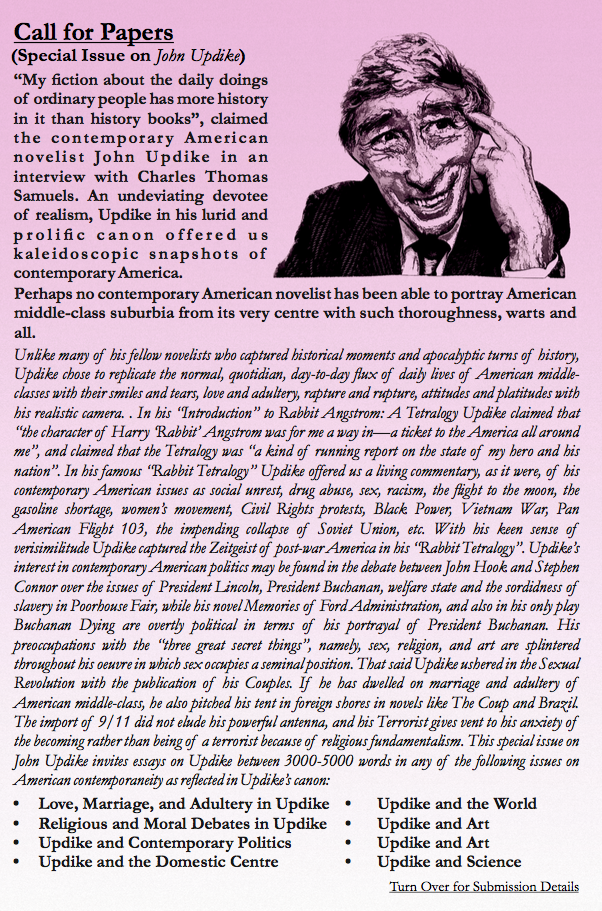
The Criterion: An International Online Journal of Literatures in English and Language Studies, has put out a call for Indian scholars to submit papers for a special issue on John Updike, to be titled “Indian Perspectives on John Updike.”

In announcing the special issue, editor Vishwanath Bite writes, “One of the most critically respected and popular contemporary American authors, John Updike died in January 2009. We propose to bring this volume in his memory and expose Indian thoughts over his literary works. Updike has amassed a large and ever-growing body of best-selling novels, acclaimed volumes of short stories, essays, and poetry since his arrival on the literary scene in the late 1950s. An incessant chronicler of post-war American customs and morals, Updike alternately finds humor, tragedy, and pathos in the small crises and quandries of middle-class existence, particularly its sexual and religious hang-ups. His trademark fiction, largely informed by Christian theology, classical mythology, and popular culture, is distinguished for its broad erudition, wit, and descriptive opulence.”

The Call for Papers from Prof. Bite suggests possible topics on “Updike’s distinct prose style, the realist tradition in a literary mode of Updike, description of the real world over imaginative or idealized representations in Updike’s novels, the portrayal of the physical world and everyday life in Updike, the problem of faith and morality in the modern post-Christian world, autobiographical elements in Updike’s novels, spiritual quest for self-fulfillment and meaning, post-war American social history in Updike’s novels, the domestic reality of suburban middle-class American life, marital tensions, sexual behavior, relationships between men and women, religious beliefs in contemporary society, magic realism, American and Third-World ideology, a reinterpretation of the medieval Tristan and Isole legend, religious doubt, mediocrity, fame, and fanaticism, humor, clever linguistic turns and sophisticated witticisms, and Updike’s poetry.”

Needless to say, it will be fascinating to hear what Indian scholars have to say about Updike, and we thank member Pradipta Sengupta for alerting us to the journal, which she says is projected to be published online in January 2010.

It’s not too early for members to begin thinking about the 21st Annual American Literature Association Conference on American Literature, which will be held in San Francisco—most likely at the Hyatt Regency San Francisco in Embarcadero Center, where ALA has met since 2004. In the past, panel topics have ranged from the general (“New Directions in Malamud,” “General Topics on Cooper”) to the specific (“Poe in the Middle East,” “Toni Morrison and Warfare”), with pedagogy sessions as well (“Teaching Hawthorne,” “New Approaches to Teaching Hemingway”). Sessions need to be proposed and approved, and author societies are requested to sponsor at least one session, but can also offer more.

Members with panel ideas should send them to a James Plath (jplath@iwu.edu) or another member of the board, and collectively the board of The John Updike Society will choose the panels which we feel are best to propose to ALA.

In addition to hosting several sessions, our society will hold a general membership meeting at ALA, which will be held May 27-30, 2010. All members are encouraged to attend, but of course attendance is not mandatory. Aside from all the literature sessions and speakers at the conference, attendees will be at a hotel near waterfront walking/jogging paths, right by the ferry that goes to Alcatraz and by a cable car stop that would allow you to take a tour of the city. You can also walk through Chinatown to Fisherman’s Wharf from this location.

This past May it was fun gathering at ALA, and I hope a number of our members will keep ALA in mind.


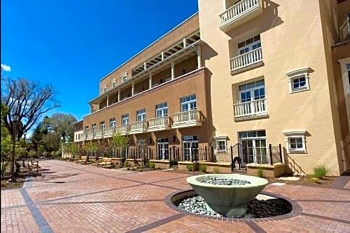
Society member Rob Luscher is working on putting together a panel on Updike for the ALA Symposium on American Fiction 1890 to the Present, which will be held October 8-10, in Savannah, Georgia. The location is the DeSoto Hilton Savannah, situated in the heart of Savannah’s historic theater district and a short walk to River Street. Anyone wishing to propose a paper for the panel should contact Rob directly via email: luscherr@unk.edu.