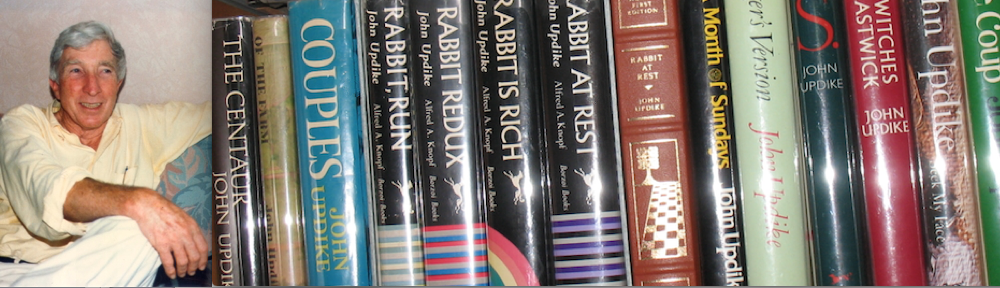
 President—James Plath, Colwell Professor of English, Illinois Wesleyan University (jplath@iwu.edu); board member since 2009.
Jim Plath has been involved in Updike criticism and scholarship since the Eighties, when he wrote his dissertation on The Painterly Aspects of John Updike’s Fiction at the University of Wisconsin-Milwaukee. His essays on Updike subsequently have been included in Rabbit Tales: Poetry and Politics in John Updike’s ‘Rabbit’ Novels, John Updike and Religion: The Sense of the Sacred and the Motions of Grace, The Cambridge Companion to John Updike, and Critical Insights: John Updike. In addition to editing Conversations with John Updike and John Updike’s Pennsylvania Interviews, he has written or edited two volumes on Ernest Hemingway, three Critical Insights volumes (Raymond Carver, Casablanca, and Conspiracies), and The 100 Greatest Literary Characters. In 2004 he received his university’s highest award for teaching, service, and scholarship, and in a previous lifetime he directed the Hemingway Days Writers’ Workshop in Key West and edited the award-winning Clockwatch Review: a journal of the arts.
 Vice President and Editor, The John Updike Review—James Schiff, Professor of English, University of Cincinnati (james.schiff@uc.edu); board member since 2009.
Born and raised in Cincinnati, Jim Schiff received his B.A. from Duke University and his M.A. and Ph.D. from New York University. He is the author or editor of five books on contemporary American fiction, including John Updike Revisited, Updike’s Version: Rewriting the Scarlet Letter, Updike in Cincinnati, and Understanding Reynolds Price. His work has appeared in The Southern Review, The Missouri Review, Tin House, American Literature, Critique, Boulevard, Studies in American Fiction, The South Atlantic Review, Gulf Coast, and elsewhere. He is also a regular reviewer of books for newspapers, magazines and journals, and a consulting editor of Critique. He has served on various boards, including the Duke University Trinity Board of Visitors, the University of Cincinnati Foundation, The Seven Hills School, WCET-TV, and the Mercantile Library. Jim is the founding and continuing editor of The John Updike Review, which is published by the University of Cincinnati and The John Updike Society. He is currently editing a volume of Updike’s selected letters.
 Secretary—Peter Bailey, Piskor Professor of English Emeritus, St. Lawrence University (pbailey@stlawu.edu); board member since 2009.
Peter Bailey attended Kenyon College before receiving his B.A. from the New School College, New School of Social Research. The Johns Hopkins University Writing Seminars provided him with an M.A., and his Ph.D. in English is from the University of Southern California. He is the author of Reading Stanley Elkin (1985), The Reluctant Film Art of Woody Allen (2000), Critical Insights Film: Stanley Kubrick (2016), and Rabbit (Un)Redeemed: The Drama of Belief in John Updike’s Fiction (2006)—as well as articles on contemporary American literature and film.
 Treasurer—Marshall Boswell, Professor of English, Rhodes College (boswell@rhodes.edu); board member since 2009.
A member of the Rhodes English Department since 1996, Marshall Boswell teaches courses in 20th Century American literature and fiction writing. He is the author of John Updike’s Rabbit Tetralogy: Mastered Irony in Motion and Understanding David Foster Wallace. In addition, Marshall has published two works of fiction, the story collection Trouble with Girls (Algonquin 2003), which was an April 2003 Book Sense 76 pick, and the novel, Alternative Atlanta (Delacorte Press 2005), both of which are now available in paperback. Most recently, he completed work as editor and primary contributor for the final volume of a forthcoming four-volume Encyclopedia of American Literature. His stories have appeared in Playboy, Shenandoah, New England Review, The Missouri Review, and New Stories from the South. In 2002 he won the Clarence Day Award for Outstanding Teaching, while in 2007 he won the Clarence Day Award for Outstanding Research and Creative Activity.
 Director—Sylvie Mathé, Professor of American Literature Emerita, Aix-Marseille University (sylvie.mathe@univ-amu.fr); board member since 2013.
A charter member of The John Updike Society, Sylvie Mathé is a graduate of Ecole Normale Supérieure in Paris and she wrote her Ph.D. dissertation at the Sorbonne on The Daily and the Sacred in John Updike’s Fiction. She is the author of various articles on Updike in French and in English (“Irreversibility and Nostalgia in ‘The Journey to the Dead,'” “Return to the Self, Return to Sources in Self-Consciousness,” “‘Welcome to the Post-Pill Paradise’: Variations on some figures of Eros in John Updike’s fiction,” “‘Love it or leave it’: America in Red, Grey, and Blue in Rabbit Redux,” “‘What writers are for’: Reflection on John Updike’s Terrorist,” “In Memoriam John Updike [1932-2009]: That ‘Pennsylvania Thing,'” “Under Gallic Eyes: The Case of John Updike’s Ambivalent Reception in France”), as well as of the monograph John Updike: La Nostalgie de l’Amérique (Paris: Belin, 2002). She is a member of the editorial board of The John Updike Review and the director of the online journal E-Rea. Though Updike is not her only center of interest and she has published on a wide range of American writers, he remains the “Midpoint” of her academic geography.
 Director—Biljana Dojčinović, Professor, Dept. of Comparative Literature and Theory of Literature, Faculty of Philology, University of Belgrade, Serbia (bdojcinovic@fil.bg.ac.rs); board member since 2014.
Biljana Dojčinović is the director of the national project Кnjiženstvo—theory and history of women’s writing in Serbian until 1915 and editor-in-chief of Knjiženstvo, A Journal in Literature, Gender and Culture. She has been a member of The John Updike Society since its founding and a member of the editorial board of The John Updike Review since 2010. Her Ph.D. was focused on the narrative strategies in John Updike’s novels, and in 2007 she published a monograph in Serbian on Cartographer of the Modern World: The Novels of John Updike. She is also the author of numerous essays on Updike’s works and other topics, as well as five more academic books.
 Director—Robert Luscher, Professor of English Emeritus, University of Nebraska at Kearney (luscherr@unk.edu); board member since 2014.
Rob Luscher is the author of John Updike: A Study of the Short Fiction and “Updike’s Olinger Stories: New Light among the Shadows.” He has also published essays on Updike and his short fiction in the Dictionary of Literary Biography, the Blackwell Companion to the American Short Story, Eureka Studies in Short Fiction, and The John Updike Review. Beyond Updike, his scholarship focuses on the short story sequence, with published essays on volumes of short fiction by Ernest Gaines, Mary Wilkins Freeman, Clark Blaise, and Robert Olen Butler. He has been a member of The John Updike Society since its founding.
 Director—Matthew Shipe, Lecturer/Coordinator of Advanced Writing, Washington University in St. Louis (mashipe@wustl.edu); board member since 2015.
Matthew Shipe received his B.A. from Rhodes College in Memphis, Tenn. and his M.A. and Ph.D. from Washington University in St. Louis. He wrote his dissertation on John Updike’s collected short fiction, and in addition to his book, Updike and Politics, his work has appeared in The John Updike Review, Philip Roth Studies, Critical Insights: Raymond Carver (Salem Press, 2013), Roth and Celebrity (Lexington Books, 2013), and Perspectives on Barry Hannah (University of Mississippi, 2007). In 2014, Matthew won the Emerging Writers Prize given by The John Updike Review, and he has been a member of the Updike Society since 2010.
 Director—Matthew Koch, Professor of English, Tarrant County College in Fort Worth, Texas (matthew.koch@tccd.edu); board member since 2023.
Matt Koch received his B.A. in Political Science/Government and his M.A. in English Language and Literature from the University of North Texas, and his Ph.D. from Texas Christian University. His work on John Updike and other 20th-century American authors has been published in such journals as ANQ, The Explicator, and The John Updike Review. In addition to publishing short fiction and poetry, his novel Halfway to Impossible was published by Read Lips Press in 2021. He has been a member of the Updike Society since 2016.
 Director—Sue Norton, Lecturer of English in the Faculty of Arts and Humanities, Technological University Dublin, Ireland (susan.norton@tudublin.ie); board member since 2024.
Sue has the distinction of having been named the first Updike Tucson Casitas Fellow (Project: “Somewhere Between Feminism and Misogyny: Classic Updike on the Modern Syllabus”). Her work has appeared in The Journal of Scholarly Publishing, The Irish Journal of American Studies, The John Updike Review, The Explicator, and other books and journals. She has co-edited two volumes of essays with Laurence W. Mazzeno: Contemporary American Fiction in the European Classroom: Teaching and Texts (Palgrave Macmillan, 2022) and European Perspectives on John Updike (Camden House, 2018). Sue came to Updike studies through her doctoral work on family in contemporary American fiction, which she completed in 2001 at University College Dublin. She has been a member of the Updike Society since 2016.
Directors Emeriti
Jack De Bellis (2009-14)
Donald J. Greiner (2013-22)
Judith Newman (2009-12)
Derek Parker Royal (2009-12)