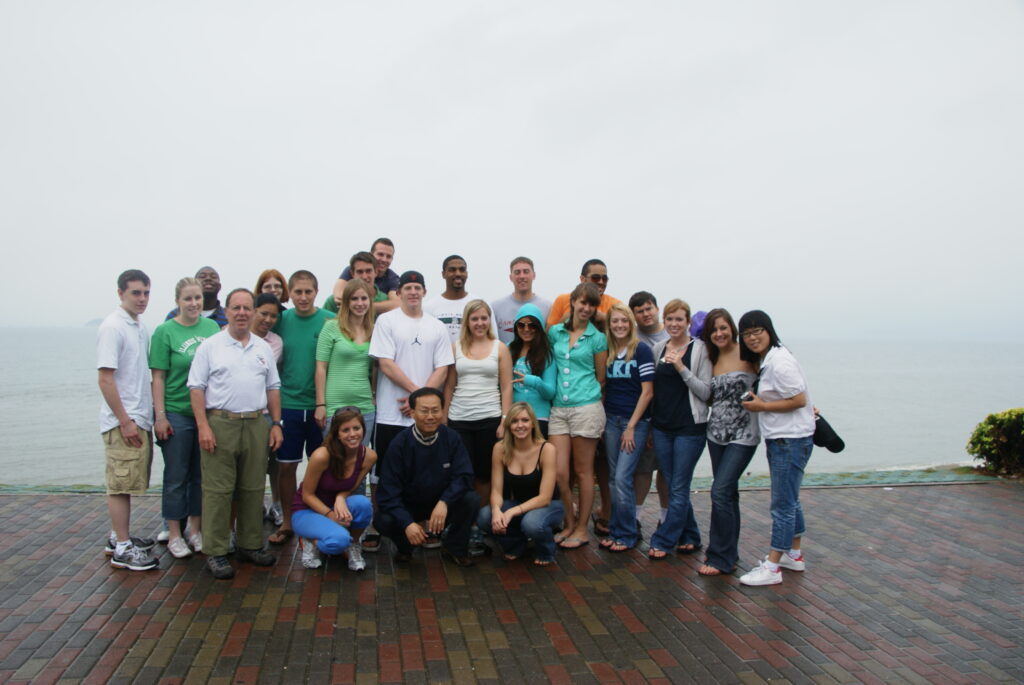
The students have arrived in America, and I’m sure their consciousness will join them soon; it takes a while to recover from jet lag (about l day for each hour of change, and it’s about 11 hours difference here), but our last day in Korea was quite structured.
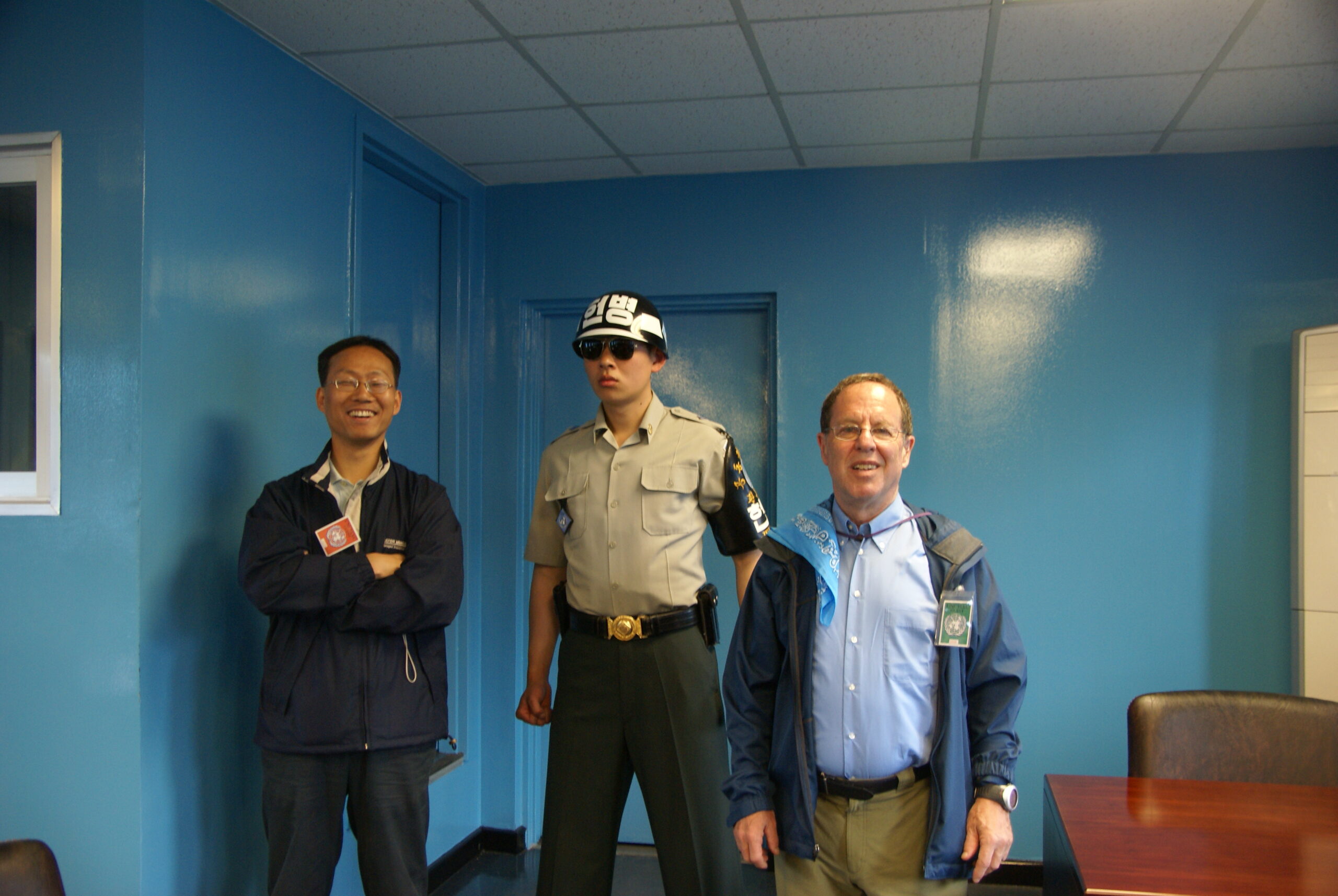
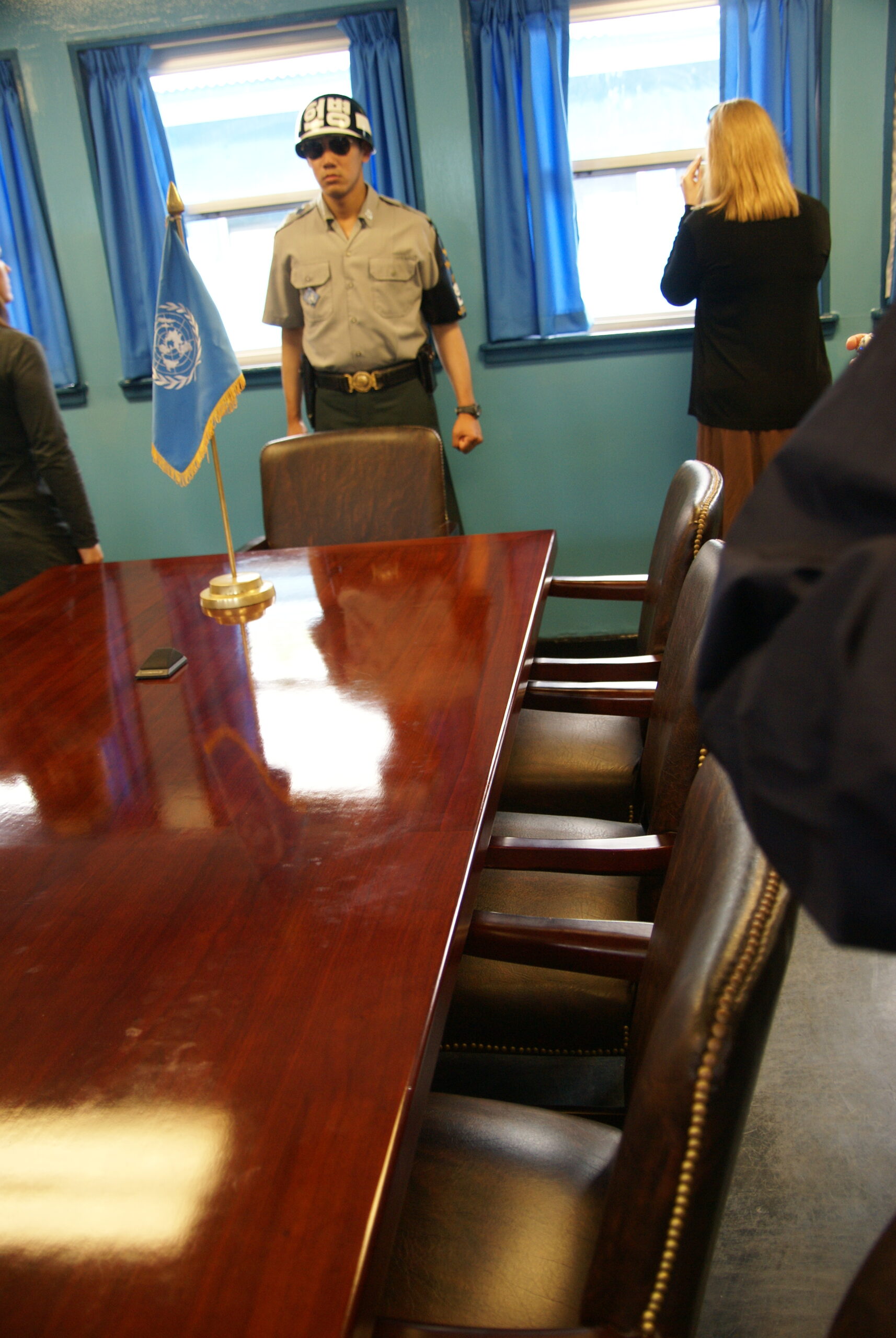
As I mentioned, we went to the DMZ, which is a somber reminder that the cold war is not quite over, and that North Korea can be a threat to peace in this area. On the way up (it’s probably less than 30 miles from Seoul to the border), there are increasing reminders that the area is on alert. There are reminders of the war monuments, trains that stopped in June 1950 with the invasion, tunnels marking efforts of the North Koreans to sabotage the peace, etc. Our goal was to visit Panmunjom, where neutral UN countries help the U.S. and
South Koreans keep the peace with the North Koreans. We were given our instructions to be somber, not provoke the North Koreans, don’t point or wave, don’t take pictures in certain areas, and the atmosphere is such that you don’t dare do so.
We stopped at one tunnel, which was kind of a propaganda against the North (you can see the northern aggressors did it because the dynamite holes are placed from the north, etc. My thought was that when Korea unifies, the propaganda line may well be that the tunnel was dug by the CIA to prevent the Koreas from being unified), and North Korea, particularly under Kim Il-Song, did present several threats to South Korea, including sending assassins who were caught in the Blue House, Korea’s presidential capital, trying to kill the Korean president.
It is sobering to think that that war, which cost around 34,000 Americans and 1-4 million South Koreans, still has not been resolved, over 50 years later. The peace was an uneasy truce (the fighting up and down the peninsula took about a year; the stalemate over the peace talks took almost two years, with bitter battles for a few yards to move the front line and ultimately the demilitarized zone). The war has never formally ended.
Still, when I was there over a decade ago, the North had built a fake village with signs and loudspeakers talking about how great the North was and that’s no longer operating. There have been a few efforts to allow North and South Koreans to visit each other. There is a tour to Caesong, about 12 miles from the border, that Hyundai helps operate. Our guide took it and said before she got off the bus in South Korea, North Korean police examined every one of her pictures and deleted ones they thought were derogatory and fined her $100. That tour is about the only way Americans can visit North Korea, which remains one of the last of the real dictatorships of my youth. There’s been interesting rumors that Kim Jong-il is dead, vehemently denied, but his death will throw leadership up for grabs, as it usually does in a dictatorship.
It was time to send them home, and me onto more adventures.
The students have left, but my adventure continues. It’s started with an adventure. When I got to the airport with them last night, I found my flight had been cancelled. So I spent the night in an airport hotel (which is nowhere) awaiting an 8:45 flight this morning.
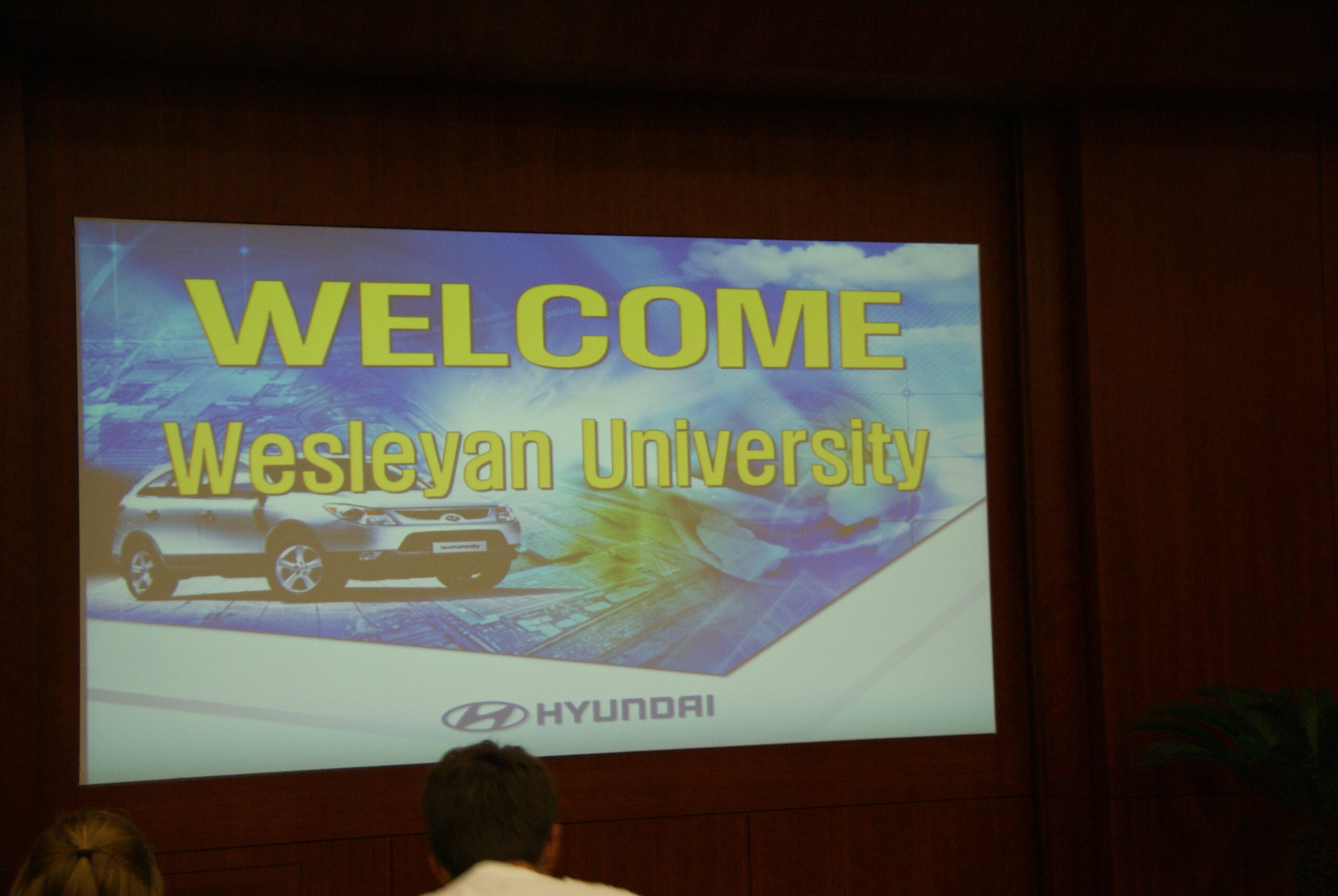
We have had an experience! When we left Kyongju, we stopped at Ulsan, a city begun by President Park in the 1960s for Hyundai. We toured the Hyundai plant (largest in the world), and learned some things that typify the Korean economy. Hyundai is one of the chaebols, large conglomerates that dominate Korea, which I recall somewhere is the 10th largest economy. The plant produces 1.7 million cars, but only 24% get purchased in Korea. Hence, the company MUST export. While it has a factory in Alabama, Hyundai sells about 450,000 cars in the US, so some come from here. I think the plant also produces all the engines for all Hyundai plants. That controls the quality, technology, and protects jobs. While the workers in Korea average around $15,000, Hyundai workers get around $50,000, with almost guaranteed overtime (the plant has only two shifts; when they need to produce more, they work overtime–it’s in the union contract).
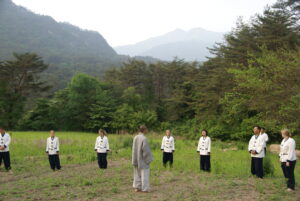
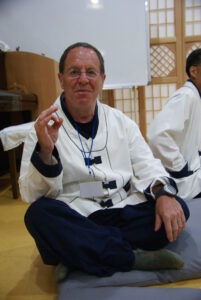
We went from Ulsan up the mountainous eastern side of the peninsula to the temple, which I mentioned was going to be like Scout camp. Indeed it was. When we got there, we put on our uniforms, went to our cabins, had vespers, and merit badge-type work. We learned about Buddhism through a silent walk (like the ones we do at camp, but I’d never let you walk barefoot like we did) contemplating ourselves. The monk who led us was as relaxed as I’ve ever seen anyone, and kept stressing inner peace; “control yourself and you can manage others,” was his advice to the business students. We continued with the Buddhist badge for meditation. Sitting lotus position in yoga for 3 minutes challenges–we sat for 30 minutes (leading to my conclusion that I could be a Buddhist, but it’d be tough to be a monk–he sits for 8 hours a day!).
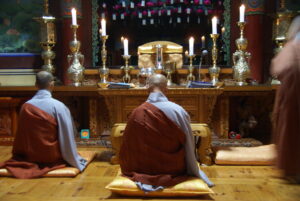
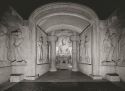
We had a voluntary Church service, Buddhist style (sounds like camp, except it was at 3 am, and not all volunteered, as you might imagine). Up down kneel, chant, up down kneel chant. Etc. The interesting thing about the temple was that it has the relics of the Buddha somewhere, so the main temple has no Buddha statues.
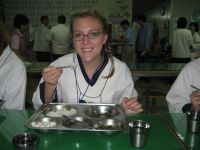
We had a (voluntary) breakfast with the monk, that many did not volunteer for when they learned you cleaned out your bowls with water, then drank the water. Just like backpacking, I said. And you eat in the lotus position. Vegetarian food (rice, spinach soup, kimchee with everything).
We made lanterns (lotus) for our craft merit badge, and then hung our dream pouches that we made (another craft merit badge). In East Asian Buddhism, you make a prayer and leave something (incense) in the temple to alert the Buddha to your dreams. You’re mentioned there–in my pouch.
When asked what was the best thing about it, I responded that it was great seeing a temple used; otherwise, it’s just a building. Korea is about 40 percent Buddhist, almost the same number of Christians (missionaries contributed apples, they kept telling us). DMZ visit yesterday is another story, but my plane is boarding. My student who was coming with got ill and is home, so I’m going somewhere where I don’t know a soul!
We’re in Kyongju, in SW Korea, about 200 miles from Seoul. It was the capital of Korea for a thousand years, most recently in 962. Thus, it resembles in Korean history what Xi’an does in Chinese–the place where the country was unified. The connections are even more tight; the Shilla invited the Tang dynasty to help them unify the peninsula, and defeat their rivals to the North. In return, the Tang promised Manchuria, which was then part of the northern Kingdom of Koreans. Hence, Korea got unified but China got Manchuria.
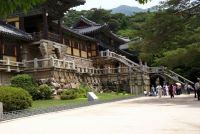
The city has some really spectacular Tang era ruins, including the most beautiful Buddha I’ve ever seen. It’s made of granite and sits in a cave atop one of the mountains surrounding the city. If you get to see the Korean movie, “Once upon a time,” you’ll get to see the Buddha without traveling up the 1,900-foot mountain. At the base is the temple, Pulguksa, one of the most unusually structured Buddhist temples I’ve ever seen. These two artifacts are so Korean that they’re usually featured on the “Come to Korea” posters.
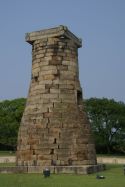
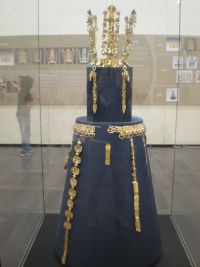
There’s a lot more here, but you need more than the 5 hours we had to tour. We did get to see the observatory, built in the 8th century; it has a very unusual shape. And royal jewels.
We’re on our way to a monastery, which sounds like Scout camp. We eat like monks, dress like monks, meditate like monks, and sleep like monks–to bed at 10, up at 3.
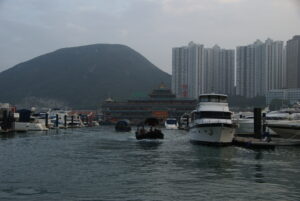
We’ve really been on the move since we left China proper. One day in Hong Kong, one day in Macau, one day in Hong Kong, one day in Seoul, and one long bus ride to spend an evening in Busan.
I’m always reluctant to leave Hong Kong, which has one of the finest skylines in the world. I’ve been there often enough to think of it as “my” city–as in my optician, my tailor, and my friend Eleanor, whom I met in 1995 in Saigon at a conference and who over the years has been a great help to me and to IWU students whenever either is in Hong Kong. I have what the Chinese call “guanxi,” which comes from repeated business and a Chinese-like sense of humor. My Chinese name for me is “Weidade Jiaoshou,” which for those who do not speak Chinese means “Great Teacher.” It proves that if you write your own copy, you can write anything you desire, whether true or not. And they do remember me by name.
I’m not sure I mentioned two features of Macau which make it distinctive in Asia. The first is that it was neutral in World War II (as a Portuguese possession); second, it was not part of the Cultural Revolution. The combination means that the Luso-Chinese (look that up in your dictionary) architecture has remained, unless torn down to make way for the high rises that dot every city in Asia. The pastels and stucco are quite stunning, but it was raining and we did not get to go to one of my favorite sights–the Protestant Cemetery, which has graves demonstrating the dangers of the far east–death at sea, in battle, in childbirth.
I spent the last night in Hong Kong walking the waterfront facing the island of Hong Kong with my friend until it was time to take the ferry (did I tell you that as a concessionaire–British for Old Guy–I get to ride the ferry for free and get half price on other transportation–and have a separate channel through customs!). Next time more time! Incidentally, Britain acquired Hong Kong in stages; the island ceded in perpetuity in 1842, the Kowloon peninsula surrendered in 1860s, and the New Territories, loaned for 99 years in 1898. The end of the lease for the New Territories was what triggered the return of Hong Kong.
When we got to Seoul, I realized I was not in China any longer. I am in the Chinese sphere of influence, both past and present though! It helps to understand the nationalism of Koreans when you realize that, as a guide told me on my first trip here, either the Chinese or the Japanese invade every hundred years. It’s China’s turn because the Japanese colonized Korea from 1910 through 1945–forcing the Koreans to adopt Japanese names, forbidding the religion, and generally behaving like a superior race. There’re a lot of reminders of the occupation. For example, we had to take one of the boys to a hospital–he was dehydrated. While we were waiting for the IV, Dr. Park and I walked across the street to a park that was new since he left Seoul to work and study in the U.S.–the centerpiece to the park is the prison where Japanese incarcerated independence advocates over the years.
Downsized Temple of Heaven
The Chinese influence is equally marked in the culture and the history. We toured one of the palaces in Seoul yesterday, and having been in Xi’an a few days ago, we saw Tang China. I still marvel at the power of Chinese civilization to reach Korean and Japan–before the information superhighway was even a trail. To be an emperor in Asia meant adopting Buddhism, Confucianism, and the imperial way. Both Japan and Korea even used Chinese characters (despite the fact that King Sejong in the 15th century developed a Korean alphabet that only today has begun to replace the Tang period characters that I saw alongside the Korean when I first came here).
There’s also a lot of western influence in Korea, partly because 58 years ago, North Korea invaded South Korea. Within three days, Seoul was captured (for the first of what I think was three times, which explains why the city is mostly new or renovated), and within three months had pushed the American and UN forces (mostly American) to the Pusan perimeter, which is where we’re staying tonight. General MacArthur then planned an amphibious landing at Inchon that punctured the overextended North Korean lines and rolled up the peninsula until he scared the Chinese, who lent their support and military to North Korea, threatening World War.
The Chinese pushback made the Korean War one of the decisive factors in 20th century Asia. As a result, the United States did not recognize the People’s Republic of China until Richard Nixon’s presidency; it intervened in the Civil War by using the U.S. Fleet to protect the other China, and it extended American influence in VietNam to the point that after 1954, we replaced the French. Important war (if you’re interested, David Halberstam’s book on the Coldest Winter is fascinating). As we drove down here, on a very modern highway full of traffic, we could see that the country really is 70 percent mountainous, highly urbanized, and very difficult battle terrain.
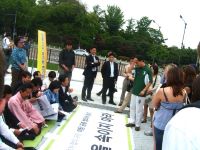
One other Western influence that we took advantage of–and one of the important points in the development of South Korea–was the 1988 Olympics. About that time, the military coalitions that had dominated Korea from its independence were overthrown by the democratic governments that we see today. The current political climate with the U.S. is marred by protests against a treaty the Korean president has been pushing to allow U.S. beef to be admitted to Korea. The protesters were at the presidential palace when we stopped by, and Professor Park engaged them in
Not all beef
discussion–he was in the same class with one of the senators. Unlike protests in the past when I’ve been here, the police sat in a bus. Previously, they would stand outside with their battle shields and helmets and tear gas…
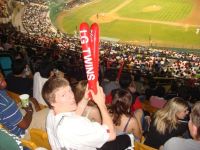
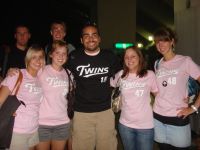
The shorter story was that as a result of the American assistance (we had 7th Army HQ in downtown Seoul until a few years ago) and the Olympics, baseball is popular here. We went to Olympic Stadium to see the LG Twins play the Kia Tigers (the corporations sponsor the teams–great marketing). It was 3 hours of disco baseball, a combination of basketball and soccer, with never a quiet moment. The baseball was pretty good, but the food was Burger King (a bulgogi Whopper was available–the Koreans love beef, and Bulgogi is a heavily marinated meat) and KFC.
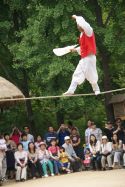
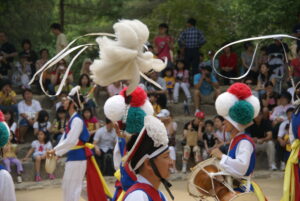
And the Korean village reconstructed at Suwon with traditional crafts and residences!
As I said, I’m not in China, and I’m enjoying Seoul Food!
Hi from Macau. Was here for one night and will write at length when I get a chance. We’re at our way to the ferry to return to Hong Kong. We’re suffering from sticker shock–probably the best way to capture the difference in prices from here to the mainland: the Internet (in HK) is 50 cents a minute, and the laundry is five times the price it was.
We arrived in HK from Xi’an after a really interesting experience that you’ve probably read about or seen on TV. At 2:28 Monday as we sat in the airport, everything came to a halt. The TV started to play, with footage from every major city, as China observed 3 minutes of silence for the earthquake
victims. The coverage has been almost non-stop, almost the same footage as on CNN. The “Katrina like” crisis has certainly brought out the nationalism of the Chinese people–more than anything I’ve seen since I’ve been coming to China. Even Hong Kong observed it–and the racetrack we had planned to go to tonight closed down. It’s very somber. Even the casinos in Macau (the main reason 25 million people come here a year–it’s a city of about half a million) observed a moment of silence.
I remember the first time I came to Hong Kong–how awed I was by the view of the harbor and the buildings and the Peak. I still get goosebumps. Shanghai may be more modern, with bigger buildings, but Shanghai doesn’t have the harbor and the Peak that make Hong Kong so special. A number of our students would like to stay here, or study here, or live here. There’s a reason you use the word “Shanghai’d” to describe being taken somewhere you don’t want to go. Hong Kong is, to use an old film title, “A Many Splendored Thing.”
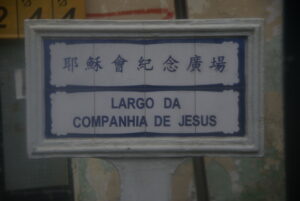
Even here, there have been many changes since the handover in 1999. Both Hong Kong and Macau have experienced influxes of Chinese tourists from the mainland, in a big way. The monopoly of the Stanley Ho family on the casinos has been broken, and there are 20 casinos now, including a Sands and a Wynn. They call it the Asian Las Vegas, but it does 2 times the revenue of Vegas. I like it because of the old, though–it was Portuguese, and we’re in the Mediterranean if you stick to the old areas–stucco and pastel, Catholic churches dating to the time when the Jesuits arrived here in the 16th century.
More later, probably from Seoul. Looking forward to some seoul food.
We’re about to leave mainland China, having spent the last few days as tourists. In Shanghai, we spent a day in a “water town,” one of the cities on the Grand Canal that has been gentrified for tourists–and was mobbed with them. What was pretty neat was that we visited the home of one of the country gentlemen, and once again realized that “to be rich is glorious,” Deng Xiao ping’s comment.
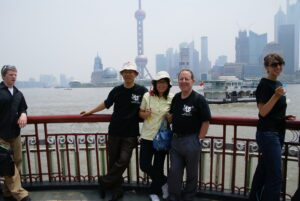
The next day (our last in Shanghai) we visited (along with half the world) the Oriental Pearl Tower, the highest TV tower in Asia. It gave us a view of Pudong and the Bund. As far as the eye can see, Shanghai is high rises. The building also houses a Shanghai museum, which had models of the International Settlement from the 1920s, which look like some of my postcards–and dioramas of the major buildings left from the foreign days. There are more than I thought–and it seems to be that the new emperors in China tend to occupy the buildings and palaces of the old.
That’s true here in Xiamen, perhaps better known in the West as Amoy, which is how it is pronounced (I think) in the local (Hokkien) dialect. It’s at 24 degrees, says my GPS, which makes it somewhere around Mexico, and located along the coast; it’s hot and humid. I hadn’t been here for about 13 years, and so it’s a real litmus test of how far China has changed since I’ve been traveling. The short answer is “a lot,” even in this city of 2 million, which the Chinese call a small city.
It has some really important history:
At the end of the Ming dynasty, the Chinese resistance focused here, on a rebel the Dutch called Koxinga (whose name is Zheng Chenggong). He helped recapture Taiwan (I think) and that makes him important in contemporary China–Amoy is the closest big city to Taiwan, and the Chinese Nationalists on Taiwan occupy a few islands in sight of the city. For years, they shelled one another at regular intervals. Last time I was here we were able to see the nationalist troops and hear slogans and the national anthem. I understand it’s pretty low-key today, but a reminder that the
You can almost see Taiwan
Taiwan Straits is one of the major problems in Sino-foreign relations. The mainland Chinese consider Taiwan part of China, and any efforts to separate are taken very seriously (nationalism is one of the bonds that unifies a disparate China).
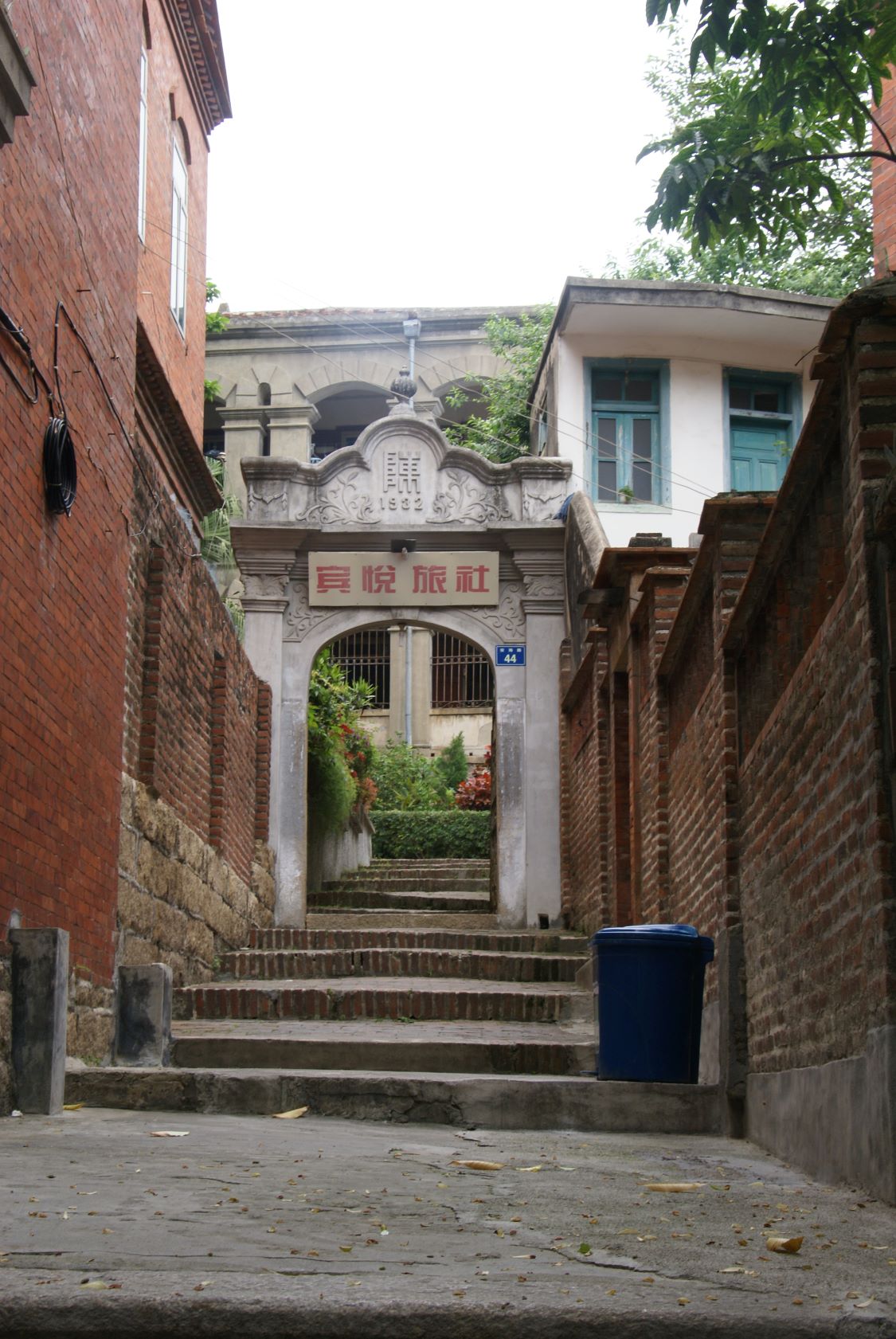
In 1860, Amoy became a treaty port–with a difference. It was the only port other than Shanghai that developed an international settlement, where foreigners set up their own government. The settlement was on Drum Wave Island (Gulangyu), and when I first went there in 1993, I was astonished at how much of the old architecture was left. The island has no cars (is this China, I asked?), had crumbling architecture, and only about 20,000 people. Because of the proximity to Taiwan, Xiamen became a closed city, controlled by the Navy, and with the Navy officers occupying many of the mansions.
Happily, much of the architecture is restored and preserved; it’s ironic to me that the Chinese now recognize the semicolonial period (how they describe it) as part of their patrimony–and there were incredible crowds on the island (it was Sunday), part of the enrichment going on that makes it possible for Chinese tourists. The part near the jetty has been converted into shops (as has been most of China), but the rear of the island has many of the old mansions restored. Since I was here last, there is a new “piano museum” collecting
the pianos that were in the foreign houses. There are some incredibly elegant works of art that passed as pianos, and there are recordings that play around the island, which is known as the “piano capital” of China.
Finally, Xiamen was one of the original special economic zones designated in the ’80s by Deng Xiao Ping to attract foreign investors with special tax and other privileges. While our guide has pointed out that the zone’s success has varied depending on who the regime in Beijing wants to favor (it was Pudong until recently) we saw lots of factories on our trip to a hot spring (everyone’s favorite visit!) The guide also pointed out that the tensions in Taiwan-mainland relations have scared some foreign investment.
China’s diaspora has come mostly from Amoy and Guangdong, the next province south, so the food has started to resemble more what we see in the United States. Happily, we are in an area where I can walk around (in the center of the city), and we found a restaurant we liked so well (it was a free night) that we took the whole group–spicy squid, goose, various pork dishes (including the best pork chops I’ve ever had)–not the standard tourist stuff we’ve been eating.
Yesterday I got up early and walked to Sun Yat-sen park, which is right around the corner. It makes an epigrammatic statement about China’s 20th and 21st century history. The park was built in the late ’20s in honor of Sun Yat-sen, the founding father of the Chinese republic. A large bronze statue of the Dr. greets you when you enter the park. The introduction talks about the development of the park, which housed a temple, creek, mountains, zoo, and pavilions, trashed during the madness of the Cultural Revolution. Parts have been rebuilt, and the park was full of Chinese doing what Chinese do in the morning–tai qi, tai qi with sword, exercising (there’s a lot of gymnastic equipment for stretching, which has only recently been installed in Bloomington at Tipton Park), dancing, and sitting and enjoying life. A far cry from the ancient regime.
Two quick comments as we prepare to leave for Hong Kong:
There are currents, most of which we do not see, because we’re pampered prisoners, pretty much seeing what they want us to see. The inflation rate is high (as it is elsewhere in the world) for food, and the general rate here is about 8%, but higher in many basics. The Chinese government in Xiamen has ordered the buses not to use air conditioning to save on fuel, which is pretty enlightened, and has pushed back the development of ethanol to put an emphasis on food.
Second, the concept of the two Chinas is valid even in small cities like Xiamen. The main street (named for Dr. Sun, and one named abolish the foreign dynasty the Qing and restore the Ming) look for all the world like Michigan Avenue. The other China is the countryside, and the neighborhoods around the corner from Michigan Avenue. No doubt, China is raising living standards. Those left behind may be making history in the future–as they have in every Chinese dynastic cycle. More from Hong Kong.
I was reading in the local paper yesterday something I should have known: China’s economic renaissance began 30 years ago when Deng Xiao-ping “opened” China to economic development. The changes in lifestyle have been enormous, and, as I’ve said, every time I come back I marvel how much change has occurred, even in the year or two since my last visit.
Probably no city has changed more than Shanghai. We’re here as long as anywhere on the trip, but “here” is as modern as anywhere in the world. As the former prime minister of Singapore pointed out, when Hong Kongers noted the rivalry between the two city-states, “I’d worry about Shanghai, not Singapore.” Like probably every city I’ve been to, it’s a melange of colors, a far cry from the 1990 visit, when the colors were dominated by gray, olive, and blue–the colors of the “Mao jacket.” And with its assortment of high rise after high rise, and some impressive architecture, including one building that looks like the yoga position, “mountain,” more “modern.” The Shanghai leaders who went to Beijing after 1990 have reversed the disdain and ignorance (literally) of Shanghai which caused the Maoists to let it alone.
Here’re some quick vignettes about business and how “socialist (no one wants to call themselves capitalist) with Chinese characteristics” this place has become:
First, we’re staying in a hotel that’s not on the Web. Partly that’s because it’s pretty far from the places foreigners frequent (my GPS says 15 miles!). In part, though, it’s because the Chen Yuen is a former guest house run by the People’s Liberation Army. I’ve seen the figures on the percentage of business that the PLA ran (at one time, I recall it was 30% or so). Our guide told us it’s now a tourist hotel because the Army is under orders to “turn a profit” on its businesses, one of the consequences of the economic opening 30 years ago, and the joining of the World Trade Organization in 2001. By the way, it’s a reasonably nice hotel with big rooms, some amenities including ESPN Asia (ever watch a cricket match?), and not many people who speak English. It does have free Internet, so I’ve been able to borrow Dr. Park’s computer overnight, and when I get up early, continue the blog.
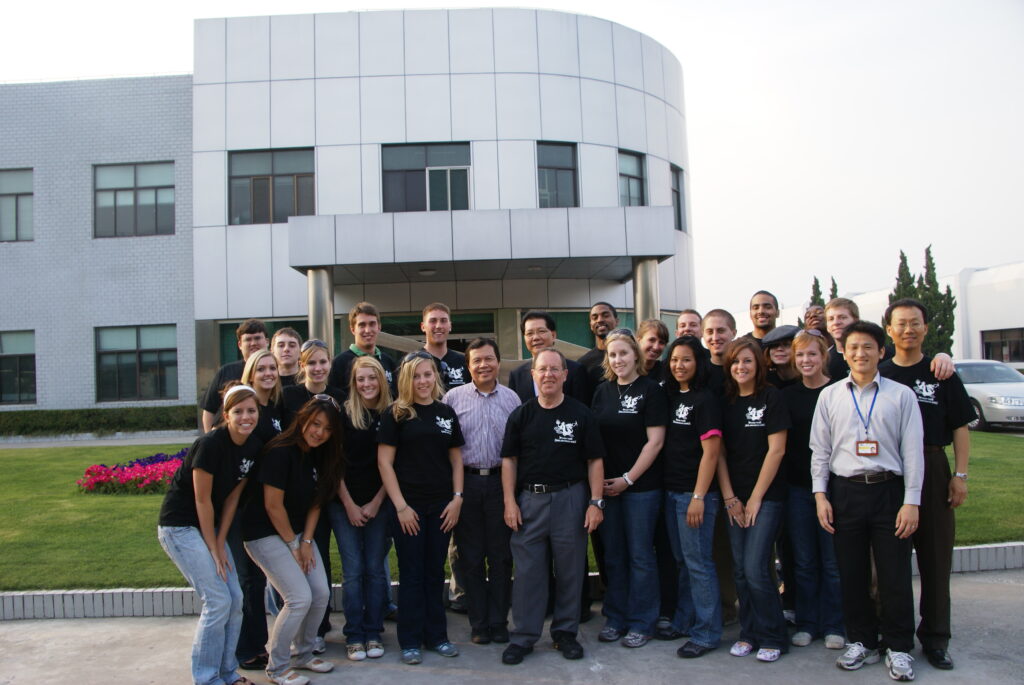
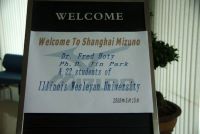
Second, our business visit was to Mizuno, a wholly-Japanese owned company that makes sporting goods. Some of you who play baseball or softball might recognize them from the quality of their gloves. We (IWU) recognize them because of the quality of their management–I think it’s the VP Finance in Osaka, the home of Mizuno, who graduated IWU, and his son, who graduated two years ago.
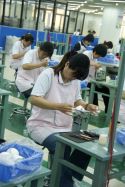
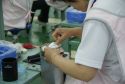
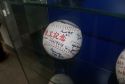
The factory employs about 1,500, with an average salary of $200 a month. It sounds like they also pay some benefits. The plant managers were most proud of their low turnover in what looks like a pretty repetitious job. Although the plant is highly automated (and one might have suspected, very clean!), automated means someone puts a baseball in a machine and the machine stitches it. And people (mostly women–the plant has 80% women) then hand stitch the balls, or the mitts, or hand glue the golf club heads to the shaft (“come and get shafted,” I quipped). Bear in mind one important fact, which I just read about in the Far Eastern Economic Review (but not in the Pantagraph, or anywhere else in the U.S.): to protect workers’ rights, the Chinese government has raised the minimum wage–to the point where factories in the Southern Province of Guangdong have closed and/or moved to Viet Nam, Indonesia, and Thailand. It may be a development worth watching in terms of China as the manufacturer to the world.
I think I mentioned that 1,000 cars a day join the traffic jam in Beijing. Shanghai boast that its traffic jams are worse (and they certainly were 15 years ago, hands down!) but today those jams are on expressways, not streets in the old French Concession meant for Model T Fords or horses. There’s also (and I’ve only seen this in Japan), occasional maps that indicate where the traffic jams are (in red), where traffic jams are slow (in yellow), or where you can weave in and out of traffic trying to see how close you can come to being annihilated (I don’t think anyone ever fails the driver’s exam, which costs $500—2-l/2 months wages for the Mizuno factory workers). I even saw a drive-through in McDonald’s, though there are some interesting stories on how the Chinese don’t know how to use them–driving through, ordering, and going inside to eat, for example.
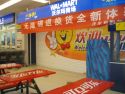
Finally, I’ve been to two “marts.” One is Walmart, the other a local variety. The Walmart in Xi’an stopped me from taking pictures (fortunately, not until after I snapped a few for my distribution class). I liked the terracotta warrior at the entrance. We were able to visit only the grocery store at Wal-Mart, but that was interesting because I think food is very cultural (good thing we didn’t have any of the squeamish with us; it was early on one of my walks, and I went with Dr. Park). Besides live, they had chicken feet and cooked dumplings and lots of other things that you don’t find in regular grocery store in the states. It was nice in those two marts to see what Chinese buy, instead of being taken to the massive “outlet stores” that sell essentially the same knockoffs and are frequented by the same foreigners you see at all the sights. Don’t buy the look-alike memory cards, Dr. Park and I learned. Mine was good for ten shots.
As for Shanghai, I wrote David Hoyt three years ago that he’d never been here, but in some ways I’d never been here either–that’s the difference that a year or two makes. It’s been the most commercial city in China since it wrested from the Chinese as a foreign settlement in the 1840s. In the International Settlement (the British and American areas combined, and the small foreign population essentially ruled the area until World War II), and the French Concession (the French consul general ruled here), industry grew, so much that after 1949, many Shanghainese fled to Taiwan or Hong Kong, and help make those two Chinese areas bastions of industry. The city itself was suspect during the craziness of the later Mao years because it had so many capitalist roaders (as they were called during the cultural revolution, and frequently beaten to death–see Life and Death in Shanghai for an interesting memoir); it is one of the great ironies here (and there are many) that you can buy dolls with dunce caps ala Cultural Revolution period!
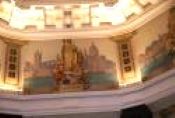
Murals inside the HKSB
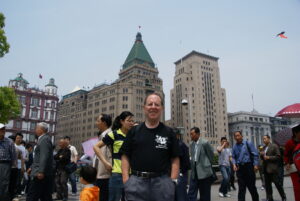
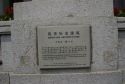
Some of the old is still here–and again, it’s one of the ironies–and even improved. Yesterday, I got us taken to the Bund, the area most foreigners visit, and the lucky ones stay near. It’s the waterfront area which, during the colonial days, had the impressive architecture that marked the permanence with which foreigners thought they would stay here. If you’ve seen “Empire of the Sun,” you’ve seen the facades which are still present. Most of the buildings on Puxi, the western bank of the Whangpu River, were built before 1930. The Chinese have erected historical markers, officially making these buildings part of their “heritage.” My favorite, the Peace Hotel (built in the 1920s by opium magnate Sassoon, and Indo-Persian) was unfortunately closed, but as I recalled, the former Hong Kong and Shanghai Bank Building had been renovated (when the British were driven out, the Bank housed the municipal government, which subsequently built a palace near the Shanghai museum–at the site of the former racetrack!). During the renovation, they discovered the murals on the dome had been painted over; in a country which can afford painstaking labor, the Chinese got the paint off, and revealed the elegance that only the old world and old times could afford. I managed to snap a picture of “London” before the guard told me “no pictures.” I hadn’t been there before, and of course our guide had never been there. It’s fun being a guide (the guides tell me, with some admiration, that I’m really Chinese.)
The old China is here in other ways, too. Shanghai being an international settlement before 1941 meant anyone could get into the city. The communist party started here, and various Asian communists (including someone you know as Ho chi minh–which wasn’t his real name) spent time here. So did various nationals–sort of like in 19th century London (Karl Marx hung out in the British Library).
One national group that found a haven here were the Koreans who declared independence from Japan in 1919–a fateful year in Asian history–including the first president of Korea after 1945, and an American favorite, Syngman Rhee. They didn’t get it until the end of WWII. There’s a museum in the old French concession in the house where the conspirators met and lived, seeking (as did the Chinese) to influence the decisions the Allies made at Versailles (with even less success than the Chinese, who eventually got the Japanese out of Shantung). Dr. Park, who is Korean, and I cut our visit short at the museum and took a cab to the building, where everything was in Korean, so I was glad I had my own personal translator. He was really moved, and it was moving to be with him–explore your own heritage and you’ll see what I mean.
For lunch yesterday we were taken to Nanking Road, the major shopping area, and left on our own. The students headed for the McDonald’s–food is very cultural, and the tourist food tends to be fairly repetitious. They were glad to have the chance to eat “real” food. We usually sit at big tables with a lazy susan, and I realized last night that the meat goes first, and sometimes exclusively, which leaves the vegetables and the more exotic dishes for me and Dr. Park.
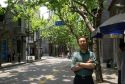
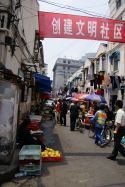
Anyway, Nanking Road is “Michigan Avenue” (one of the billboards here featured Chicago, and for all the world, it could have been Shanghai). Four of us, looking for “Chinese food” cut through an alleyway, with Chinese eating outside, having dumplings and indoor seating in mind. All of a sudden we were in the local China–two stories high, bedspreads and underwear drying in the sun, etc. We found a restaurant that met our low standards, and found no one who spoke English, no one who looked like he was from out of town, no English menu, and local prices. I asked for jiaozi and baozi, and hoped for the best. And it was. So even in the most cosmopolitan area in the most cosmopolitan town in China, it’s not all Michigan Avenue and “best quality” look-alikes.
We also got to the Yu Garden, a tourist spot in the old Chinese city at least for a hundred years (and I have the postcards in my collection to prove it). Now surrounded by the “City God Mall,” the Garden was an estate of a Ming dynasty official (built for his parents–recommended as a gift from the class to their teachers), who had both money and taste. It had its own opera house, rocks brought in with wondrous shapes from Tai Lake, mahogany furniture (that frankly looked uncomfortable, but we weren’t allowed to sit in it anyway), and the ponds and hills that combined make up the word for scenery in Chinese. Even with the crowds, and even surrounded by 15 million Shanghainese, it provides the serenity that the rich could afford.
Bear in mind, as I think I’ve said millions of times, quoting Deng Xiao ping, “To be rich is glorious.” As true in the Ming Dynasty as today. In other words, study hard.
Good morning to me, good evening to you. Two more days here–thence to Xiamen.
The minaret that is Chinese: come and be transformed
Napoleon once said, “the world will tremble when China awakes,” but I don’t think he had in mind what we experienced. As I mentioned, we were in Xi’an, about 500 miles from the epicenter, when the quake hit. It was about 2:30 in the afternoon, and we were in the Great Mosque of Xi’an when all of a sudden everything started to sway. We got away from any buildings (the Mosque area has lots of open areas) and watched while the water in the huge cauldrons (fire barrels)
SONY DSC
splashed around. When it stopped, we found that one of the tiles had fallen from the roof and crashed, and somewhat shaken, literally and figuratively, we wound our way back to the bus. We were on our way out of town to the airport, and as we drove through the city, we could see people were not in buildings; the local McDonalds told us that it had not been given permission to go back inside. And it stayed that way for at least an hour. The news here has been filled with information about the damage, and China’s response. Contrast the government’s acceptance of aid, fast moving, sending of the army, etc. with the response of the junta in Myanmar, and I think you’ll understand how far China has come in becoming a responsible member of the world community. In 1976, an earthquake in Tangshan resulted in 100,000 deaths in five minutes, and China responded to efforts to help the way the Burmese generals did. It was an unsettling minute, and we had a lot of inquiries from worried parents and a worried University.
Our ability to communicate in this flat world has certainly changed since my early times here, when I remember asking our secretary to fax information on IWU basketball games. Today, we can hear them live on the net!
The rest of the trip so far, I’m happy to say, has been at least as exciting, and far less menacing. Jack Perkowski, in Managing the Dragon, a new book that I recommend highly, talks about two Chinas (economically and lifestyle speaking), the foreign/local, and the local. We’ve seen them both in the last few days (have we been here only a week?)
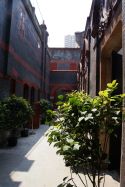
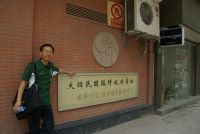
old and new in close proximityMarker for the boundary of the International Settlement
The foreign/local are parts of the big cities: certainly Beijing and Shanghai, but even Xi’an. In fact, Shanghai is almost non-Chinese anymore, there are so many expressways, high rises, and new buildings.
A case in point here in Shanghai is the museum I insisted we go to–it commemorates the first meeting of the Communist Party in China, held here in 1921. I’d gotten tour guides to take us here in the past–it’s not on the tour itinerary of most foreigners, who come to China (according to our guide) mostly to eat and shop. I remember that early trip (I got my first Mao watch there–when people asked what time it was, I said “Mao says it’s 5:21” which it is right now, “and therefore it is 5:21”).
The museum is in the old French Concession (more on that later, maybe), in an area which the local government has preserved as a relic of the old city, but it is now a shopping mecca with bars and coffee houses and discos–including a Starbucks (that doesn’t serve Chai!) I remember narrow streets, laundry from windows, and row after row of the two-story houses. Today, apart from the saved island, there’s high rises. As for the museum, the information is the same, the rhetoric (feudal democratic revolution, etc.) the same, but a new slick display area (including a mockup of the table where the founding fathers met, with Mao standing and speaking) glorifying the new, post-1949, China.
For Dr. Park, the highlight in Shanghai was where the Korean independence activists established a provisional government in 1919. It included Syngman Rhee, who was later president of an independent Korea.
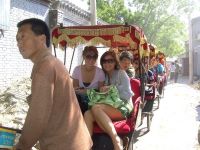
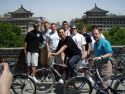
It was similar in Beijing. Our last day there, we took a hutong tour. The hutongs were (and I suppose are) the small buildings in Beijing, a courtyard-type house with four apartments for an extended family surrounding a central area. Our group got into bicycle rickshaws and got pedaled around the streets near Beihai, a local park once reserved for the Mongol emperors. When I first came to China, there were many hutongs and no tours; today, there are few hutongs left and many tourists in them. Our guide told us the apartments sell for over $1 million despite many still lacking indoor plumbing and heating–and it gets cold in the winter in Beijing! Much of the rest of the city of 15 million is in high rises.
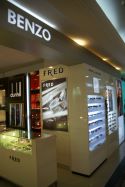
Even Xi’an is similar in being part of the foreign/local economy. I remember writing two years ago about being on Michigan Avenue (China style), the main streets with Puma and Armati and Rolex (the real ones) etc. stores. It is still the same today.
A FRED STORE?
The local economy is frequently viewed two blocks away. When Dr. Park and I walked in front of our hotel in Xi’an, where we had a location within the city wall, and we walked down a leafy street (the trees even today are called French trees, and look like a sycamore), he was ecstatic. He said, “I feel at home here,” meaning the name brand stores and upscale folks reminded him of Seoul, which is his measure of what home (he’s a native of Seoul) should look like. We walked a block, and turned down a smaller street dominated by the local economy–some foreign brands (mostly made in China–like Coke), but local stores selling local quality at local prices, with chickens running on the street, goat carcasses for sale, and small restaurants offering the good food you don’t get in the tourist shops. I turned to him and said, “I feel at home here!”
The local economy was especially apparent on our long train ride, from Beijing to Xi’an, about 574 miles as the GPS reads, but probably much longer by overnight train–and we had the most fast (translating literally) train–about 12 hours long. Going through the countryside (mostly wheat in North China) we could see villages and farms, many of them unchanged by the world economy, or even machinery. People are in the fields all the time, not just for planting and harvesting.
Nonetheless, change is happening here too. The China Daily had an article about farmers who used to have a few pigs around; when they needed money, they would put the pig on a bicycle (I’ve seen them in the city) and sell it for seed money or whatever. As a measure of the changes, the Chinese now send a child to the city to work in a factory, or work in construction, or do whatever the middle classes in the city no longer want to do!
As for tourism, I think it’s alive and well. It’s the world’s biggest business, and certainly well developed in China. Take Xi’an.
SONY DSC
Capital of China until 907 A.D. (and starting in the 2nd century B.C.) the city welcomes about 7 million visitors a year. What you see depends in part on who you are. If you’re a Westerner, you probably spend no more than two nights. For one of them, you get taken to a high-tech Hollywood-type performance (surrounded by other foreigners) of music and dance that they say is Tang dynasty, but seems more Bill Bixby, who wrote a lot of ’30s choreographed dance and song movies (I refrained from singing Hooray for Hollywood). You also get to see the buried army of the first emperor, Qin Shih-huang, who unified China around 221. It is spectacular, and did help turn this once sleepy West China city into a tourist mecca.
When I got here in 1990, the buses pulled up to the museum, you walked the gauntlet between the shopkeepers who hassled and hustled to sell you copies of the warriors and left. Last time I was here (two years ago) you got to walk a long way through a rather attractive park from the bus lot to the museum. Today, you return to your bus passing an international mall with fountains and more opportunities to shop till you drop (do you remember the former leader who opened China–done shopping was his name!)
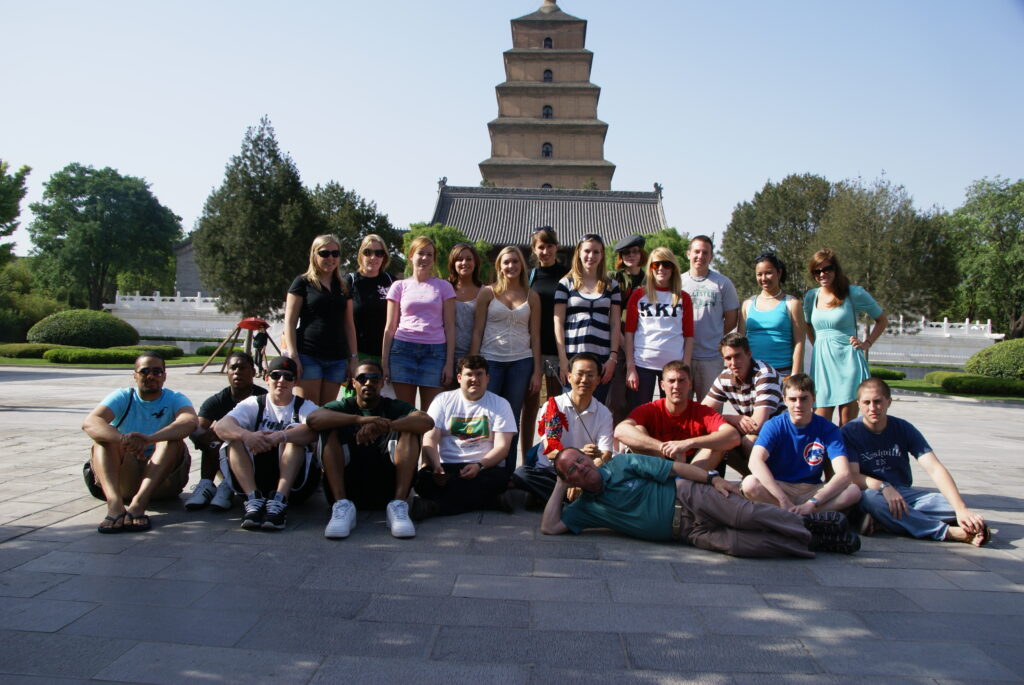
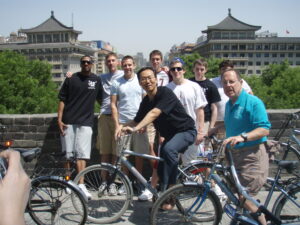
And you get one of the ancient pagodas built in the 7th century. If you’re non-Western, especially a Buddhist, you can spend a week in the area around Xi’an and never run out of interesting ruins. For example (and I’ve never seen it), Xuan Zhong is buried here–the monk whose “Journey to the West” brought Buddhism to China. And if you are Japanese or Korean, you spend a lot of time in Xi’an because Chinese civilization spread to those countries during the Tang dynasty. The other tourist activity is a visit to the wall, a 13.8 kilometer wall, around 30 foot wide, that was built during the Ming Dynasty. It’s a great place to bike and see the city, though, as I said, over the years, much of the city has been rebuilt.
You might have read in the Chicago paper a news story making the rounds here; China announced it formed a company to build aircraft. Our guide in Xi’an told us that factories there were already making parts for Boeing. That was probably more what Napoleon had in mind than earthquakes. Talk to you soon!
Monumental. That’s what Peking can be, and frequently is. There were at least three monuments we saw the last few days. Starting from the newest:
Bird’s Nest (what else? became a mall)
The Olympic Village and stadia. No doubt, as I mentioned, Beijing is ready to welcome the Olympics, and you’ll be seeing a lot of what I saw, and hearing what I heard this a.m. (at 4 a.m. Professor Park and I left our hotel for a cab ride in to Tiananmen Square for the flag raising; you can recognize me from the pictures–I’m the one without a cigarette, that is, if you can find me amid the 4000 people there for the 5:06 flag raising and the national anthem, QiLai, which means “Arise‚” or, at 5 a.m., “awake!”)
The Olympics dominate almost everything–the vendors everywhere (I think the Beijing city government owns the copyright, so there’s little intellectual property theft), the only English language TV station (the torch was up on Mt. Everest today, and there’s a special postal cancel at 20,000 feet! I’m not going up there to get it!), and the billboards. As I viewed the stadium from the bus (which was crawling on the expressway near it), I thought–another monumental project with one million people working on it.
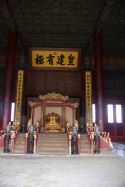
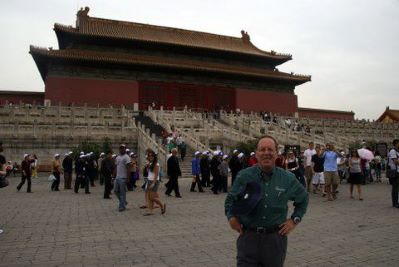
Just like the other two monuments we visited the last two days. One was the Forbidden City, home of the Ming and Qing Emperors since the late 15th century, when the 3rd Ming emperor moved his capital north (so he could better control the barbarians, as I recall).
No matter how often I’ve been here, I’m still in awe of the 9,999 rooms that it has, only a small portion of which are open to the public. The last emperor lived here in 1908, was dethroned in 1911, but lived in parts of the city until 1924, when he was evicted and went to live in the Japanese concession in Tientsin, then became the first and last emperor of Manchukuo in the 1930s, then was a gardener after spending some time as a guest of the PRC in jail.
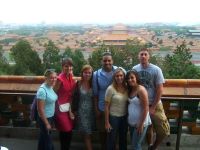
Anyway, like so much around here, it’s brushed up, the Starbucks evicted, bolstered by fresh paint and huge crowds. There were probably more people in the city yesterday than were in it during most of the entire reigns of the emperors. It’s laid out north to south, with the private quarters toward the north. The best part of the visit for me has always been the trek up Coal Hill, which overlooks the Forbidden City. The 1 million people who built it, built a moat and piled the dirt at the north end for an imperial park.
North of Coal Hill there’s an interesting place, too–it’s the Normal University, but in 1919 was the site of the origins of the May 4th movement, a student led protest against the Allies’ conceding of the Shantung peninsula to Japan as one of the fruits of the First World War. The uproar led, among other things, to the origination of the Chinese Communist Party. Ironically, when the communists came to power, one of the first things they did was to move the students to the former Christian college (Yenching University) on the outskirts of town.
Ming Tomb after pillaging
The final monument was the Great Wall, another treat, no matter how many times you’ve seen it. It boggles the imagination to think that the first emperor (Qin, whose tomb we’ll visit tomorrow in Xian) solidified the 3,000-mile wall, which stretches from the Gulf of Chili into the Gobi desert. The part we went to is the closest to Beijing, about 40 miles away, is at an elevation of 2,500 feet (my GPS sometimes comes in handy). We took a cable car with the other “balloons‚” (it was raining and
people bought colorful ponchos) and walked for about two hours. The wall, incidentally, can’t be seen from the moon (despite what they say) and never kept anyone out, but probably kept the Chinese in. I liked it better in January, when I did not have to share it with crowds (they say when you’re one in a million, in China there are 1,500 others just like you)!
A word on our one business visit. We went to Caterpillar Beijing, which was neat because they had heard of Illinois Wesleyan. We had an American expat, who has spent time at Cat Europe as well, talk about an hour on the history of Cat in China. It’s been here since the late 1970s, and is still trying to establish a presence. Although Cat for the first time earned more overseas than in the United States, Cat’s sales here are only about $1 billion. Sounds like a lot, and I wish I had it, but it’s only about the same as the amount Cat earns on licensing (it gets money for letting people sell Caterpillar shoes!) Nonetheless, the company has moved its Asia Pacific headquarters to Beijing (from Tokyo) and has put China into its strategic plan as a critical factor in the company’s success. It’s a premium brand though, in a largely price market, so Cat has done some unusual things here: developed independent financing, started rental stores, and is manufacturing world-class quality equipment in China. Wanna buy a wheel loader anyone? People here probably do. China is like I-55–under construction.
We have a long day today of sightseeing (a tour of the hutongs, the older neighborhoods, on bicycle), then the overnight train to Xi’an, nearly 600 miles away (I’ll check my GPS) and I think 10 or 11 hours on a sleeper. That was the capital of China for a thousand years, most recently a thousand years ago! Now that’s a lot of history!
Time flies–especially when you are flying West (to go East). If you fly far enough, you lose a day! That’s what happened to us. We left at 1:00 a.m. on Tuesday, and the next thing I knew (after about 18 hours in the air and 4 hours in Seoul) we were in Beijing–and it was 9 a.m. on Wednesday. At least that’s what they told us (sorry, I’m typing much faster than the machine can handle–at 1 yuan a minute I need to).
Beijing is getting ready for the Olympics, and perhaps the best example I can give you of the face lifting (and of the changes from when I first came in 1990) is the airport. When I came in 90, I still remember the two lane road. You can still see it from the 8 lane expressway! We got stuck behind a horse cart. And the terminal was probably vintage 1940. It was so old they said it was when I was your age.
Today, they’ve opened a new terminal that is 3 miles long! And of course, the newest in the world. That seems appropriate given that Beijing is still constructing high rise after high rise, so that when the 3 million people descend on this city for the Olympics (and get stuck in the traffic that even without them is swelled by the addition of one thousand new cars each day!), and they’re stuck in traffic, like we are, they’ll be impressed by the newness of China. I think I read in Business Week that Chinese architects, buoyed by their design work for the Olympic facilities (which we’ll see later this weekend) are aiming for contracts and building around the world. It’s part of the the edifice complex that’s hit all the Asian countries, all of whom want to be able to say “highest, tallest, biggest, or newest” and all can!
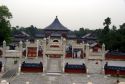
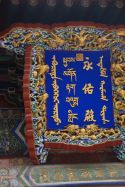
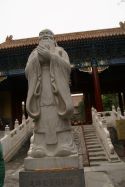
We got in at 9 and have been on the run (or stuck in traffic) ever since. Wednesday was devoted to three of my favorite temples–the Temple of Heaven, the (Tibetan) Lama Temple, and the Confucian Temple, all in central Beijing (about an hour from where we’re staying; I never had a sense of how Beijing sprawls until this trip. We’re far out, and yet hemmed in!).
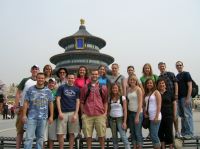
The Temple of Heaven is where the emperor regulated the harvest; if he failed, he might lose the mandate of heaven, or the right to rule, and in an agricultural economy (remind me to say something about food prices today, even here) good harvests are important–and the last time I was here, the main harvest hall was being renovated. So, it was exciting to be back and see it without nets and bamboo and falling paint, in splendor that the emperors saw. If only we could have sacrificed a bullock. And there were probably almost as many people in the mile long facility and park as there were in all of the Qing Dynasty period.
The Lama Temple gets
fewer visitors, and like many of the historic places in Beijing, has a great deal of serenity; you’d never know you were in a city of 15 million people and 80 million cars. The temple, like many of the existing historic buildings, owes a lot to the Qian lung emperor, who ruled China in the late 17th century, and was the longest lived monarch in Chinese imperial history. He had many wives and even more girlfriends, many of whom were minorities. And as a Manchu (non Chinese), he had a tendency to support the various forms of Buddhism besides the main one. Tibetan Buddhism was one of his favorites, so he gave a former palace to the Tibetans whom he summoned to Beijing (partly as hostages, I think, to keep the peace)–and today it’s an active Tibetan monastery, which the combination of animism and Buddhism that makes the Tibetan Buddhist statues so frightening and wondrous.
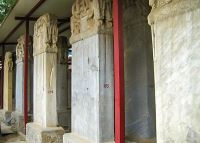
The next door Confucian temple is one of my favorites, because it memorializes scholars who passed the Confucian exams and became the ruling class of China–for centuries until 1908, students vied for good government jobs by memorizing the Chinese classics. The best in each province got to Beijing, and the best of the best wound up getting their Jin Shi degrees and jobs that would earn them money and power. And their names on stone steles.
If you do well, maybe your names will be up here.
Today, the exams (not the topics) are similar, and people get to go to the Beijing University for a route to wealth and power. We like to think of Beida (as it’s abbreviated) as the IWU of China.
We’re off to the Great Wall today, and I better run or I’ll have to miss the bus and run to the wall–and that’s about 50 miles!
Will be back online again, but I hope you all have a wonderful Mother’s Day!
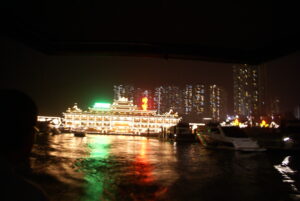 I spent the last night in Hong Kong walking the waterfront facing the island of Hong Kong with my friend until it was time to take the ferry (did I tell you that as a concessionaire–British for Old Guy–I get to ride the ferry for free and get half price on other transportation–and have a separate channel through customs!). Next time more time! Incidentally, Britain acquired Hong Kong in stages; the island ceded in perpetuity in 1842, the Kowloon peninsula surrendered in 1860s, and the New Territories, loaned for 99 years in 1898. The end of the lease for the New Territories was what triggered the return of Hong Kong.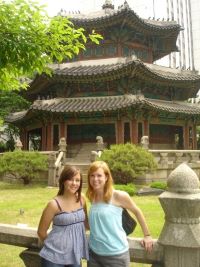

 revenue of Vegas. I like it because of the old, though–it was Portuguese, and we’re in the Mediterranean if you stick to the old areas–stucco and pastel, Catholic churches dating to the time when the Jesuits arrived here in the 16th century.
 Chinese city at least for a hundred years (and I have the postcards in my collection to prove it). Now surrounded by the “City God Mall,” the Garden was an estate of a Ming dynasty official (built for his parents–recommended as a gift from the class to their teachers), who had both money and taste. It had its own opera house, rocks brought in with wondrous shapes from Tai Lake, mahogany furniture (that frankly looked uncomfortable, but we weren’t allowed to sit in it anyway), and the ponds and hills that combined make up the word for scenery in Chinese. Even with the crowds, and even surrounded by 15 million Shanghainese, it provides the serenity that the rich could afford.
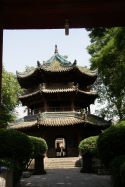
 had not been given permission to go back inside. And it stayed that way for at least an hour. The news here has been filled with information about the damage, and China’s response. Contrast the government’s acceptance of aid, fast moving, sending of the army, etc. with the response of the junta in Myanmar, and I think you’ll understand how far China has come in becoming a responsible member of the world community. In 1976, an earthquake in Tangshan resulted in 100,000 deaths in five minutes, and China responded to efforts to help the way the Burmese generals did. It was an unsettling minute, and we had a lot of inquiries from worried parents and a worried University.
 Beijing is getting ready for the Olympics, and perhaps the best example I can give you of the face lifting (and of the changes from when I first came in 1990) is the airport. When I came in 90, I still remember the two lane road. You can still see it from the 8 lane expressway! We got stuck behind a horse cart. And the terminal was probably vintage 1940. It was so old they said it was when I was your age.